
Compare the best theory test apps for UK learners, see how official DVSA questions and four in one practice fit together, and follow Mudassar’s study plan...
Pass Tolworth Test: 40 Minute Mock, Instructor Led Hazard Drills
Tolworth Driving Test Centre puts learners through a real mix of fast dual carriageway, a tight 20 mph residential corridor and a multi-lane roundabout, all inside one test. The tolworth test routes cover roads like the A3, Kingston Road and Ewell Road, and the smartest preparation is not memorising turns but drilling the hazards you’ll meet regardless of which route your examiner picks. Everything below covers the roads, the fault zones and a practise plan built for exactly that.
TL;DR:
- Practice making early lane choices at Tolworth Tower roundabout to avoid last-minute hesitation and potential faults on multi-lane roundabouts.
- Focus on controlling your speed in the Kingston Road 20 mph zone to prevent creeping above the limit, especially when transitioning from faster roads.
- Prioritize reading road markings on bus lanes and restricted areas around Tolworth Broadway to avoid faults related to late recognition of lane restrictions.
- Drill the rapid speed limit transitions from 20 mph to 60 mph, as most faults occur during these short-distance changes on test routes.
- Seek targeted, instructor-led sessions that repeatedly simulate known hazard zones, such as the roundabout and steep climbs, for confidence-building and better decision-making.
Table of Contents
- Tolworth test area at a glance: centre facts and commonly used roads
- How to practise Tolworth routes effectively: session plan, tools and timings
- Common hazard zones and frequent fault areas
- A short instructor or pupil perspective on preparing for Tolworth
- How Connect Driving School can help with Tolworth-specific preparation
- Sources
Tolworth test area at a glance: centre facts and commonly used roads
Tolworth Driving Test Centre sits at Douglas House, 1 Douglas Road, Surbiton KT6 7RZ, a short walk from Tolworth Broadway. Local mapping sources put the typical test at around 40 minutes, covering roughly 11 to 12 kilometres, which gives you a sensible benchmark for planning your own practise drives.
The DVSA does not publish an official list of fixed routes for any test centre, including Tolworth, and examiners choose the route on the day. That said, independent route repositories have mapped 17 to 19 recurring routes around the centre, and they consistently feature the same road types:
- The A3 dual carriageway, used for higher-speed driving and lane discipline near the Tolworth junction.
- Kingston Road (A240), a 20 mph zone that catches out a lot of candidates on speed control.
- Ewell Road, with gradients and junctions that test observation on the approach.
- Tolworth Broadway, busy with pedestrians, parked cars and bus stops.
- Residential streets around Douglas Road, often used for turn-in-the-road and parallel parking manoeuvres.
Route distances across the mapped set vary from about 7.6 km to 15.8 km, so no two candidates get quite the same test, even on the same day.
How to practise Tolworth routes effectively: session plan, tools and timings
Forget trying to learn a route by heart. The examiner won’t necessarily drive you down it, and even if they do, real traffic changes the picture every time. What you’re actually training is your reaction to Tolworth’s specific mix of roads, not a sequence of left and right turns.
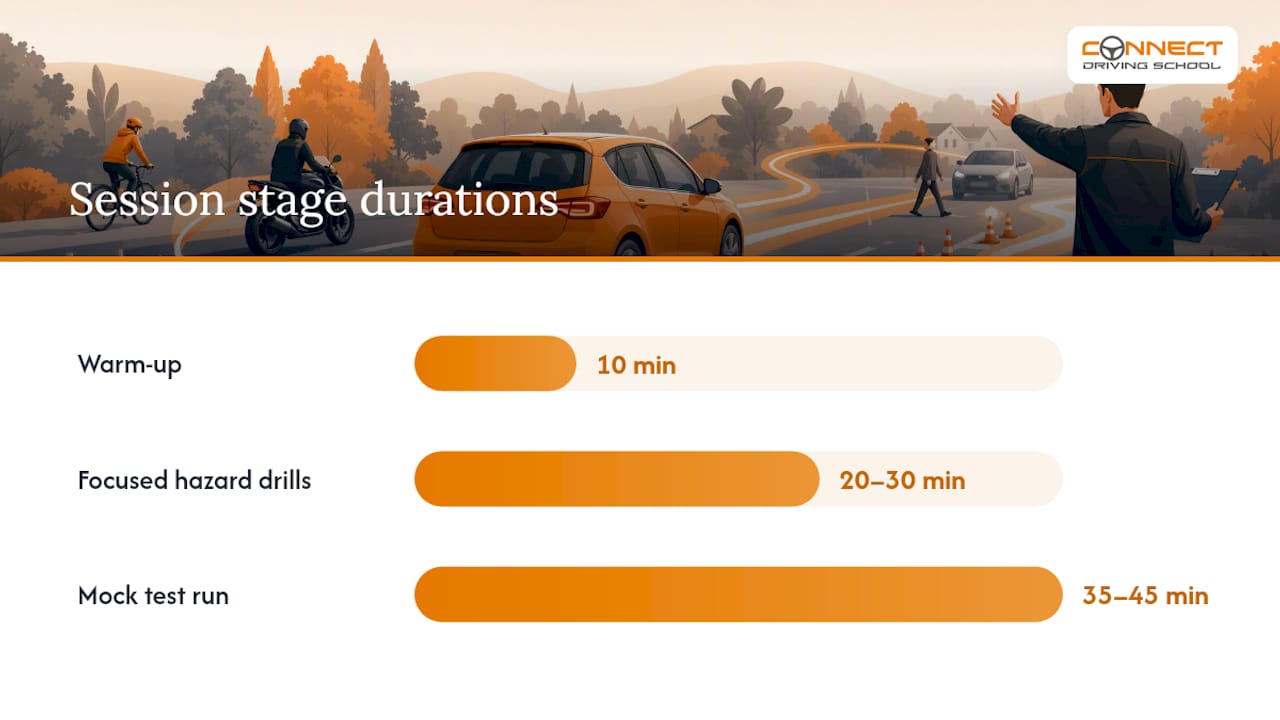
A session that works well runs in three stages:
- Warm-up (10 minutes): a familiar loop near Douglas Road to settle nerves and get your observations sharp before anything demanding.
- Focused hazard drills (20 to 30 minutes): repeated passes through the Kingston Road 20 mph zone, the Tolworth roundabout, and one steep residential climb, each done slowly enough to talk through what you’re checking.
- Mock test run (35 to 45 minutes): a full route pulled from a mapped repository, driven start to finish exactly as you would on test day, including your chosen manoeuvre.
On timing and frequency, aim for two to three sessions a week in the fortnight before your test, each one covering different roads rather than repeating the same familiar loop.
- Book at least one session during the morning or evening rush to feel real congestion on the A3 and Kingston Road corridors.
- Book at least one off-peak session too, since quieter roads test your independent judgement without traffic dictating your pace for you.
- Vary your start point each time so you’re reading the road, not recognising the scenery.
Apps and mapped route guides are genuinely useful for showing you which roads to expect, but treat them as a shortlist of hazards to master, not a script to rehearse. An instructor who knows the Tolworth test area can spot the difference between a learner who’s memorised a turn and one who’s actually reading the road, and examiners can spot it too.
Common hazard zones and frequent fault areas
Four spots account for a disproportionate number of faults around Tolworth, and it’s worth naming them plainly.
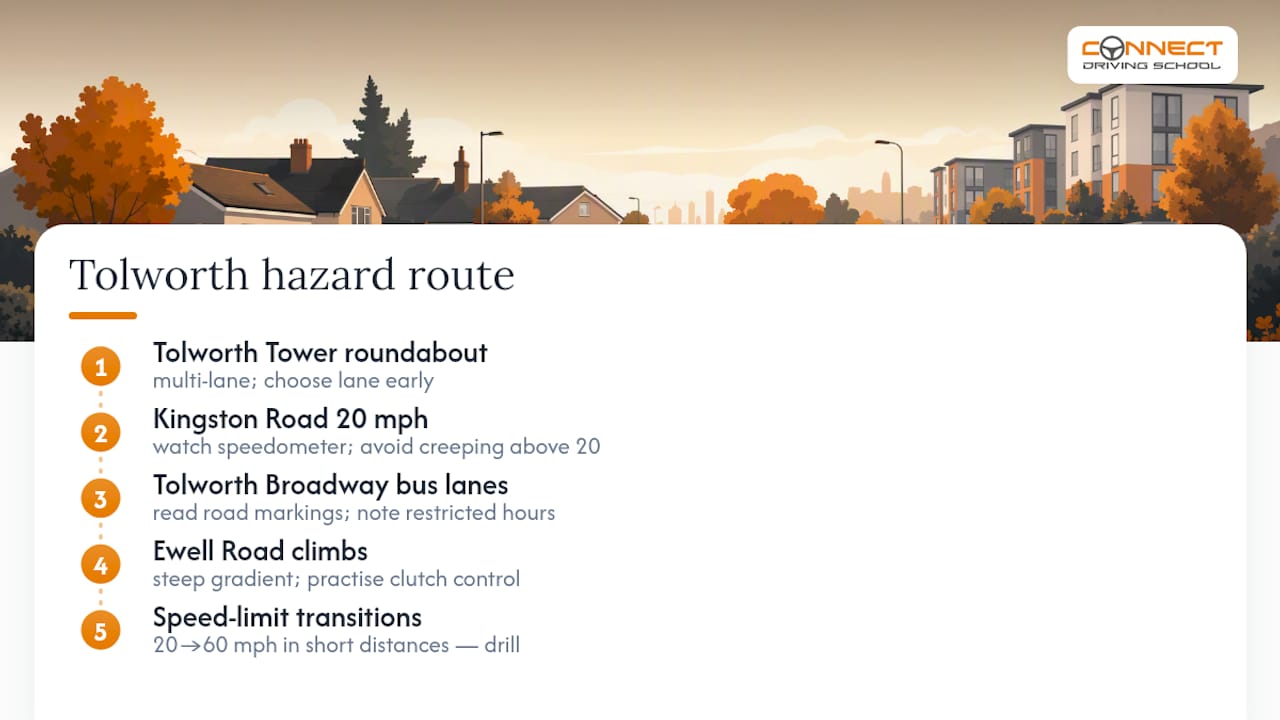
The Tolworth Tower roundabout, where the A3 meets local traffic, demands early lane selection. Candidates who dither or pick a lane at the last second tend to lose marks here, so practise on any multi-lane roundabout nearby until committing to a lane feels automatic.
The Kingston Road 20 mph zone is a well-known trap. Drivers used to national speed limits often “creep” above 20 mph without realising, especially coming off a faster stretch of road. Speed-awareness drills, glancing at the speedometer more deliberately on the approach, help break the habit before test day.
Bus lanes around Tolworth Broadway and the Broadway itself catch learners who aren’t reading road markings early enough, particularly during restricted hours.
Steep residential climbs near Ewell Road test clutch control and observation on a gradient, a combination that unsettles drivers who’ve only practised on flat ground.
Underneath all four is one pattern: Tolworth routes shift speed limits from 20 mph up to 60 mph within short distances, and that rapid change is where most avoidable faults happen. Drilling those transitions specifically, rather than driving generally, is the single most useful thing you can do.
A short instructor or pupil perspective on preparing for Tolworth
The pattern that shows up again and again with Tolworth candidates isn’t a lack of general driving ability. It’s a wobble at one specific spot, usually the roundabout or the Kingston Road creep, that undoes weeks of otherwise solid driving. One learner who kept losing marks for late lane choice on multi-lane roundabouts fixed it in two sessions once the practise stopped being “drive around Tolworth” and became “do this roundabout ten times, slowly, talking through the decision each time.”
That’s the real lesson. Confidence on test day comes from having already made the hard decision, in that exact spot, more times than you can count. Broad practise builds comfort. Targeted repetition builds the instinct that actually gets you through.
— Mudassar
How Connect Driving School can help with Tolworth-specific preparation
If you’d rather not build this practise plan alone, Connect Driving School gives you a shortcut: DVSA-approved instructors who already know the Tolworth roundabout, the Kingston Road creep and the Ewell Road climbs, and who build lessons around them rather than generic road drills.

A Tolworth-focused lesson typically means an instructor deliberately routes you through the test area’s known hazard zones repeatedly, tightens up your speed control on the 20 mph corridor, and runs at least one full mock test on a mapped local route before your actual date. Connect Driving School offers structured test preparation, motorway lessons and Pass Plus courses alongside standard tuition, and reports a pass rate above 92% across its DVSA-approved instructors, which is the kind of margin that comes from exactly this sort of targeted local practise rather than generic lesson plans.
If you’re based near Surbiton or anywhere across London and want lessons built around the Tolworth test area specifically, you can book a lesson with Connect Driving School and get paired with an instructor who already knows these roads.
Sources
Related Posts

Comments (0)