
Compare the best theory test apps for UK learners, see how official DVSA questions and four in one practice fit together, and follow Mudassar’s study plan...
Stop Memorising Routes: 3 Instructor Drills for Hornchurch Test Routes
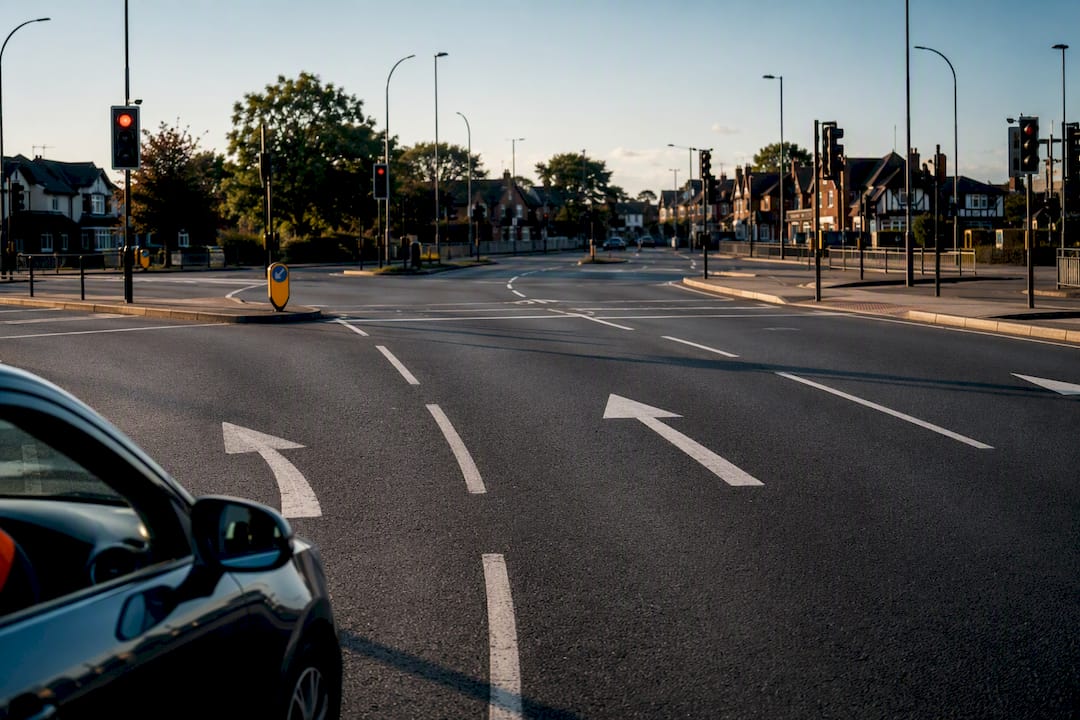
Hornchurch tests lean heavily on the A127 and A124, the Station Lane loop with its level crossing, Roneo Corner’s multi-lane roundabout, and the residential streets around Elm Park and Abbs Cross. Prioritise three things: confident lane discipline on dual carriageways, smooth speed transitions into the High Street’s 20 mph zone, and calm independent driving. The DVSA doesn’t publish official routes, so route packs and instructor lessons are your best rehearsal tools, not a script to memorise.
TL;DR:
- Practising lane discipline early on dual carriageways and verbalizing lane choices at roundabouts can significantly reduce hesitation and last-minute swerve faults.
- Repeatedly encountering specific hazards such as the level crossing, multi-lane roundabouts, and slip road merges makes targeted drills like stop-start rehearsals and lane calling highly effective.
- Nearly half of Hornchurch candidates struggle with timing-related faults, particularly speed zone lapses and hesitation at junctions, which can be improved with deliberate speed checks and routine observation.
- Familiarity with the routes alone does not guarantee success, as examiners draw from multiple combinations; developing adaptable driving habits outweighs route memorization.
- Instructor-led mock tests and specific drills focused on Hornchurch hazards are the most reliable ways to prepare effectively for the test day.
Table of Contents
- Which roads make up the Hornchurch test routes?
- Detailed common routes and the tricky spots examiners watch
- Common faults at Hornchurch and how to fix them
- How to practise Hornchurch routes properly
- What to expect on test day at Hornchurch
- Instructor drills that target Hornchurch’s specific hazards
- Why route memorising isn’t the answer
- Book Hornchurch-focused lessons with Connect Driving School
- Sources
Which roads make up the Hornchurch test routes?
Learners booked at 75 Station Lane will almost certainly meet a handful of recurring roads. Knowing them in advance means you can practise the behaviours that actually matter, rather than guessing blind on test day.
- A127 (Southend Arterial Road): dual carriageway sections that test slip-road merging, lane discipline, and quick speed adjustments.
- Roneo Corner and Gallows Corner: busy, multi-lane roundabout sequences where lane choice has to happen well before you arrive.
- Station Lane and its level crossing: stop-start driving, yellow-box awareness, and finding a legal, safe place to pull up.
- Elm Park and Abbs Cross residential streets: tighter roads suited to manoeuvres, parked cars, and careful observation.
- Independent driving towards Upminster or Elm Park: following road signs or satnav prompts without leaning on them too heavily.
Route aggregators list between 15 and 23 mapped Hornchurch routes, most built around this same set of roads in different combinations.
Detailed common routes and the tricky spots examiners watch
Examiners at Hornchurch don’t follow a fixed script, but the roads they draw from behave the same way every time. Break the area down by junction type and you can drill the specific skill each one demands, rather than trying to memorise a sequence of turns that won’t repeat on your actual test.
- Station Lane loop. The level crossing and its adjoining yellow box catch out learners who either creep forward when queuing or stall when restarting on a slight incline. Practise stopping short of the box, checking the crossing lights, and pulling away smoothly without excessive revs.
- A127 Southend Arterial runs. These stretches test merging at speed and reacting to sudden limit changes, often dropping from 50 mph to 30 mph with little warning. Rehearse checking your mirrors and blind spot before committing to a lane change, and get comfortable matching traffic speed within a few seconds of joining.
- Roneo Corner and similar multi-lane roundabouts. Indecision here costs marks fast. Choose your lane before you reach the roundabout, commit to it, and use clear signals on the way out.
- Elm Park and Abbs Cross manoeuvre streets. Bay parking, reversing around a corner, and tight three-point turns tend to happen on these quieter roads. Small, controlled steering inputs beat big, sudden ones every time.
- Upminster independent driving section. You’ll likely follow either signs or satnav instructions for around ten to twenty minutes. Practise reading road signs early and choosing safe gaps in traffic rather than hesitating at junctions.
Pro Tip: Say your lane choice out loud on every roundabout approach during practice, even alone in the car. Verbalising “I’m taking the second exit, middle lane” forces the decision earlier and stops the last-second swerve examiners mark down.
Mapped route data puts most Hornchurch test routes somewhere between 9 and 39 minutes depending on which sections get combined, so don’t assume every test covers the same ground twice.
Common faults at Hornchurch and how to fix them
Local instructors see the same handful of faults repeat at Hornchurch, and nearly all of them come down to timing rather than lack of skill.
- Speed zone lapses. The High Street’s permanent 20 mph zone catches learners who creep a few miles over without noticing, particularly straight after leaving the faster A124. Practise a deliberate speed check the moment you see the repeater signs.
- Poor lane discipline on slip roads and multi-lane approaches. Drifting between lanes or hesitating mid-manoeuvre reads as a lack of control. Call your lane choice aloud before you commit, then hold it.
- Hesitation at junctions and roundabouts. A missed gap because you weren’t ready is a minor fault; a series of them becomes a pattern examiners notice. Run through your mirror-signal-manoeuvre routine until it’s automatic.
- Weak observation and anticipation. Learners who scan late tend to brake late too. Practising a running commentary out loud during lessons, describing what you see and what you’re about to do, sharpens this fast.
Hornchurch’s pass rate sits in the mid-to-high 40s percent, which puts it roughly in line with, or slightly ahead of, several nearby east London test centres. That’s encouraging, but it also means close to half of candidates are making avoidable mistakes on roads that are entirely predictable in type, if not in exact sequence.
How to practise Hornchurch routes properly
Route familiarity helps, but only if it builds the right habits rather than a memorised checklist.
- Instructor-led mock tests remain the most reliable method. A DVSA-approved instructor can simulate examiner conditions on the actual roads around Hornchurch and correct faults in real time.
- Route apps and GPX downloads let you preview junctions and lane layouts before you drive them, which is useful for confidence but risky if you start anticipating turns instead of reading the road.
- Supervised practice with a qualified driver works best when you log every hesitation or fault afterwards and deliberately increase difficulty session by session, starting on quieter streets before tackling the A127.
- Satnav familiarity matters. Examiners often use satnav instructions during the independent driving section, so practise following prompts without second-guessing every instruction; that hesitation itself creates faults.
What to expect on test day at Hornchurch
The structure is fixed even though the roads vary. It starts with an eyesight check and a “tell me” question about vehicle safety, followed by roughly 20 minutes of general driving that includes an independent driving section, then one manoeuvre or a “show me” question.
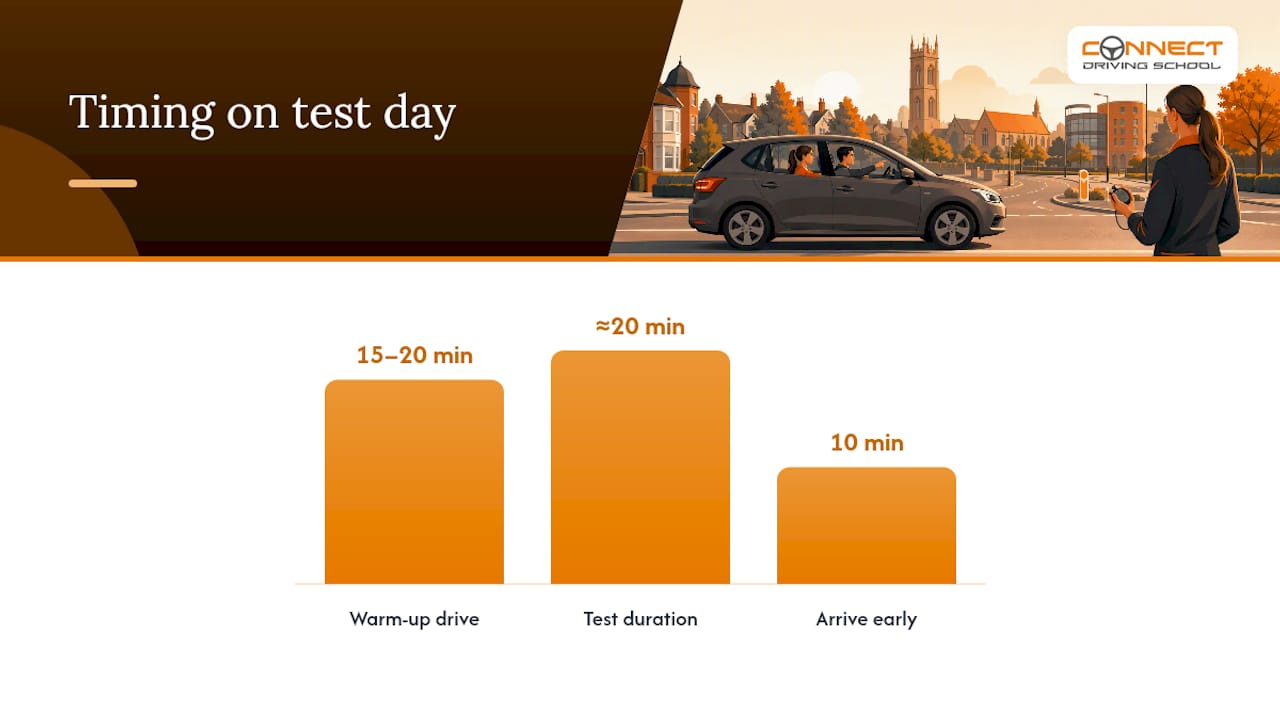
Arrive at 75 Station Lane around 10 minutes early. The centre uses its own yard for reversing manoeuvres, and you’ll likely encounter the level crossing and yellow-box junction on Station Lane itself during the test.
Before you set off, run through a short checklist:
- Provisional licence in hand
- Sensible, flat-soled footwear
- Enough fuel or charge for the full test plus the drive home
- A 15 to 20 minute warm-up drive beforehand focusing on clutch control and observation, which settles nerves before the real thing starts
Instructor drills that target Hornchurch’s specific hazards
Connect Driving School builds Hornchurch preparation around the faults examiners actually record, not generic driving practice. Three drills come up repeatedly in lessons for this test centre.
The lane-discipline sequencing drill has learners approach a multi-lane stretch of the A127 at test speed, call their intended lane aloud, and hold it through to the exit. The Station Lane stop-start rehearsal focuses purely on the level crossing and yellow box, building a smooth, stall-free restart. The roundabout progression drill at Roneo Corner pairs spoken lane calls with early positioning, cutting the hesitation that costs most marks there.
Pro Tip: Book a mock test in the final week before your real one. Instructors who know the local roads can spot the one or two faults you repeat without realising, which is far more useful than another lap of the same familiar streets.
Why route memorising isn’t the answer
Most learners assume the smart move is memorising a handful of Hornchurch routes until the turns feel automatic. That’s backwards. The DVSA deliberately avoids publishing test routes, and examiners at Hornchurch draw from dozens of possible combinations, so the odds of your test matching a memorised sequence are low.

What separates a pass from a near-miss here is behaviour, not familiarity: decisive lane choices before a roundabout, a speed check the second you see a 20 mph sign, an observation routine that runs without thinking. Those transfer to any road, memorised or not.
The conventional advice, drive the same three practice routes until they’re second nature, builds false confidence. It teaches you where the next turn is, not how to react when traffic doesn’t behave the way it did last Tuesday. If there’s one priority worth focusing on, it’s this: spend more time on the skill (lane discipline, speed transitions, calm independent driving) and less on the map. Instructors who know the Hornchurch roads well can spot exactly which habit needs fixing, which is worth more than another solo lap of Station Lane.
— Mudassar
Book Hornchurch-focused lessons with Connect Driving School
Connect Driving School gives you a genuine alternative to guessing your way through practice laps: lessons built specifically around Hornchurch’s known hazards, not a generic driving course adapted to fit.

Lessons cover the A127 merges, the Station Lane level crossing, and Roneo Corner’s roundabout sequencing, with a DVSA-approved instructor correcting faults as they happen rather than after the test. Packages include intensive courses for learners on a deadline, Pass Plus for newly qualified drivers wanting motorway confidence, and standard hourly lessons starting from £14.99. A qualified instructor spotting a repeated hesitation in real time beats any amount of solo route rehearsal, because the feedback happens the moment it matters. If you’re preparing for Hornchurch, book a lesson with Connect Driving School and start with a mock test on the roads you’ll actually be examined on.
Sources
Related Posts



Comments (0)