
Compare the best theory test apps for UK learners, see how official DVSA questions and four in one practice fit together, and follow Mudassar’s study plan...
Two Week Instructor Plan for Chingford Test Routes
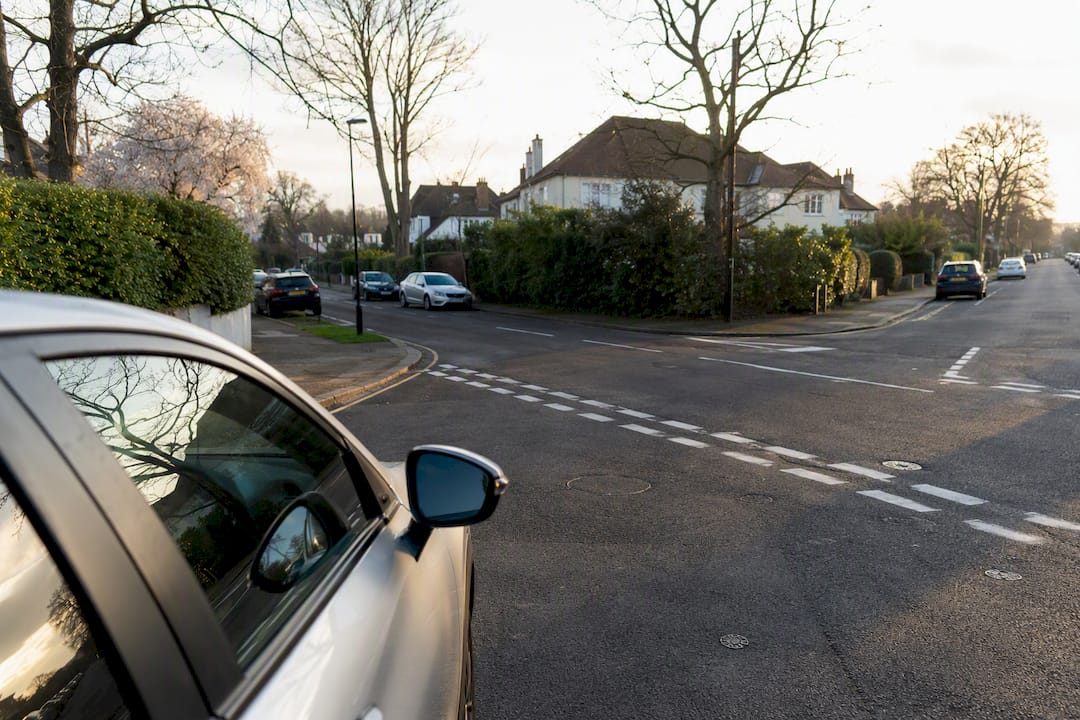
Focus your practice on four roads: Station Road, Chingford Mount Road, Lea Valley Road and the A406 North Circular. Three spots decide most outcomes: Charlie Brown’s Roundabout, the 20 mph corridor on Chingford Mount Road, and the downhill run on Lea Valley Road toward the speed camera. Pull up a route app, drive each spot on repeat, then book one instructor-led session to sharpen what still feels shaky.
TL;DR:
- Focusing on lane discipline at Charlie Brown’s Roundabout and speed control on Lea Valley Road can prevent common examiner faults and automatic serious failures.
- Repeating practice at key spots like the downhill section on Lea Valley Road in third gear helps maintain steady speed and avoid creeping past 30 mph near the speed camera.
- Short instructor-led sessions targeting your weakest junctions and specific drills on manoeuvres improve performance more effectively than lengthy route repeats.
- Most test faults are concentrated around areas with heavy pedestrian movement, narrow streets, and merge points, making early planning and calming techniques essential.
- Practising in typical weather conditions, including rain and low visibility, ensures learners are prepared for potential test-day challenges that could otherwise cause errors.
Table of Contents
- How many Chingford test routes are there, and how long do they take?
- Where do learners lose marks on Chingford routes?
- How should you structure two weeks of Chingford route practice?
- Which manoeuvres come up on Chingford test routes?
- What happens at Doric House on test day?
- What do instructors say actually fixes small faults?
- Where can you park to practise near the test centre?
- How does Chingford’s weather affect test-day driving?
- A note on nerves before your Chingford test
- Sources
How many Chingford test routes are there, and how long do they take?
Route apps and driving test sites map multiple distinct routes running out of Chingford, and durations typically fall within a range of several minutes depending on which one the examiner picks. That’s a wide spread, which is exactly why memorising a specific sequence of turns is a weaker strategy than learning the roads that recur across nearly every route.
Certain roads show up again and again regardless of which route you draw. Chingford’s driving test routes consistently feature:
- Station Road – the start and finish point outside the test centre, usually your first minute of pressure
- Kings Road – a narrower residential stretch used to test observation around parked cars
- Chingford Mount Road (A112) – a shopping parade with a strict 20 mph limit
- Lea Valley Road (A110) – a faster road with a notorious downhill section
- Larkshall Road – links residential Chingford to the busier arterial roads
- A406 North Circular – dual carriageway slip roads, used to check merging and lane discipline
Routes generally alternate between quiet residential sections, a dual carriageway slip or two, and in some cases a run toward the edges of Epping Forest, where the road narrows and visibility drops. Knowing which category a road falls into, rather than which route number it belongs to, is the more useful way to prepare.
Where do learners lose marks on Chingford routes?
Most test faults cluster around a handful of locations rather than being spread evenly across a route. AUDrive’s mapping of Chingford test routes flags the same trouble spots examiners see repeatedly.
- Charlie Brown’s Roundabout: pick your lane early, before you’re committed, and follow the overhead gantry arrows rather than guessing from memory. Examiners mark lane discipline here more heavily than route knowledge itself, since instructors report that gantry awareness matters more than remembering a full sequence of turns.
- Chingford Mount Road (A112): hold 18 to 20 mph through the shopping parade and keep scanning for pedestrians stepping out between parked cars and shopfronts. Select a lower gear in good time rather than braking hard mid corridor.
- Lea Valley Road (A110): this downhill stretch tempts you to creep past 30 mph without realising it, right where a fixed speed camera sits. Local instructor guidance recommends holding third gear on the way down and keeping a steady gap from the car ahead, since speeding here counts as an automatic serious fault.
- Estate roads and narrow streets: parked cars force you to judge gaps precisely, and cyclists often appear from side turnings with little warning. Slow early rather than braking on approach.
- Multi-lane roundabouts and A406 slip merges: mirror, signal, manoeuvre needs to happen with enough time to actually merge smoothly, not as a last-second scramble.
Pro Tip: Drive the downhill on Lea Valley Road in third gear on your first few practice runs, even if it feels unnecessarily cautious. Once you can hold 30 mph without touching the brake, shift up. Building the habit in a lower gear first stops the creep that catches so many candidates out.
How should you structure two weeks of Chingford route practice?
Repeating full routes end to end feels productive, but it isn’t the fastest way to improve. Research into effective practice patterns shows that mixing short instructor sessions with app-based repeats of specific junctions beats driving the same 25 minute loop over and over.
A simple two-week structure works well:
- Days 1 to 3: one short lesson focused purely on Charlie Brown’s Roundabout and the Chingford Mount Road corridor, repeated from different approach angles.
- Days 4 to 7: independent drives (with a qualified driver or instructor alongside) covering Lea Valley Road, Larkshall Road and the A406 slip merges.
- Days 8 to 11: a full mock test, timed properly, including 20 minutes of independent driving where you follow directions or a sat-nav without prompts.
- Days 12 to 14: one final instructor session targeting whatever the mock test exposed, plus a last run through your weakest spot.
Several route apps let you download Chingford-specific routes onto a phone, complete with turn-by-turn navigation and mock-test modes. Many offer a free trial before you pay for full route access and voice guidance, which is worth using before committing.
- Check current DVSA guidance on independent driving before your mock test so you know exactly what’s being assessed.
- Ask your instructor for a session built entirely around your weakest junction, not a generic lesson.
- Rehearse the independent driving section specifically, not just the manoeuvres.
Which manoeuvres come up on Chingford test routes?
Four manoeuvres appear regularly around Chingford: parallel park, forward bay park, reverse bay park, and pull up on the right then reverse. Examiners tend to use the quieter residential roads off Station Road and around the estate streets near Kings Road for these, since they offer enough space without heavy traffic.
Independent driving now makes up around half the test and is marked on your ability to follow directions, a sat-nav, or road signs for roughly 20 minutes without turn-by-turn prompts from the examiner. Minor route deviations aren’t penalised on their own. What gets marked is how you handle the deviation, whether you stay calm, check mirrors, and correct safely.
- Practise each manoeuvre in at least two different locations so you’re not relying on familiar landmarks.
- Run independent driving drills where your instructor gives you a destination, not directions, and stays silent unless safety requires input.
- Repeat tight residential turns until the steering feels automatic rather than counted.
What happens at Doric House on test day?
The Chingford test centre operates from Doric House on Station Road, and it’s the address you’ll see on route planning apps and DVSA correspondence alike. The practical test itself runs for around 40 minutes, with roughly 20 of those minutes given over to independent driving.
Published pass-rate figures for individual test centres shift year to year and shouldn’t be treated as a fixed target. Local pass-rate ranges reported by public sources give a rough sense of centre difficulty, but your result depends far more on preparation than which building you test from.
- Arrive at least 10 minutes early with your provisional licence and theory test pass certificate.
- Bring glasses or contact lenses if you need them for the eyesight check.
- Confirm accessibility arrangements in advance if you need an interpreter or have additional requirements.
What do instructors say actually fixes small faults?
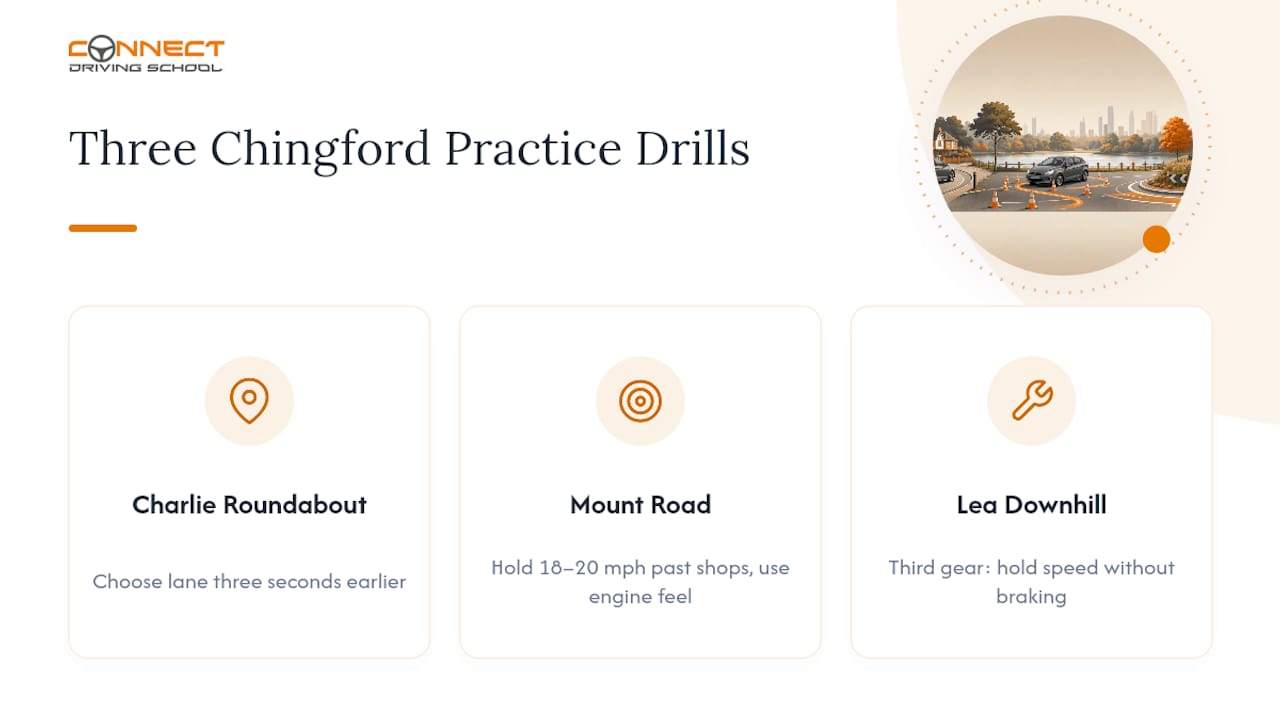
The three highest-impact spots reward specific, repeatable drills rather than general confidence. At Charlie Brown’s Roundabout, rehearse lane selection until you’re choosing it three seconds earlier than feels natural. On the Chingford Mount Road corridor, practise holding a steady 18 to 20 mph past every shopfront without checking your speedometer constantly, using engine sound and gear feel instead. On the Lea Valley downhill, drill third gear control until the car holds its speed without brake input.
A targeted lesson with a DVSA-approved instructor tends to convert these small faults into habits faster than solo practice alone, partly because an instructor spots the half-second hesitation you won’t notice yourself.
Bring three things to a pre-test lesson: your specific goals for the session, feedback from your last mock test, and an honest account of which manoeuvre or junction makes you anxious. That last point matters more than learners expect, since instructors can only target nerves they know about.
Where can you park to practise near the test centre?
Station Road itself has limited free stopping, so most learners practise starting manoeuvres from the residential side streets just off it. Quiet roads near Kings Road offer enough width for a supervised driver to pull over safely without blocking traffic, and they mirror the kind of narrow, parked-car-lined streets the test itself uses.
For longer practice sessions, look toward the residential estates further from the main shopping parade on Chingford Mount Road. These streets are wide enough for a learner to attempt bay parking or a three-point turn without an instructor needing to step in constantly, and traffic is lighter outside school run hours.
Avoid practising directly outside Doric House during peak test times, since instructors and examiners are constantly manoeuvring in and out and the road gets congested. A five-minute drive away, on the calmer streets bordering Ridgeway Park, gives you space to reset between manoeuvres without an audience of other learners doing the same thing.
Pro Tip: Time your parking practice for mid-morning on a weekday. School traffic has cleared, and the roads near the test centre are far quieter than during the 8am or 3.30pm rush.
How does Chingford’s weather affect test-day driving?
Chingford sits close to Epping Forest and the Lea Valley, and both bring their own weather quirks. Ground fog settles in low-lying areas near Lea Valley Road on cold mornings, particularly in autumn and winter, cutting visibility right where you need to judge that downhill speed accurately.

Rain is the more frequent challenge. Wet roads on Chingford Mount Road lengthen stopping distances exactly where pedestrians step out between parked cars, so easing off the accelerator earlier than usual becomes essential. The A406 North Circular collects standing water at certain points during heavy downpours, which can pull a car slightly off line if you’re not braced for it.
Winter brings the added complication of low sun angle in the early morning and late afternoon, particularly heading east along Larkshall Road, where glare can make it genuinely hard to see traffic lights until you’re close. If your test falls in December or January, practise at the same time of day your test is booked for, since lighting conditions change your judgement more than most learners expect.
None of this means avoiding practice in bad weather. It means practising in it deliberately, so test-day conditions don’t throw you off if the forecast doesn’t cooperate.
A note on nerves before your Chingford test
Feeling nervous before your test is completely normal, and it doesn’t predict how you’ll actually drive. A slow, deliberate breath before you start the engine, paired with picturing yourself calmly checking your mirrors at Charlie Brown’s Roundabout, settles most people faster than trying to think your way calm.
One habit worth adopting: check your mirrors twice before every lane change, not once. It sounds excessive until it becomes automatic, and it catches the vehicles you glanced past the first time. Book one final short mock test with your instructor or a confident, honest passenger in the days before your test. It’s the cheapest confidence boost available.
— Mudassar
Sources
Related Posts

Comments (0)