
Practical guidance for newly qualified UK drivers: what Pass Plus' six modules cover, typical costs, and why any insurance discount should be treated as a...
Pass your test: 6 UK pedestrian crossings, tactile paving and rules
Zebra, pelican, puffin, toucan, Pegasus and parallel crossings make up the main types you will meet on UK roads, each with its own markings, signals and priority rules. The core principle never changes: drivers must give way once a pedestrian has moved onto a crossing, and everyone else must follow the Highway Code’s rules for pedestrians for that specific type.
TL;DR:
- Drivers must give way to pedestrians once they step onto a zebra or parallel crossing, and should not overtake or stop in zig-zag markings.
- Puffin crossings feature automatic detection and near-side signals, reducing unnecessary waiting times, while pelican crossings are phased out.
- Pedestrians should wait for a steady green figure, avoid crossing during flashing signals, and make eye contact with drivers for safety.
- Tactile paving and audible signals help visually impaired pedestrians identify crossing points and verify signal changes.
- Local authorities prioritize pedestrian desire lines and use features like tactile paving and raised tables to improve accessibility and safety.
Table of Contents
- Types of pedestrian crossings and how each one works
- How to use pedestrian crossings: rules for drivers and pedestrians
- Accessibility and tactile features for disabled pedestrians
- How councils decide where to put a crossing
- What recent casualty figures tell us about crossing safety
- Instructor tips for mastering crossings before your test
- What the rules get right and where drivers still fall short
- Learning to handle crossings confidently with Connect Driving School
- Sources
- FAQ
Types of pedestrian crossings and how each one works
UK crossings split into two broad families: uncontrolled crossings, where markings alone establish priority, and controlled crossings, which use traffic signals. Recognising which one you are approaching, as a driver or on foot, changes what you are legally required to do.
Zebra crossings are the simplest uncontrolled type. Black and white stripes mark the crossing itself, and flashing amber Belisha beacons on striped poles mark each end. According to the Highway Code, drivers must give way to pedestrians waiting to cross and must stop once someone has stepped onto the crossing. Parallel and tiger crossings work the same way but add a cycle lane alongside the pedestrian stripes, letting cyclists cross without dismounting.
Controlled crossings rely on traffic lights rather than priority alone. Pelican crossings are the older design: pedestrians face a steady red or green figure, and drivers see a flashing amber phase during which they must give way to anyone still on the crossing but can proceed if it is clear. GOV.UK guidance confirms that pelicans are legacy installations and are no longer being built new. Puffin crossings replaced them with near-side signals, placed on the same side of the road as the waiting pedestrian, and automatic detection that adjusts the crossing phase to how many people are actually waiting rather than running a fixed cycle.
Toucan crossings look similar to puffins but carry a joint pedestrian and cycle symbol, allowing cyclists to ride across without dismounting. Pegasus, or equestrian, crossings serve horse riders and usually include a higher push button reachable from the saddle. A few practical distinctions worth remembering:
- Zebra and parallel crossings: no signals, priority is established the moment a pedestrian steps onto the stripes.
- Pelican crossings: legacy signal design with a flashing amber phase for drivers; being phased out of new schemes.
- Puffin crossings: near-side signals with automatic pedestrian detection, reducing unnecessary waits for traffic.
- Toucan crossings: shared use for pedestrians and cyclists, who may ride across together.
- Pegasus crossings: designed for horse riders, with raised push buttons and longer crossing phases.
Informal crossings, sometimes just a dropped kerb with no markings, appear on quieter residential streets and rely entirely on mutual awareness between drivers and pedestrians.
How to use pedestrian crossings: rules for drivers and pedestrians
The Highway Code sets out clear duties for both sides of the crossing, and most disputes on the road come down to one party not knowing them.
For drivers, the rules are specific rather than general good manners:
- Give way to pedestrians waiting to cross at a zebra or parallel crossing, and never wave or flash your lights to invite someone across, since this can confuse other road users.
- Do not stop or park within the zig-zag markings on either side of a crossing, and never overtake the last vehicle that has stopped to let someone cross, as detailed in the Highway Code’s rules for using the road.
- Stop fully at a red signal on pelican, puffin or toucan crossings, and treat the pelican’s flashing amber phase as a strict “give way if anyone is still crossing” instruction rather than a green light.
- Never enter a crossing or the space immediately beyond it if your exit is not clear, even when your own signal is green.
- Slow down and expect the unexpected near schools, in 20mph zones, and wherever visibility is reduced by parked vehicles or bends.
Pedestrians have their own responsibilities. Press the button where one is provided and wait for a steady green figure rather than stepping out the moment lights start to change. At pelican crossings specifically, do not start crossing once the green figure begins flashing, since that phase exists to let people already crossing finish safely, not to invite new starters. Making eye contact with drivers before stepping out, and listening for audible signals at signalled crossings, adds a margin of safety that markings alone cannot guarantee.
If lights fail or a crossing is clearly out of order, treat it as you would an uncontrolled junction: proceed with caution, make eye contact, and never assume the other party has seen you.
Accessibility and tactile features for disabled pedestrians
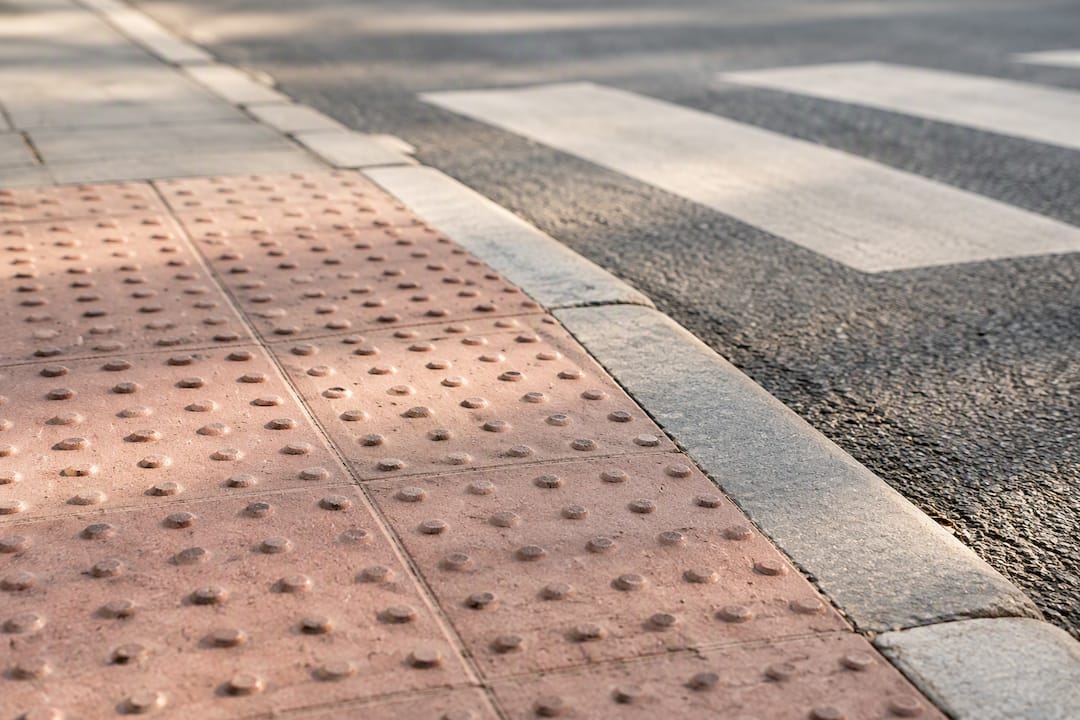
Tactile paving is the most visible accessibility feature at UK crossings, and it does specific work. The blister pattern, laid out in an L-shape at controlled crossings, tells visually impaired pedestrians where the carriageway begins and helps them line up correctly with the crossing point. Inclusive Mobility guidance from the Department for Transport recommends this L-shape layout precisely because consistency across sites builds confidence: a pedestrian who has learned to trust the pattern in one town can rely on it elsewhere.
Audible and tactile signals extend that same logic to the crossing itself. A rotating cone under the push-button box turns when the pedestrian phase is active, giving a physical signal to anyone who cannot see or hear the lights change. Equipment meeting the TOPAS standard is the version local authorities are advised to fit, since it gives a consistent, reliable cue across different sites.
- Push-button units on puffin and toucan crossings should sit between 1,000mm and 1,100mm from the ground, within easy reach from a wheelchair.
- Central refuge islands need a minimum width of 1,500mm, with 2,000mm preferred for comfortable waiting.
- Dropped kerbs should align precisely with the tactile paving and the crossing point, not offset to one side.
- Accessibility groups are typically consulted during crossing assessments, since real-world use often reveals problems that design drawings miss.
Pro Tip: If you rely on audible or tactile signals, position yourself directly over the tactile paving before pressing the button, since some units are offset and pointing the wrong way can mean missing the cue entirely.
How councils decide where to put a crossing
Highway engineers do not place crossings at random. The starting point is almost always the desire line, the route pedestrians already take whether or not a crossing exists there. Inclusive Mobility guidance notes that crossings built away from these natural paths tend to go unused, pushing pedestrians back onto the road at the point they actually wanted to cross in the first place.
Traffic and pedestrian volumes then determine whether a site needs a signal-controlled crossing or whether a zebra or informal crossing will do. Local design standards for new streets often specify a crossing roughly every 60 metres on busy links, with raised tables built in as a default rather than an afterthought. A few recurring factors shape the final design:
- Desire lines and footfall data set the location before any signal type is chosen.
- Raised tables, build-outs and zig-zag markings are used to slow traffic and improve sightlines at the chosen point.
- Minimum dimensions for refuge islands, tactile paving and signal placement follow the Traffic Signs Regulations and General Directions and the Traffic Signs Manual.
- Suppressed demand, where people avoid a route because there is no safe crossing, is a known risk, which is why local engagement forms part of most assessments.
Single-stage crossings, where a pedestrian crosses the full carriageway in one movement rather than pausing on a central island, are generally preferred where road width allows, since they reduce the time spent exposed to traffic.
What recent casualty figures tell us about crossing safety
In 2024, hundreds of pedestrians died on Great Britain’s roads, according to the Department for Transport’s pedestrian factsheet, alongside thousands of reported serious and slight injuries on an adjusted basis. Pedestrians accounted for a significant share of all road deaths that year, a disproportionate share given how few journeys are made entirely on foot.
The same data shows a meaningful proportion of pedestrian fatalities happen away from junctions, which means good crossing design alone cannot solve the problem. Infrastructure such as well-placed crossings, tactile paving and raised tables reduces risk at known pinch points, but cautious driving on the ordinary stretches of road between them matters just as much. For pedestrians, the practical takeaway is to use a formal crossing wherever one exists rather than crossing at the nearest convenient gap, even on quieter roads.
Instructor tips for mastering crossings before your test
Examiners watch closely for how candidates handle crossings, and it is one of the more common places nerves show. Instructors typically focus on three habits: early observation of pedestrians approaching a crossing, correct positioning well before the stop line, and anticipating a zebra crossing’s zig-zag markings rather than reacting at the last second.
- A common learner mistake is creeping forward at a zebra crossing while a pedestrian is still deciding whether to cross, which reads as pressuring them.
- Another is misjudging the pelican’s flashing amber phase and either stopping unnecessarily or failing to give way when someone is still crossing.
- First lessons build the basic scan-and-respond habit, while an intensive course gives concentrated repetition of crossings across varied routes in a short time.
- Pass Plus and motorway lessons extend the same observation skills to faster, less predictable environments.
Our instructors build these habits through repeated, deliberate practice rather than one-off explanation.
What the rules get right and where drivers still fall short
The Highway Code’s crossing rules are clear on paper, yet the gap between knowing them and applying them under pressure is where most incidents happen. Drivers tend to treat a pelican’s flashing amber as “clear to go” rather than “give way if anyone remains”, and that single misreading causes more near misses than any gap in the regulations themselves.
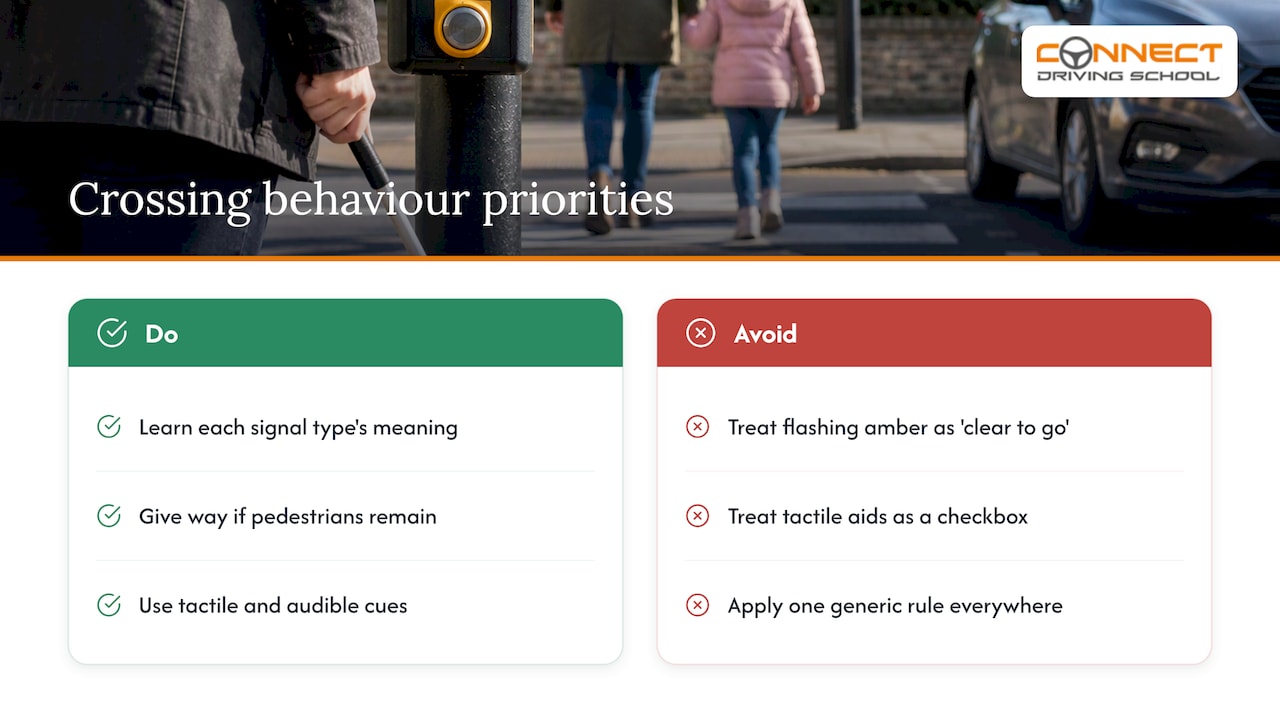
Inclusive design guidance, meanwhile, gets less attention than it deserves. Tactile paving and audible signals are often treated as a compliance checkbox rather than infrastructure that determines whether a visually impaired person can cross safely at all. A crossing that technically meets the Traffic Signs Regulations but has a poorly positioned push button is not a minor oversight, it is a functional failure for the person who depends on it.
For learners and experienced drivers alike, the priority is simple: learn to read the specific signal type in front of you rather than applying a single generic rule to every crossing. That distinction, more than any amount of general caution, is what separates confident crossing behaviour from guesswork.
— Mudassar
Learning to handle crossings confidently with Connect Driving School
Reading a crossing correctly under test conditions takes practice, not just theory, and that is exactly where in-person lessons earn their keep. Our instructors build crossing awareness into ordinary lessons rather than treating it as a separate topic, so learners get repeated exposure to zebra, puffin and toucan crossings on real London streets.

A First Driving Lesson is enough to establish the basics of observation and positioning near a crossing, while an Intensive Driving Course packs concentrated practice into a short timeframe for learners working towards a test date. Pass Plus builds on those habits once you have passed, and both automatic and manual tuition are available depending on which you are learning in. Full pricing for these and other courses is listed on the prices page, and lessons can be booked directly with a DVSA-approved instructor near you.
Sources
- Gov
- Inclusive mobility: a guide to best practice on access to pedestrian and transport infrastructure (DfT)
FAQ
What are the new rules for pedestrian crossings in the UK?
Recent Highway Code updates reinforced that drivers must give way to pedestrians waiting to cross at a zebra or parallel crossing, and to anyone who has already stepped onto one. The guidance also confirms that pelican crossings are no longer being installed as new schemes, with puffin and toucan designs used instead.
How many types of pedestrian crossings are there in the UK?
The main types are zebra, pelican, puffin, toucan, Pegasus (equestrian), and parallel or tiger crossings, alongside informal crossings with no markings at all. Each uses different signals and priority rules, as set out in GOV.UK’s crossing guidance.
Can you get fined for not stopping at a zebra crossing?
Failing to give way to a pedestrian at a zebra crossing is an offence under the rules set out in the Highway Code, and it can lead to penalty points and a fine. Drivers must stop once someone has moved onto the crossing, not just when they are waiting at the kerb.
Do pedestrians have right of way at all crossings?
No, priority depends on the crossing type. At zebra and parallel crossings pedestrians have priority once they step onto the crossing, but at signal-controlled crossings such as pelican, puffin and toucan, pedestrians must wait for the green signal rather than assuming right of way.
Related Posts
Comments (0)