
UK DVSA backed practice plan to lift your hazard perception score. Learn when to click, how scoring works, and how to aim for 44/75.
Save £2–£3 Per Lesson: Block Booking Lessons for UK Learners
Block booking lessons is usually the better choice for learners who can keep a regular weekly slot, since it lowers your per-lesson rate and keeps your progress consistent. Most schools sell blocks of 5 or 10 lessons, and any purchase made at a distance carries a statutory 14-day cooling-off right. For learners ready to commit, many driving schools offer block packages alongside standard lesson options.
TL;DR:
- Paying upfront for a block of lessons reduces the likelihood of cancellations and encourages consistent weekly scheduling, which benefits skill retention.
- Typical discounts on a ten-lesson block range from £2 to £3 per lesson compared to individual prices, with larger blocks offering slightly deeper savings.
- Buying a block is most suitable if your schedule is stable, you have a clear test target, and you can commit to regular lessons over the expiry period, usually three to four months.
- When purchasing online or over the phone, ensure the school provides clear terms on cancellation notice periods, expiry dates, refund policies, and additional fees, preferably in writing.
- For those still unsure about instructor compatibility or variable schedules, starting with single lessons before upgrading to a block helps avoid unnecessary financial commitment.
Table of Contents
- What block booking actually means and how it works
- How much you can actually save
- Your consumer rights and what to check before you pay
- How to decide whether a block is right for you
- Why instructors sell blocks and what a good one looks like
- When I would recommend a block and when I would not
- Connect Driving School block packages and how to book
- Where these figures and rules come from
- Sources
- FAQ
What block booking actually means and how it works
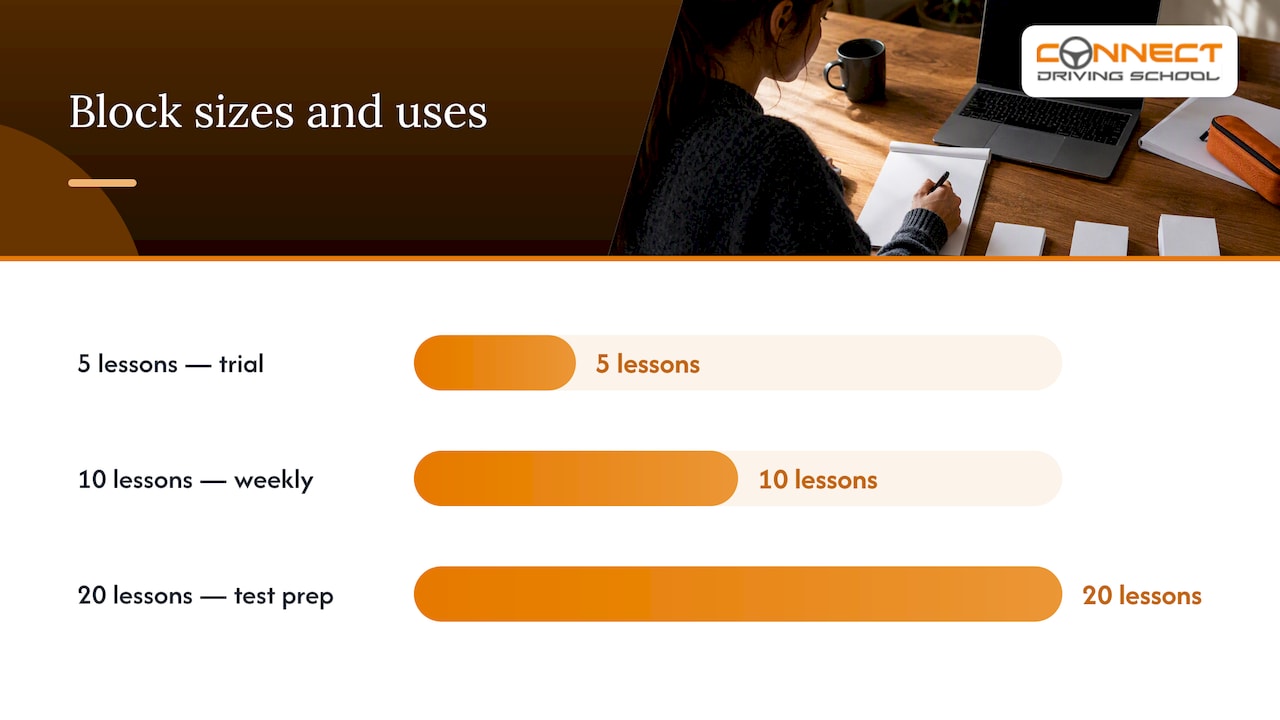
Block booking is simply paying in advance for a set number of lessons rather than booking and paying one at a time. Schools typically sell blocks in a few standard sizes: 5 lessons for learners testing the water, 10 lessons for steady weekly progress, or 20 lessons for those working towards a test within a few months. Some learners prefer an intensive pattern, cramming several lessons into consecutive days, while others spread the same block across weekly sessions over a couple of months.
Because you have paid upfront, most instructors also set a “shelf life” on the block, often a window of three to four months, within which you need to use the lessons. This protects the instructor’s diary from being blocked indefinitely by a single learner and gives both sides a clear timeframe to work towards.
Buying a block tends to bring a few practical advantages:
- A guaranteed weekly slot with the same instructor, rather than fitting around whoever has space.
- Steadier progress, since skills build more reliably week to week than in scattered single lessons.
- Better retention of what you learned last time, because the gap between lessons stays short and consistent.
How much you can actually save
The savings on a block are usually modest per lesson but add up over a full course. Take a simple worked example: a single lesson is priced individually, while a ten-lesson block is typically sold at a modest discounted rate per lesson, resulting in overall savings when purchasing multiple lessons upfront.
Discount structures tend to follow a pattern. Five-lesson blocks often carry a small saving, ten-lesson blocks a bit more, and twenty-lesson blocks occasionally the deepest discount, though very large discounts on big blocks are uncommon because instructors still need to cover fuel, time and admin regardless of how many lessons you buy at once.
Modest per-lesson discounts, often around £2 to £3 on a ten-lesson block, are typical in the industry’s block-pricing practice, which is enough to reward commitment without eating into an instructor’s income.
The real value of a block often shows up away from the price list:
- Fewer cancelled or rescheduled lessons, since both sides have already committed.
- Faster skill retention from lessons spaced closely and regularly.
- A realistic chance of needing fewer total hours to reach test standard, since consistent practice tends to beat stop-start learning.
Your consumer rights and what to check before you pay
If you buy a block of lessons online or over the phone, rather than in person at the school, you are covered by the Consumer Contracts Regulations 2013. These give you a statutory 14-day cooling-off period after you enter the contract. If you cancel within that window, you are entitled to a refund, though if you have already taken lessons during the cooling-off period, the school can charge you proportionally for what you have used rather than refunding the full block.
Price transparency matters too, as explored in What online piano lessons actually cost in the UK. The Competition and Markets Authority (CMA) took enforcement action against the AA and BSM driving schools after finding they had used drip pricing, adding booking fees at checkout instead of showing them in the headline price. Any school that hides mandatory charges until the final step of payment is out of step with what regulators now expect, and reputable providers show the full price upfront.
Before paying for a block, check the small print for:
- The notice period required to cancel or reschedule a lesson without losing it.
- The expiry window for using the block and what happens to unused lessons after that date.
- How refunds are handled if you stop lessons partway through, and by what method.
- Whether there are any mandatory add-on fees not shown in the headline price.
Pro Tip: Ask the school to confirm the cancellation notice period and expiry date in writing before you pay, not after.
How to decide whether a block is right for you
Buying a block only makes sense if your circumstances match how blocks are meant to work. A few questions help you judge this quickly.
- Can you commit to the same time slot every week for the length of the block?
- Do you have a rough test date or timeframe in mind, or are you still deciding whether to learn to drive at all?
- Are you comfortable paying upfront, or would you rather keep cash flexible lesson by lesson?
- Have you already had at least one lesson with this instructor, or would you be buying blind?
Once you are ready to talk to a school, ask directly:
- What is the expiry window on this block, and what happens if I do not use all the lessons in time?
- Do you offer make-up lessons if I have to cancel with reasonable notice?
- How are refunds calculated if I need to stop partway through?
- What is your notice period for cancelling or rescheduling a booked lesson?
- If my usual instructor is unavailable, is there a substitute policy?
Pro Tip: Get the answers to these questions in writing, even a simple e-mail confirmation, before you transfer any money.
Watch for red flags: fees that appear only at checkout and were not mentioned before, a cancellation policy that is vague or verbal only, and no written terms and conditions at all. Any of these should make you pause before paying for a full block.
Why instructors sell blocks and what a good one looks like
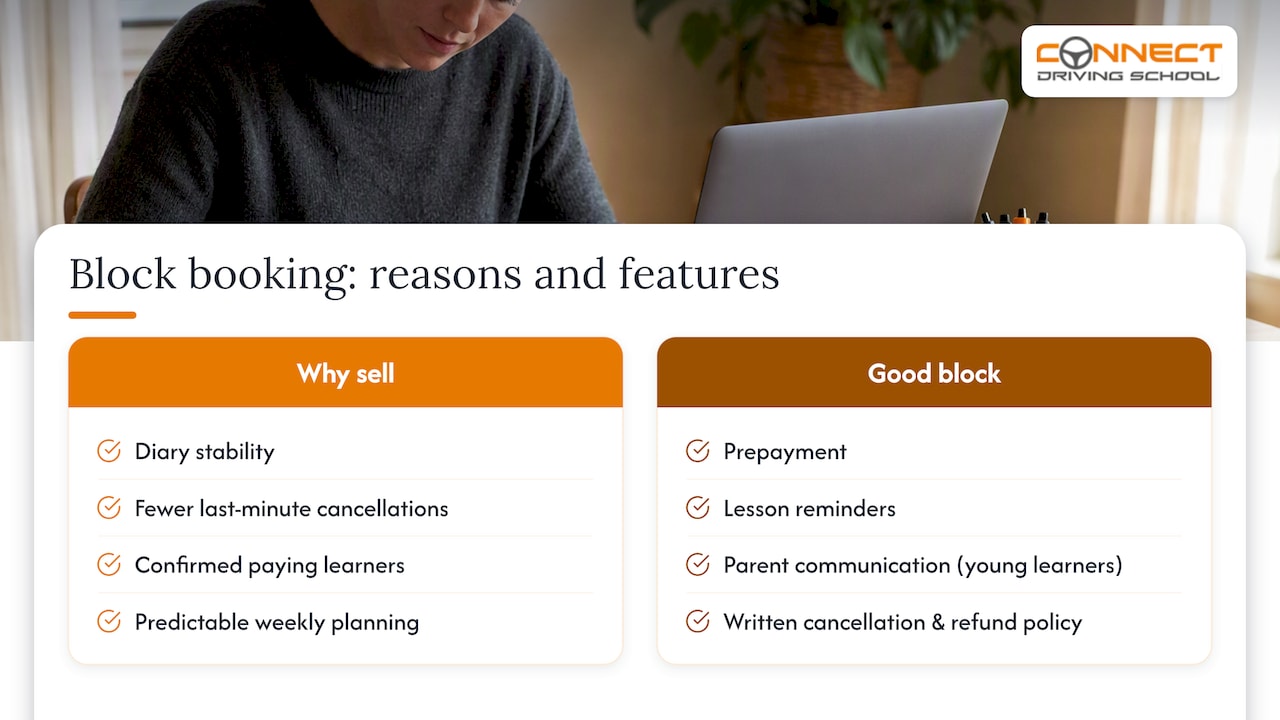
Instructors sell blocks mainly for diary stability. A prepaid block reduces last-minute cancellations and lets an instructor plan a working week around confirmed, paying learners rather than guessing who will show up. In practitioner accounts of block-pricing structures, prepayment, lesson reminders and, for younger learners, communication with parents are common ways schools make block policies stick in practice.
Its course offerings span beginner lessons, intensive courses and Pass Plus training, so a block can be structured around whichever goal a learner actually has, rather than a one-size package.
Whichever school you choose, you should expect a written cancellation and refund policy, regular reminders about upcoming lessons, a coaching plan that builds skills in a logical order rather than repeating the same exercises, and clear answers about what happens to your money if your plans change.
When I would recommend a block and when I would not
Block booking makes sense once you know your schedule is stable and you have a rough test target in mind. Paying upfront for 10 lessons only pays off if you can actually turn up to all 10 on roughly the same weekly rhythm.
If you are still deciding whether an instructor suits your learning style, or your work or study timetable changes week to week, pay as you go first. Try one or two single lessons, see how the teaching style fits and how reliably lessons run, then upgrade to a block once you can see the pattern holding steady. Committing money before committing to a routine rarely works out.
— Mudassar
Connect Driving School block packages and how to book
Once you decide a block suits your schedule, the pricing of some driving schools reflects a straightforward approach: no hidden checkout fees, just honest per-lesson pricing across their course ranges. Learners can start with a First Driving Lesson to test the fit, move into an Intensive Driving Course if working towards a tight deadline, or add a Pass Plus course once they have passed and want extra motorway confidence.
The full range includes:
- First Driving Lesson, priced from £37.50 per hour, for learners wanting to try before committing to a block.
- Intensive Driving Course, priced from £1,200 one-off, for learners working to a short timeframe.
- Pass Plus, priced from £270 one-off, for newly qualified drivers building motorway and night-driving confidence.
- Automatic Driving Lessons and Manual Driving Lessons, both available depending on which you plan to test in.
You can see the full current pricing and package details and book directly when you are ready to commit to a block.
Where these figures and rules come from
The legal points in this article come from the Consumer Contracts Regulations 2013 on cooling-off rights and the CMA’s action against drip pricing in driving schools. Pricing and instructor-practice examples draw on industry guidance on block-booking structures. For test statistics and booking, the DVSA’s operational statistics and its practical test booking service remain the official reference points.
Sources
- The Consumer Contracts (Information, Cancellation and Additional Charges) Regulations 2013
- CMA orders the AA and BSM driving schools to refund learner drivers over drip pricing
- How driving instructors fill the diary with block bookings (not one-off lessons) · Voll
FAQ
How much is it to block book driving lessons?
Prices vary by school and block size, but a typical structure charges a small per-lesson saving as the block gets bigger. Using a worked example of a ££37.50 single lesson per hour against a ten-lesson block is typical, resulting in a modest per lesson saving of around £2 to £3, based on typical block-pricing practice.
What is a 10-hour block booking?
A 10-hour block booking means paying upfront for 10 lessons with an instructor, usually taken as one hour each on a weekly or intensive schedule. It is one of the most common block sizes schools offer, sitting between a small 5-lesson trial block and a larger 20-lesson package.
How much is a block of 10 driving lessons?
Based on the same worked example used earlier, a ten-lesson block is typically priced to give a modest saving per lesson compared with a single lesson priced from £37.50. Actual prices depend on the school and area, so always check the current rate before comparing blocks.
Is 20 lessons enough to pass?
There is no fixed number of lessons that guarantees a pass, since it depends heavily on prior experience and how often you practise between lessons. Consistent weekly lessons, whether bought as a 10-lesson or 20-lesson block, tend to support steadier progress than irregular single bookings.
Related Posts

Comments (0)