
Master mini roundabout rules: Highway Code basics, the four DVSA test faults to avoid, and instructor drills to fix them before your driving test.
45 Hours Average: How Many Driving Lessons Do UK Learners Need
Most learners who pass their test in the UK take around 45 hours of professional lessons plus extra private practice, though the real range runs from about 20 to 60 hours depending on the learner. Private practice shortens the professional hours needed, and individual variation is wide. The honest answer is to follow your instructor’s “ready to pass” signal rather than a fixed number.
TL;DR:
- Learners with prior driving experience or heavy private practice may need fewer than 20 hours, while complete beginners typically require closer to 45 hours of professional lessons.
- Regular lessons twice a week and private practice with a qualified supervisor can significantly reduce the total hours needed to reach test standard.
- Booking a test too early without consistent skill development often leads to failed attempts and longer delays, especially with long waiting times of around 22 weeks.
- Costs average around £1,575 for 45 hours of lessons at typical rates, but stacking lessons close to the test date and maximizing private practice can save money.
- The best approach is to follow your instructor’s guidance and build a personalized plan rather than aiming for a fixed number of lessons based on the average.
Table of Contents
- UK averages and common ranges: what the numbers actually show
- Factors that raise or lower the number of lessons you need
- Practical lesson planning: cadences, milestones and test booking timing
- Cost expectations: lesson prices and an example total
- How test waiting times affect lesson plans and how to avoid losing progress
- How Connect Driving School maps lessons and packages to realistic learner needs
- Editorial takeaway: realistic expectations for UK learners
- Book lessons with Connect Driving School
- Sources
- FAQ
UK averages and common ranges: what the numbers actually show
The most quoted figure in UK driving comes from the DVSA, which puts the average at 45 hours of professional lessons plus additional private practice for learners who go on to pass. That average sits alongside a practical pass rate slightly below half for July to September 2024, meaning a significant share of tests end in a fail, often prompting extra lessons before a retest.
Government research into learner behaviour paints a messier picture than a single average suggests. Qualitative research with learner and novice drivers found that some learners took fewer than about 20 hours before their test, while others required between about 30 to 40 hours or more, and most were not even aware of a suggested hours benchmark when they booked.
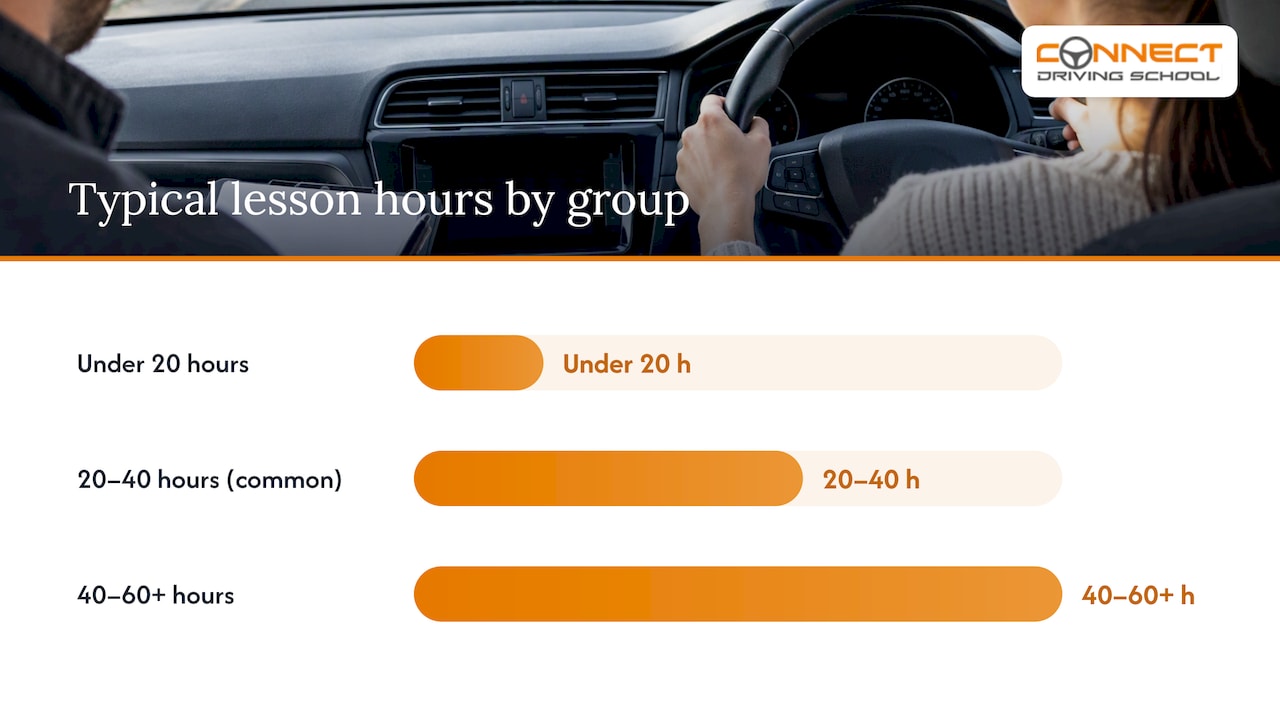
Roughly, learners fall into three groups:
- Under 20 hours: usually learners with prior driving exposure, strong spatial awareness, or heavy supervised private practice before starting lessons.
- 20 to 40 hours: the most common band, typically weekly lessons combined with some private driving between sessions.
- 40 to 60+ hours: learners starting from zero experience, nervous drivers, or those with longer gaps between lessons that slow retention.
The DVSA’s 45-hour average is a midpoint, not a finish line. It is pulled from thousands of learners with wildly different starting points, so using it as a personal target can mean booking too few lessons or wasting money on too many.
Factors that raise or lower the number of lessons you need
The 45-hour average moves a lot once you factor in who is actually behind the wheel. Several variables consistently push the number up or down.
- Prior driving experience: learners who have driven off-road, on farmland, or abroad often transfer core control skills, cutting the hours needed to reach test standard.
- Manual versus automatic: automatic cars remove gear changes and clutch control, which tends to shorten the time it takes to feel confident, particularly for nervous learners.
- Lesson frequency: short, regular sessions, say twice a week, generally build retention better than one long lesson with a two-week gap before the next.
- Instructor quality and experience: a structured lesson plan that targets weak points speeds progress more than an unstructured series of general drives.
- Local ADI availability: where approved driving instructors are in short supply, learners sometimes stretch lessons further apart, which can slow progress through no fault of their own.
- Supervised private practice: time spent driving with a qualified supervisor, who must be over 21 and have held a full licence for at least three years according to guidance on private practice, can meaningfully cut the number of paid lessons needed.
Pro Tip: Book a block of lessons close together in the weeks before your test rather than spacing them out, since skills learned days apart fade faster than skills reinforced within the same week.
Practical lesson planning: cadences, milestones and test booking timing
How you schedule lessons matters almost as much as how many you take. Two cadences dominate in the UK: weekly one or two-hour lessons spread over several months, and intensive courses that compress the same hours into one or two weeks. Weekly lessons suit learners balancing school, college or work and allow time to absorb each skill. Intensive courses suit those with a looming deadline, such as a job offer conditional on a licence, though they demand full attention for several consecutive days.
A simple way to judge readiness is to work through a milestone checklist with your instructor:
- Confident vehicle control: smooth clutch control or, in an automatic, consistent acceleration and braking without instructor correction.
- Junctions and roundabouts: reading approach speed and priority correctly on repeated attempts.
- Independent driving: following directions or a sat nav for ten minutes without prompts.
- Reversing manoeuvres: parallel parking, bay parking and reversing round a corner completed to test standard.
- Higher-speed roads: comfortable with dual carriageways and, where relevant to your test centre, motorway-style driving.
Booking timing matters too. The DVSA’s “Ready to Pass?” campaign specifically advises learners to book a test only once their instructor confirms they are consistently meeting test standard, rather than booking against a calendar date and hoping skills catch up in time.
Cost expectations: lesson prices and an example total
Lesson prices vary by region, but the Working as a Driving Instructor survey found that £36 to £40 per hour is the most common rate charged by approved instructors nationally. London rates often sit above that range, reflecting higher operating costs for instructors in the capital.
Using the DVSA average of 45 hours at a mid-range hourly rate, press coverage has worked out a rough total cost of around £1,575 for professional lessons alone, before test fees.
A few ways to keep costs down without cutting corners:
- Block-book lessons where the school offers a reduced hourly rate for bulk packages.
- Maximise supervised private practice with a qualified driver, which the AA estimates delivered around 5 million hours across UK learners in 2024.
- Consider Pass Plus after passing, which can improve skills for higher-risk situations rather than paying for extra pre-test lessons you may not need.
Private practice hours are doing more of the heavy lifting than many learners realise, and they cost nothing beyond fuel and insurance.
How test waiting times affect lesson plans and how to avoid losing progress
Current booking conditions are reshaping how lessons should be planned. The National Audit Office found that average waiting times reached around 22 weeks by September 2025, creating what it describes as a “stop-start” learning cycle where learners book a test slot many months out, then either lose sharpness waiting or need refresher lessons closer to the date.
A few tactics limit the damage:
- Keep a light ongoing lesson rhythm rather than stopping entirely after booking, even one lesson every few weeks preserves core skills.
- Plan a concentrated refresh in the final fortnight before your test date to rebuild confidence on manoeuvres and independent driving.
- Check nearby test centres within your area for shorter waits, since availability can differ significantly between centres only a short drive apart.
Following DVSA’s “Ready to Pass?” guidance before booking, rather than booking the earliest available slot regardless of readiness, avoids paying for a test you are likely to fail and then needing to re-book into another long wait.
How Connect Driving School maps lessons and packages to realistic learner needs
Connect Driving School builds packages around these realities rather than a single fixed number. A First Driving Lesson suits complete beginners testing the water, while an Intensive Driving Course fits learners working toward a deadline. Pass Plus and Motorway Driving lessons suit newly qualified or nearly-test-ready drivers who want extra confidence on faster roads, and separate Automatic and Manual Driving Lessons let learners choose the transmission that shortens their own learning curve.
A nervous beginner with no experience would typically start with weekly lessons and build toward Pass Plus later, while someone with existing private practice might go straight into an intensive course to consolidate skills quickly. Full pricing sits on the prices page.
Editorial takeaway: realistic expectations for UK learners
The right number of lessons is the number that gets you consistently meeting test standard, not a figure copied from an average. Mix steady professional lessons with regular supervised practice, check your local test centre’s waiting time before booking, and trust your instructor’s judgement over a calendar date.
— Mudassar
Book lessons with Connect Driving School
Once you know roughly where you sit on the hours scale, choosing a package becomes straightforward rather than guesswork. Driving schools typically price lessons from around £37.50 per hour, with packages often built around learner pathways.
- First Driving Lesson, from £37.50 per hour, suits anyone starting from scratch.
- Intensive Driving Course, from £1,200 one-off, suits learners working to a fixed deadline.
- Pass Plus, from £270 one-off, suits newly qualified drivers wanting broader road experience.
- Motorway Driving, from £135 one-off, suits learners nearing test standard who want motorway confidence.
- Automatic and Manual Driving Lessons are available separately, matched to whichever transmission suits your learning pace.
If you took the milestone checklist above and recognised where you currently stand, get in touch through the pricing and booking page for a plan matched to your experience, or visit Connect Driving School to see lesson types and service areas across London.
Sources
- Driver and rider testing and instructor statistics: July to September 2024
- Ready to Pass? (DVSA campaign)
- Investigation into car driving test waiting times – Summary
- Research with learner and novice drivers (annex A)
FAQ
Is 20 lessons enough to pass?
For some learners, yes, particularly those with prior driving exposure or heavy private practice, since GOV.UK research found many learners report fewer than 20 hours before testing. Most learners, however, sit closer to the DVSA average of 45 hours, so 20 lessons works best as a starting estimate rather than a guarantee.
Is there still a shortage of driving instructors?
Local availability varies, and the Working as a Driving Instructor survey provides regional data on instructor numbers and pricing that shows uneven distribution across the UK. Where instructors are in short supply, learners sometimes wait longer between lessons, which can slow overall progress.
How many driving lessons average in the UK?
The DVSA’s own figure is an average of 45 hours of professional lessons plus additional private practice for learners who pass. That average masks a wide spread, with some learners passing on far fewer hours and others needing considerably more.
Is 12 driving lessons enough?
Twelve lessons, typically around 12 to 18 hours depending on lesson length, is below the common range most UK learners report and would usually only suit someone with substantial prior driving experience. For most beginners, reaching test standard in that time is unlikely without extensive supervised private practice alongside those lessons.
How long are driving lessons usually?
Most UK driving lessons run for one or two hours, with two-hour sessions often preferred once a learner moves beyond the basics, since longer sessions allow more time on roads like dual carriageways or in traffic. Connect Driving School prices lessons from £37.50 per hour, letting learners choose the length that suits their pace and budget.
Related Posts
Comments (0)