
Understand Highway Code rule 174 and the TSRGD basis, how ANPR camera enforcement works, and DVSA-approved instructor tips to judge box junctions and...
New UK Drivers, Book Pass Plus for Skills Not Insurance
Pass Plus is worth it for most newly qualified drivers who want structured experience in conditions the driving test barely touches, such as motorways and night driving, but the insurance saving is not guaranteed. Some insurers still recognise the certificate, others do not, so the financial case depends entirely on your own policy. The best approach is to book the course for the skills, then contact your insurer to confirm whether it lowers your premium before you commit.
TL;DR:
- Many insurers do not recognize Pass Plus or only offer discounts at renewal, so the potential savings may not justify the course cost for everyone.
- The course covers six modules, focusing on skills like motorway driving, rural roads, night driving, and adverse weather, with practical on-road instruction and continuous assessment.
- The total price varies depending on instructor rates and regional costs, with grants available in some areas that can significantly lower expenses if you search locally in advance.
- Confirm with your insurer beforehand whether passing Pass Plus will lower your premium, and obtain written proof of any discount to avoid misunderstandings.
- Pass Plus primarily provides valuable skill development for conditions not thoroughly covered in the standard test, making it worthwhile especially for nervous drivers or those facing specific road challenges.
Table of Contents
- What Pass Plus covers: the six modules and what you actually learn
- How Pass Plus works in practice and how to get the DVSA certificate
- Cost, grants and how much you should expect to pay
- Does Pass Plus reduce insurance? How to test the numbers for your situation
- When Pass Plus is worth it: a practical decision checklist
- Real-world perspective from a DVSA-approved driving school
- Author perspective: honest summary and recommended next steps
- How Connect Driving School can help you with Pass Plus
- Sources
- FAQ
What Pass Plus covers: the six modules and what you actually learn
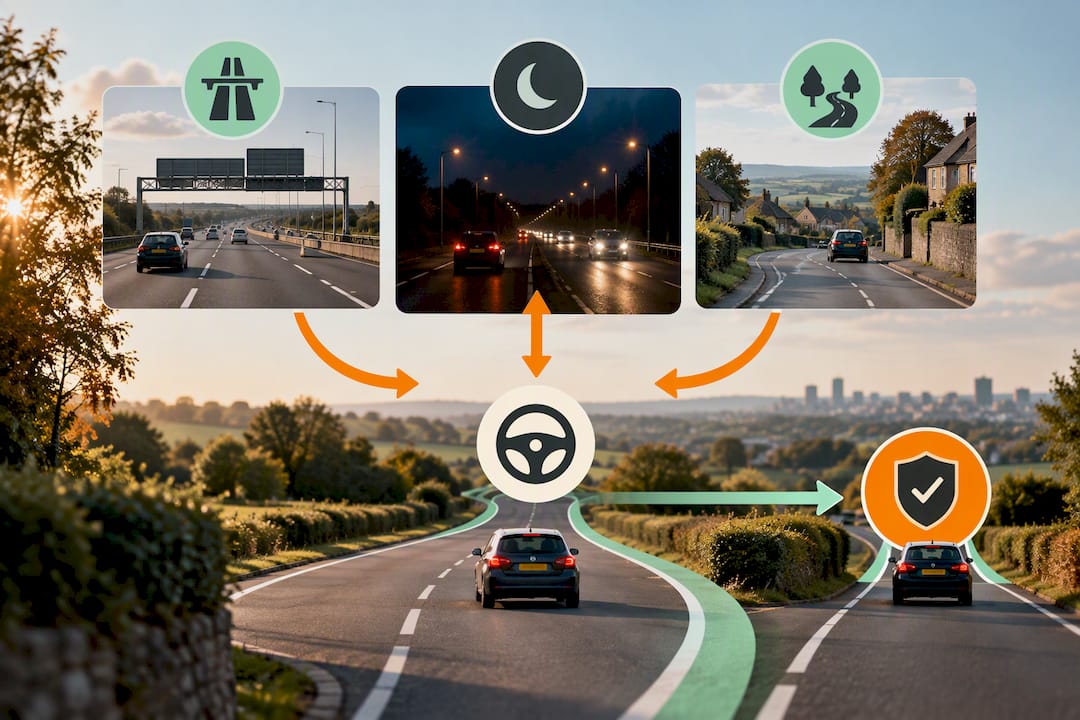
Pass Plus is a voluntary training scheme built around six modules that fill the gaps left by the standard driving test: town driving, all-weather conditions, rural roads, night driving, dual carriageways and motorways. Each module targets a specific weakness that catches out newly qualified drivers, from judging speed on unfamiliar roads to coping with glare and reduced visibility after dark.
The course requires several hours of practical, on-road instruction rather than classroom theory, as confirmed by Gov. An instructor will occasionally cover a point verbally when local conditions make it unsafe to demonstrate on the road, but the emphasis stays on driving time.
- Town driving sharpens hazard awareness in heavy traffic, pedestrian crossings and complex junctions.
- All-weather driving builds confidence handling rain, fog or poor visibility, situations many learners rarely practise before their test.
- Rural roads teach how to read bends, hidden dips and unmarked junctions where speed limits can be deceptive.
- Night driving covers dazzle management, reduced stopping distances and reading the road with less visual information.
- Dual carriageways introduce higher-speed merging, lane discipline and overtaking judgement.
- Motorways cover joining and leaving at speed, lane positioning and sustained high-speed concentration.
There is no formal exam at the end. Instead, a Pass Plus registered instructor assesses you continuously throughout each module and signs you off once you consistently meet the required standard.
How Pass Plus works in practice and how to get the DVSA certificate
Booking Pass Plus is straightforward once you know the steps, though the pace and order of modules will vary depending on your instructor and local roads.
- Find a Pass Plus registered ADI. Not every driving instructor runs the course, so confirm registration before booking.
- Agree the module order with your instructor. Some tailor the sequence to your weakest areas, starting with whichever module you find most daunting.
- Complete the practical training. You’ll spend a minimum of six hours behind the wheel, usually across several sessions rather than one long day.
- Get assessed continuously. There’s no pass or fail exam; your instructor tracks your progress against the required standard in each module, as Gov.
- Sign the training report. Once you’ve met the standard in every module, you and your instructor sign the form together.
- Apply to the DVSA. Send the signed report to the DVSA to request your certificate, which typically arrives within about two weeks, according to Gov.
Keep a copy of the signed report until the certificate arrives. You’ll need the certificate itself, not just the training report, if you want to show it to an insurer later.
Cost, grants and how much you should expect to pay
Pass Plus pricing varies by instructor and region, reflecting local hourly lesson rates rather than a fixed national fee. Expect the total to scale with how many hours your instructor recommends beyond the six-hour minimum, particularly if you need extra time on motorways or night driving.
Some councils have historically subsidised the course for newly qualified drivers. South Lanarkshire Council, for example, has offered a grant scheme in the past, though availability is patchy and depends entirely on your local authority’s current road safety budget. It’s worth a quick search of your council’s road safety pages before booking, since a grant can offset a meaningful chunk of the cost if one happens to be running.
Before paying anything, ask your instructor or school:
- What exactly is included in the price: all six modules, or a subset?
- Is fuel or additional driving time charged separately if a module runs long?
- What happens if you need extra sessions to reach the required standard?
- Is there a refund policy if you’re unhappy with the first lesson?
Pro Tip: Ask for a written breakdown of what’s covered before you book, so a “six hour course” doesn’t quietly become eight hours of billed time.
Does Pass Plus reduce insurance? How to test the numbers for your situation
This is where most of the confusion sits, and it’s worth being blunt about it: GOV.UK is explicit that whether Pass Plus lowers your premium depends entirely on your individual insurer. Some still offer a discount, some don’t recognise the certificate at all, and others only apply it at renewal rather than mid-policy. Treating any saving as a probable bonus, rather than a certainty, keeps your expectations realistic.
A key detail from GOV.UK’s own guidance on insurance discounts is that insurers commonly require the certificate to be recent, often within 12 months of passing your test, before they’ll apply any reduction. This is why timing matters: taking the course six months after passing gives you a real shot at claiming a discount, whereas taking it two years later may be too late for many insurers’ rules.
Work through this method before you book:
- Call your current insurer first. Ask directly whether they offer a Pass Plus discount and, if so, how much and under what conditions.
- Get it in writing. A verbal “yes, we do that” from a call centre isn’t enough. Ask for an email or policy document confirming the discount and its terms.
- Request two quotes. One with your current no-claims record and no certificate, one showing what the premium would be with a Pass Plus certificate added.
- Compare against the course cost. If the annual saving is smaller than the price of the course, you’re relying on multiple years of renewal to break even.
- Check telematics policies separately. If you’re on a pay-how-you-drive policy, the Association of British Insurers notes that telematics data drives pricing more than a certificate, so a Pass Plus discount may not stack with or even apply to your plan.
As a worked example only, say the course costs £270 and your insurer confirms a discount that saves you £60 a year. You’d need roughly four and a half years of renewals at that saving to recover the outlay through insurance alone, which is exactly why the course is better justified by the driving experience it gives you, with any premium reduction treated as a welcome extra rather than the main reason to book.
When Pass Plus is worth it: a practical decision checklist
Skills should drive this decision, not the hope of a discount. Run through this checklist before booking:
- Your typical journeys. If you’ll regularly drive motorways, unlit rural roads or unfamiliar towns, the relevant modules address real gaps.
- Your current confidence. If certain conditions, such as night driving or dual carriageways, still make you anxious, targeted practice under supervision is more useful than muddling through alone.
- Your claims history. A clean record strengthens any case you make to an insurer for a discount, though it won’t guarantee one.
- Your insurer’s stance. Confirmed in writing, a discount changes the arithmetic; without that confirmation, budget for the course as pure skills investment.
- Local funding. A council grant, where one exists, can materially reduce the net cost.
Compare Pass Plus against the alternatives too. A handful of extra post-test lessons focused specifically on your weak spots can deliver similar confidence gains at a lower cost if you only need help with one or two situations. Telematics coaching, where your insurer reviews your driving data and offers feedback, can also improve your habits and your premium over time, though it works differently from a one-off course.
Pro Tip: If your only goal is a cheaper premium, ask your insurer about telematics before assuming Pass Plus is the faster route: the two aren’t always compatible, and one might suit your situation better than the other.
The prioritisation rule is simple: book Pass Plus for the roads and conditions you’ll actually face, and treat any insurance saving as a bonus you confirm afterwards rather than a reason to book in the first place.
Real-world perspective from a DVSA-approved driving school
Connect Driving School’s instructors, all DVSA-approved, see a consistent pattern in who benefits most from Pass Plus: newly qualified drivers who passed their test with little exposure to motorways, rural routes or night driving, and who now find themselves nervous about exactly those situations.
Students who tend to get the most from the course include:
- Nervous drivers who avoid motorways or night driving altogether after passing.
- New drivers about to start a job or routine that involves regular motorway or rural travel.
- Anyone who passed their test with minimal exposure to dual carriageways or adverse weather.
If you’re booking with any school, not just this one, ask these questions upfront: is the instructor Pass Plus registered, how are the six modules scheduled, and what happens if you need extra time in one area to reach the required standard.
Author perspective: honest summary and recommended next steps
The honest verdict is that Pass Plus earns its cost through the driving experience it gives you, and the insurance saving, when it exists, is a genuine but unpredictable extra. I’d never book it purely chasing a discount, because too many insurers either ignore the certificate or apply conditions that erode the saving. Book it because you want structured time on motorways, at night or on rural roads you rarely practised before your test.
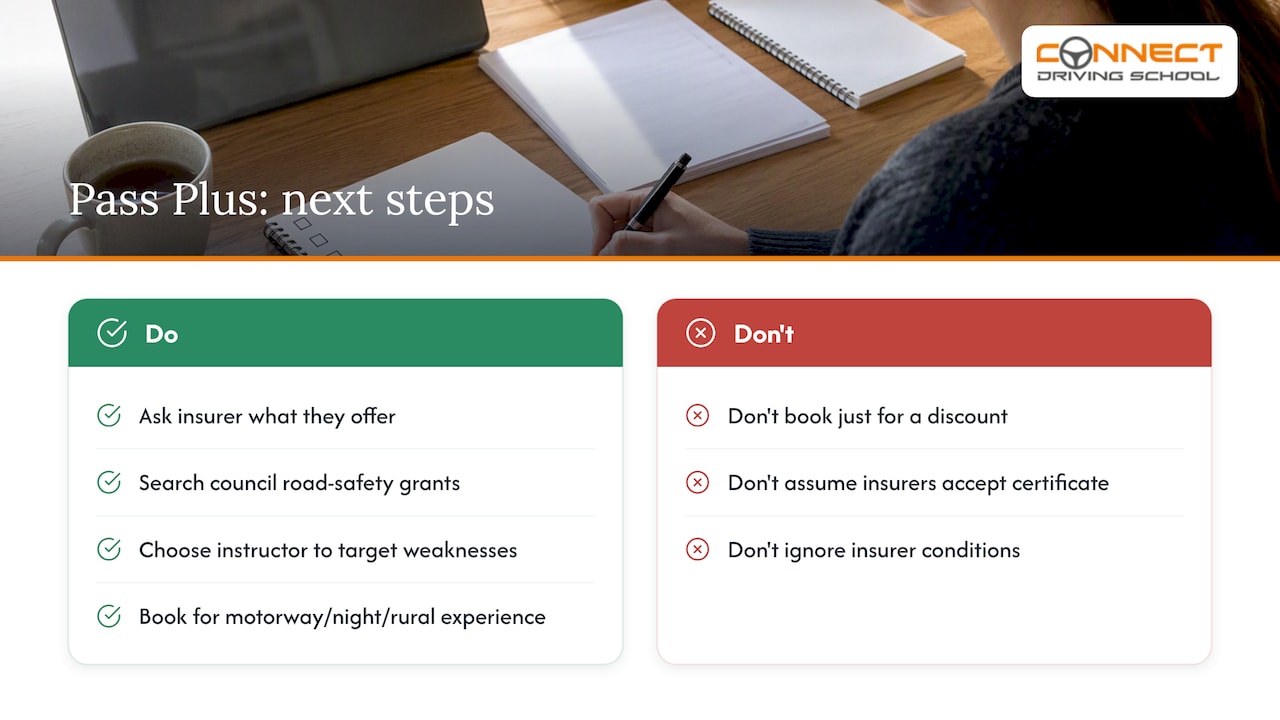
Your next steps are straightforward: call your insurer and ask directly what they offer, search your local council’s road safety pages for a grant, and pick an instructor who will focus the six hours on whatever unnerves you most. If you’re weighing up options in London, Connect Driving School runs Pass Plus alongside its other courses and can tailor the modules to whichever roads or conditions you find hardest.
— Mudassar
How Connect Driving School can help you with Pass Plus
A Pass Plus course typically runs with DVSA-approved instructors who tailor the six modules to a student’s actual gaps, rather than following a fixed script regardless of what is needed. If motorways are the problem, expect more time there. If it’s night driving, that’s where the hours go.
You can check current pricing and what’s included on the Pass Plus and course prices page, which also lists the school’s other services if you want to combine Pass Plus with refresher lessons or motorway-specific tuition. Instruction is available in both manual and automatic cars, so whichever you passed your test in, there’s a route through the course:
- Module scheduling can often be tailored based on a student’s weakest areas.
- Instruction is generally provided by DVSA-approved instructors with local road knowledge.
- Booking is usually flexible to accommodate work or study commitments.
Get in touch to discuss which modules make sense for you and to check current availability.
Sources
For the full rules and application process, these are the primary references used throughout this guide:
FAQ
Does Pass Plus actually reduce insurance?
It depends entirely on your insurer: some offer a discount, others don’t recognise the certificate at all, and GOV.UK advises treating any saving as a possible bonus rather than a guaranteed outcome. Always confirm the discount and its conditions in writing before you book the course expecting a lower premium.
Is Pass Plus worth it for newly qualified drivers?
For most newly qualified drivers, yes, mainly because it delivers structured practice in motorway, night and rural driving that the standard test often skips. The insurance saving is a possible extra rather than the main reason to book, since it varies by insurer.
Can you fail Pass Plus?
There’s no pass or fail exam. Instead, GOV.UK confirms you’re assessed continuously across all six modules, and your instructor signs off the training report once you consistently meet the required standard in each one.
Can I get a full driving licence with Pass Plus?
No, Pass Plus is a post-test training scheme, not a licence category. You need a full driving licence already to take the course, and completing it earns you a certificate from the DVSA rather than any change to your licence itself.
Related Posts
Comments (0)