
Practise five Bromley route fragments with a mock then fix plan. Use Test Routes and a local instructor to stop mirror and junction faults.
5 Step Observation at Junctions: Instructor Drills Fix UK Test Fails
Effective observation at junctions means looking early, processing what you see, and judging gaps accurately before you move, not just turning your head. The one thing to fix today: build a proper MSM/PSL routine and pause at the observation point long enough to actually judge speed and distance, rather than glancing and going. Rushing this single habit causes more test failures than almost anything else.
TL;DR:
- Proper junction observation requires pausing long enough to accurately judge speed and distance, not just glancing and moving on.
- Different junctions demand tailored checks: open, closed, T-junctions, mini-roundabouts, and signals each require specific priorities and routines.
- Using the MSM and PSL routines repeatedly until automatic helps prevent hesitation and improves judgment under pressure.
- Look well in advance, check mirrors, and make deliberate eye contact at the observation point to demonstrate actual processing.
- Weather and lighting conditions, such as rain, glare, or night, necessitate recalibrating what constitutes a safe gap to avoid misjudgment.
Table of Contents
- What effective observation at junctions really means
- Junction types and how your priorities shift
- The step-by-step routine that gets you through safely
- Common test-day mistakes and how to fix them
- Watching for cyclists, motorbikes and pedestrians
- How weather and light change what you can rely on
- Scanning techniques that catch hazards before they become problems
- Adjusting your approach for busy versus quiet junctions
- An instructor’s view on getting this right
- Book junction practice with a DVSA-approved instructor
- Sources
- FAQ
What effective observation at junctions really means
Examiners aren’t marking you on how far you turn your head. They’re marking whether you process what’s out there and act on it sensibly. A learner who swivels dramatically but pulls out into a gap that was never safe fails just as surely as one who barely glances sideways. What matters is the judgement behind the look.
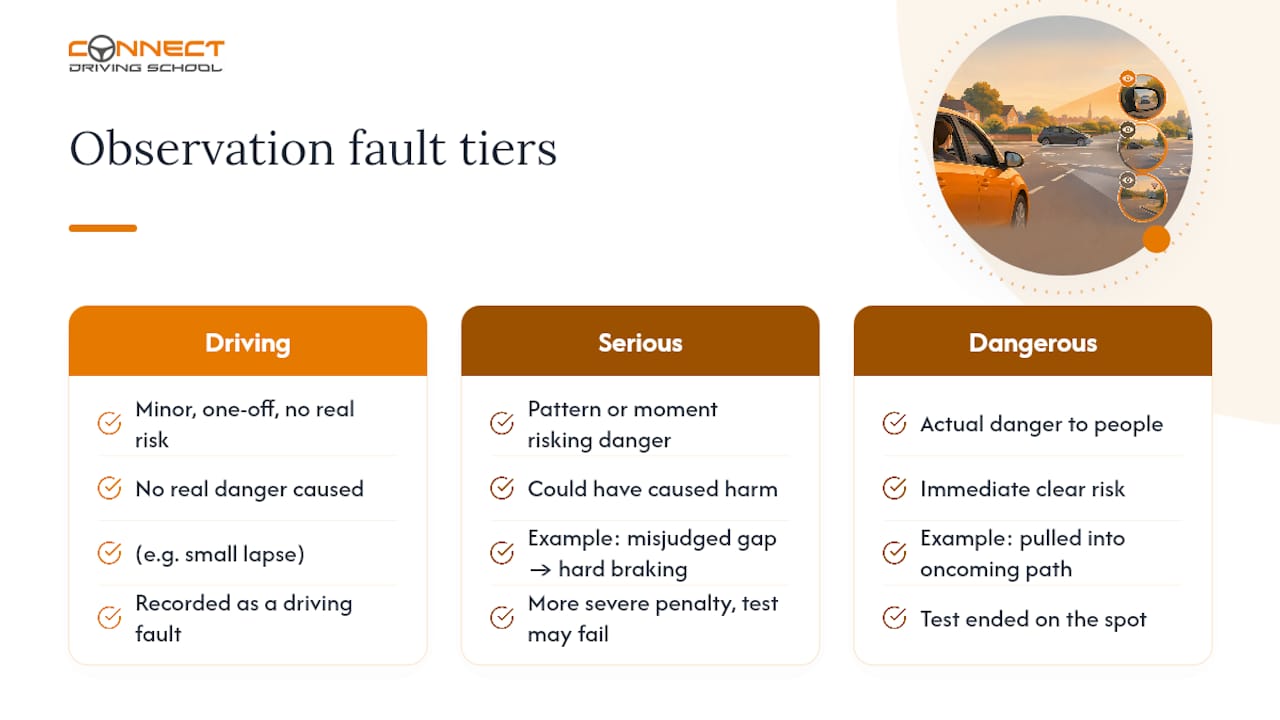
DVSA’s own examiner guidance sorts observation errors into three tiers: a driving fault (minor, one-off, no real risk), a serious fault (a pattern or a moment that could have caused danger), and a dangerous fault (actual danger to you, the examiner, or someone else). Pulling out and having to brake hard because you misjudged a gap is a classic serious fault. Pulling into the path of an oncoming vehicle is dangerous, and that ends the test on the spot.
Not making effective observations at junctions sits consistently among the top 10 reasons candidates fail their test in Great Britain. It isn’t a rare technicality that catches out unlucky candidates. It’s one of the most common ways learners lose their test, usually because they treat the look as a box to tick rather than information to act on.
The stakes go well beyond the test centre. Failing to look properly is a factor in roughly half of all road collisions, according to government road safety guidance, which is exactly why examiners weight it so heavily. Get this right and you’re not just passing a test, you’re avoiding the single biggest cause of crashes on British roads.
Junction types and how your priorities shift
Not every junction asks the same thing of you. Recognising the type in the first second or two of approach tells you what to check and in what order.
- Open junctions give you a clear view down the road you’re joining early, so you can plan your speed well before you arrive.
- Closed junctions hide the view behind walls, parked cars, or hedges, meaning you creep forward carefully and look again once your view improves.
- T-junctions (the most common type on test routes) demand a clear look both ways before turning right at a T junction or emerging left, since traffic can appear from either direction at speed.
- Unmarked junctions have no give way lines, so nobody officially has priority. Slow right down and be ready to stop.
- Mini-roundabouts need a check for traffic already circulating from your right, plus cyclists cutting close to the kerb.
- Signal-controlled junctions still need a visual check even on a green light, because red-light runners and cyclists filtering through are common.
The rule that holds across all of them: never assume priority just because a junction “feels” like yours. Check the actual signs, markings, and traffic before committing.
The step-by-step routine that gets you through safely
Two frameworks do almost all the heavy lifting at junctions: MSM and PSL. MSM stands for Mirror, Signal, Manoeuvre, the broad structure for any change in speed or direction. PSL stands for Position, Speed, Look, which sits inside the manoeuvre stage and tells you exactly how to execute it. Ready to Pass recommends practising both until they run without conscious thought, because junctions demand several tasks at once and hesitation under pressure is where mistakes creep in.
Here’s the sequence to drill into a habit, broken into what happens on approach and what happens as you emerge.
On approach:
- Spot the junction early. Read the signs, road markings, and the shape of the road so you know the type before you’re on top of it.
- Check your mirrors, then signal in good time if you’re turning.
- Move into the correct position for your direction of travel, well before the give way line.
- Control your speed so you arrive at the observation point already slow enough to stop if needed, not still braking.
- Pull up at the point where you have the best view without blocking anyone else’s path.
Emerging safely:
- Take a final mirror check, because something may have appeared behind you since you positioned.
- Look both ways, and for a right turn out of a T junction, look right, left, then right again before moving.
- Judge the gap honestly. Would you comfortably cross a similar gap on foot? If not, wait.
- Move off smoothly and decisively once you’ve judged it’s safe, no hesitation, no snatched clutch control.
Examiners can’t read your mind, so showing your working matters. A confident, unhurried head movement followed by a smooth pull away tells the examiner you’ve actually processed what you saw. Snapping your head side to side and then hesitating for three seconds tells them the opposite; it looks like panic, not judgement.
Pro Tip: Count a silent “one, two” at the observation point before you decide. That tiny pause is often the difference between spotting an approaching motorbike and missing it entirely.
Common test-day mistakes and how to fix them
Most junction faults trace back to a handful of repeat offenders, and every one of them is fixable with deliberate practice rather than luck.
- Looking too late, often because the learner is still finishing the approach checks when they should already be scanning. Fix: separate positioning and speed control from the actual look, so the look happens with nothing else competing for attention.
- Forgetting the final mirror check before emerging, especially after a long wait at a busy junction. Fix: build the mirror glance into the routine every single time, even if you checked thirty seconds ago.
- Misjudging speed and distance, usually by underestimating how fast an approaching vehicle is closing. Fix: practise at quieter junctions first, narrating out loud what you see and how fast it’s moving.
- Cutting corners on left or right turns, drifting into the wrong lane on the new road. Fix: pick a reference point on the new road before you turn, and steer towards it rather than reacting mid turn.
A single instance of any of these is usually marked as a driving fault. Repeat the same one several times in a test, though, and examiner guidance allows it to escalate towards a serious fault, because a pattern shows the skill genuinely isn’t secure yet.
Watching for cyclists, motorbikes and pedestrians
Vulnerable road users get missed at junctions more often than cars, mainly because they’re smaller, quieter, and easier to filter out when your brain is under load. Motorbikes in particular seem to appear from nowhere because their narrow profile makes speed harder to judge.
The Highway Code is explicit that drivers must watch specifically for cyclists and pedestrians at junctions, not just other cars.
- Do a proper shoulder check, not just a mirror glance, immediately before emerging or turning, since mirrors have blind spots that hide cyclists alongside you.
- Check twice at busy junctions: once early, once again immediately before you move, because a cyclist’s position changes fast.
- If you’re not certain the gap is clear of a vulnerable road user, wait. There’s no version of the test where hesitation for safety costs you more than a collision would.
How weather and light change what you can rely on
Rain, low sun, and darkness don’t just make the road harder to see. They change how much you can trust your first glance, so your routine needs to adapt rather than stay identical.
In heavy rain, spray from other vehicles and fogged windows shorten your effective sightline. Give yourself an extra beat at the observation point rather than relying on a single quick look, and be aware that other road users may also be reacting more slowly than usual.
Low winter sun sitting directly behind an approaching vehicle can hide it almost completely, particularly at junctions facing east or west during morning and evening rush hours. If you’re dazzled, don’t guess. Shift your head position slightly to break the glare, or wait an extra second for your eyes to adjust before committing to emerge.
At night, headlights make judging distance harder because you’re reading light intensity rather than the vehicle’s actual shape. A distant motorbike headlight can look identical to a car much further away. Treat any approaching light at a junction at night as closer and faster than it appears until you’ve had a second or two to confirm otherwise.
Wet or icy road surfaces also change your stopping distance if you misjudge a gap, so the margin you’d accept on a dry summer afternoon needs to widen considerably. None of this means driving nervously. It means recalibrating what “safe gap” looks like for the conditions you’re actually in, not the conditions you learned in.
Scanning techniques that catch hazards before they become problems
The learners who look competent at junctions aren’t scanning harder, they’re scanning smarter, in a pattern that covers hazards other drivers miss.
Start scanning further back than feels natural. By the time you’re at the give way line, you should already have a rough picture of what’s approaching from both directions, built up over the previous few seconds of approach rather than assembled in a single glance.
Use a systematic sweep rather than fixing on one spot. Look far distance first to catch fast-approaching traffic, then mid distance for anything closer, then near distance for cyclists or pedestrians right beside the junction. Staring at one point, even the “obvious” direction of danger, is exactly how learners miss a cyclist approaching from the other side.
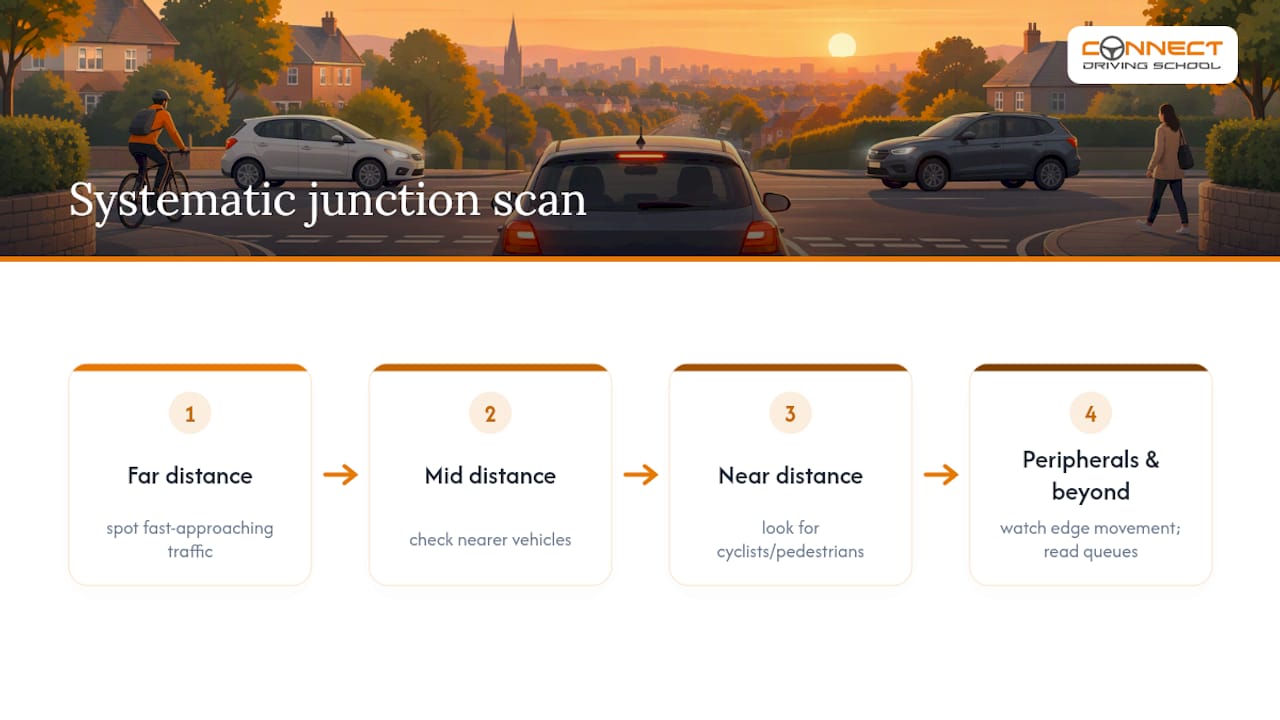
Check for movement in your peripheral vision as you scan, not just what’s directly ahead. A pedestrian stepping off a kerb or a cyclist emerging from a side road often registers at the edge of your vision before you consciously look their way. Trust that flicker and turn to confirm it.
Also read the road beyond the junction itself. A queue of stationary traffic on the road you’re joining might hide a gap that closes the moment you commit, or a bus about to signal and pull out. Reading intentions, not just positions, keeps you ahead of what’s about to happen rather than reacting to what already has.
Adjusting your approach for busy versus quiet junctions
A quiet residential T-junction and a busy arterial road junction demand genuinely different handling, and treating them identically is a common learner mistake.
At low-traffic junctions, the risk isn’t usually a missed vehicle, it’s complacency. Learners get used to an easy gap and stop checking properly, then get caught out the one time a car does appear. Keep the same full routine every single time, even when the road looks empty, because the habit needs to be automatic for the junctions where it actually matters.
At high-traffic junctions, the challenge shifts to patience and gap judgement under pressure. Traffic may never fully stop, so you’re waiting for a gap rather than an empty road. Resist the urge to force a marginal gap just because you’ve been waiting a while. A slightly longer wait costs you nothing; a wrong judgement call costs considerably more. Busy junctions near town centres or roundabout approaches also often carry more cyclists and motorbikes filtering through slow-moving traffic, so your vulnerable road user checks need to work harder, not less, when things are congested.
An instructor’s view on getting this right
Most learners don’t lack the ability to observe properly, they lack the habit of pausing long enough to use it. The fix is rarely more head movement, it’s more patience at the observation point. If junctions still feel like a blur of decisions rather than a routine, targeted practice on the exact roads you’ll be tested on makes the difference faster than general lessons alone.
— Mudassar
Book junction practice with a DVSA-approved instructor
Reading about MSM and PSL only gets you so far. The gap between knowing the routine and running it smoothly under pressure closes fastest with repetition on real roads, alongside someone who can flag the exact moment your judgement slips. Repetition is built into every lesson by instructors who focus specifically on the patience and gap-judgement skills examiners are actually marking, rather than generic “turn your head more” advice.

If you’re just starting out, a first driving lesson is the natural place to build the MSM/PSL routine from scratch. If test day is close and junctions are your weak point, a block of refresher lessons can target that one skill directly, and an intensive driving course compresses weeks of junction practice into a tighter timeframe if you’re working to a deadline. Learners who prefer fewer gear changes to think about can also start in an automatic car, freeing up attention for observation, while those set on a manual licence can book manual lessons with the same instructor throughout. Full pricing sits on the prices page, and lessons run across SW London, Kingston, Sutton, and surrounding service areas. The next step is simple: pick a lesson type and book it.
Sources
Test-centre waiting times and local pass-rate context are also worth checking before booking your test date, via resources like Early Car Test’s driving test centre guide.
FAQ
Is junction observation a serious fault?
It depends on what happens. A single minor lapse is usually recorded as a driving fault, but a pattern of repeated observation errors, or one incident that puts someone at risk, can escalate to a serious or dangerous fault under DVSA marking criteria.
What are the rules of observation when driving?
The core rule is to look effectively before you move, using MSM and PSL routines to check mirrors, signal, position correctly, control your speed, and judge the gap before emerging. Ready to Pass frames this as a sequence that needs to run automatically at every junction, not just the obviously tricky ones.
Does the examiner know if you’ve failed before?
No. Examiners assess the drive in front of them on the day and don’t factor in previous test results, so a past fail carries no weight into your next attempt.
What are the rules of observation?
Observation means checking mirrors, looking both ways at junctions, and using blind-spot shoulder checks for cyclists and motorbikes the Highway Code specifically warns about. Getting this consistently right matters well beyond the test, since failing to look properly is linked to roughly half of all road collisions in Great Britain.
Related Posts
Comments (0)