
Instructor‑backed, action‑first plan to pass the UK theory test: run 57‑minute timed mocks, drill hazard‑perception timing, and follow a 2–6‑week study...
Beat Bromley’s 52.90% Pass Rate: 5 Bromley Test Route Fragments
For Bromley, prioritise junction observation, mirror discipline and the local mix of A-roads and residential streets. DVSA’s own top reasons for failing put junction observation and mirror use at the top of the list, and Bromley’s 52.90% pass rate reflects a centre that rewards drivers who’ve rehearsed its specific road mix, something instructors like those at Connect Driving School build lesson plans around.
TL;DR:
- Drivers must master junction observation and mirror discipline, especially on busy roads like Sundridge Avenue and Bromley Hill, to avoid common faults.
- Practice should focus on short fragments covering key road types, including A21 merge points, roundabouts, residential streets, and town centre approaches, from multiple directions.
- Mock tests under exam-like conditions, including full route rehearsals, help identify specific weaknesses and prepare for both sat nav and sign-based independent driving.
- Instructors familiar with Bromley routes and DVSA standards are crucial for targeted fault correction, with recommendations to ask about route experience and mock test procedures.
Table of Contents
- Which roads and junctions come up on Bromley test routes?
- What happens on the day at Bromley Driving Test Centre?
- How should you structure your practice in the weeks before?
- How do you choose between local test-prep options?
- How Connect Driving School prepares learners for Bromley
- An instructor’s honest take on Bromley test day
- Ready to book Bromley-focused lessons?
- Sources
- FAQ
Which roads and junctions come up on Bromley test routes?
Bromley examiners draw from a fairly consistent pool of road types, and knowing what each one demands changes how you practise.
A21 and Bromley Hill carry faster traffic and test lane discipline more than manoeuvring skill. You need to commit to a lane early, hold your position through gentle bends, and resist the urge to hover between lanes when a lorry looms in your mirror. Speed changes quickly here, so gear selection and early braking matter more than on the town centre roads.
Burnt Ash Lane and the approaches into Bromley town centre are a different animal entirely. Pedestrian crossings, parked delivery vans, and buses pulling in and out mean your observation has to run constantly, not just at junctions. This is where examiners catch the “looked but didn’t see” fault, glancing at a mirror without actually processing what’s in it.
Sundridge Avenue and Elmstead Lane feature multi-arm roundabouts where lane choice and signalling timing get tested properly. Get into the wrong lane on a five-exit roundabout and you’re either cutting across traffic or missing your exit, both of which rattle confidence for the rest of the drive.
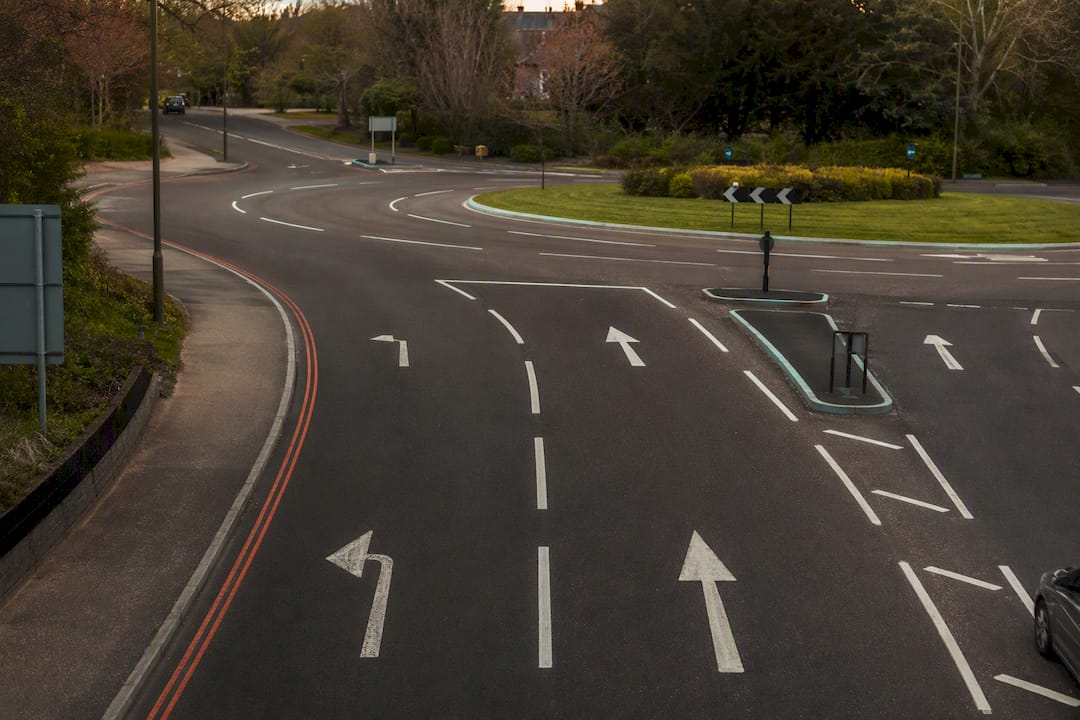
Residential streets with parked cars on both sides force constant positioning decisions, judging gaps, meeting oncoming traffic, and deciding who gives way first.
Rather than memorising a “Bromley test route” wholesale, which examiners vary anyway, work through short fragments that combine these road types:
- Burnt Ash Lane into Bromley High Street, focusing on pedestrian awareness and bus stops
- Sundridge Avenue roundabout, practised from at least three different approach directions
- Bromley Hill onto the A21, working on merge timing and lane discipline
- A residential loop near Widmore Road, purely for meeting traffic and positioning
- Elmstead Lane approaching its junction cluster, for multi-arm decision making
Independent driving on the day will either follow a sat nav (set by the examiner) or a series of traffic signs, and the two feel different in the car. Sat nav following means less thinking about direction and more about reacting to what the road throws at you; sign following demands you spot instructions early enough to position correctly. Practise both, because you won’t know which you’ll get until the examiner tells you.
Pro Tip: Drive the same fragment in both directions. A roundabout that felt easy approaching from the north can feel completely different from the south, and Bromley has several like that.
What happens on the day at Bromley Driving Test Centre?
The Bromley Driving Test Centre sits on a well-used route mix that draws on all four road types above, so what you rehearse genuinely maps onto what you’ll face. Arrive around 10 minutes early. GOV.UK’s centre finder lets you check parking notes and any special local instructions before test day, which is worth doing the night before rather than discovering a road closure on arrival.
The test itself hasn’t changed in structure: an eyesight check, a “show me, tell me” vehicle safety question, roughly 40 minutes of driving, one manoeuvre, and around 20 minutes of independent driving.
Facilities are basic but adequate, toilets and standard access are available inside the centre. The centre’s pass rate sat at 52.90% for 2025/26, based on 13,228 tests, which puts it close to the national average rather than being an unusually hard or easy centre. To pass, GOV.UK’s marking guidance confirms you need zero serious or dangerous faults and no more than 15 driving faults.
How should you structure your practice in the weeks before?
Diagnostic testing beats blind repetition. Mock tests run under real pressure, two to four weeks before your test date, surface your actual weak points far more reliably than another casual lesson around roads you already know well.
- Baseline mock test — drive a Bromley-style route under test conditions and log every fault, not just the serious ones.
- Targeted lessons on the top three faults — if mirrors and junction timing dominate your list, spend three or four sessions almost exclusively on those, not a general tour of the area.
- Second mock, full test conditions — no talking, no hints, examiner-style silence except for instructions.
- Light review the day before — a short, low-pressure drive that touches your weakest fragment once, not a marathon session that tires you out before test day.
The Test Routes app fits well into step two and three. It offers turn-by-turn navigation on recorded UK test routes with a mock-test mode, which is genuinely useful for solo rehearsal between lessons. Its limit is obvious: an app can’t watch your mirror checks or correct your observation habits mid-drive, so it works best paired with in-car instruction rather than replacing it.
A solid 60 to 90 minute session in the weeks before test day should cover junction observations early (while you’re fresh), one manoeuvre in the middle, independent driving for 15 to 20 minutes, and mirror discipline threaded through the whole thing rather than treated as a separate topic.
Pro Tip: Practise the A21 and Bromley Hill earlier in your session and residential streets later, when concentration naturally dips, because slower roads punish lapses less severely.
How do you choose between local test-prep options?
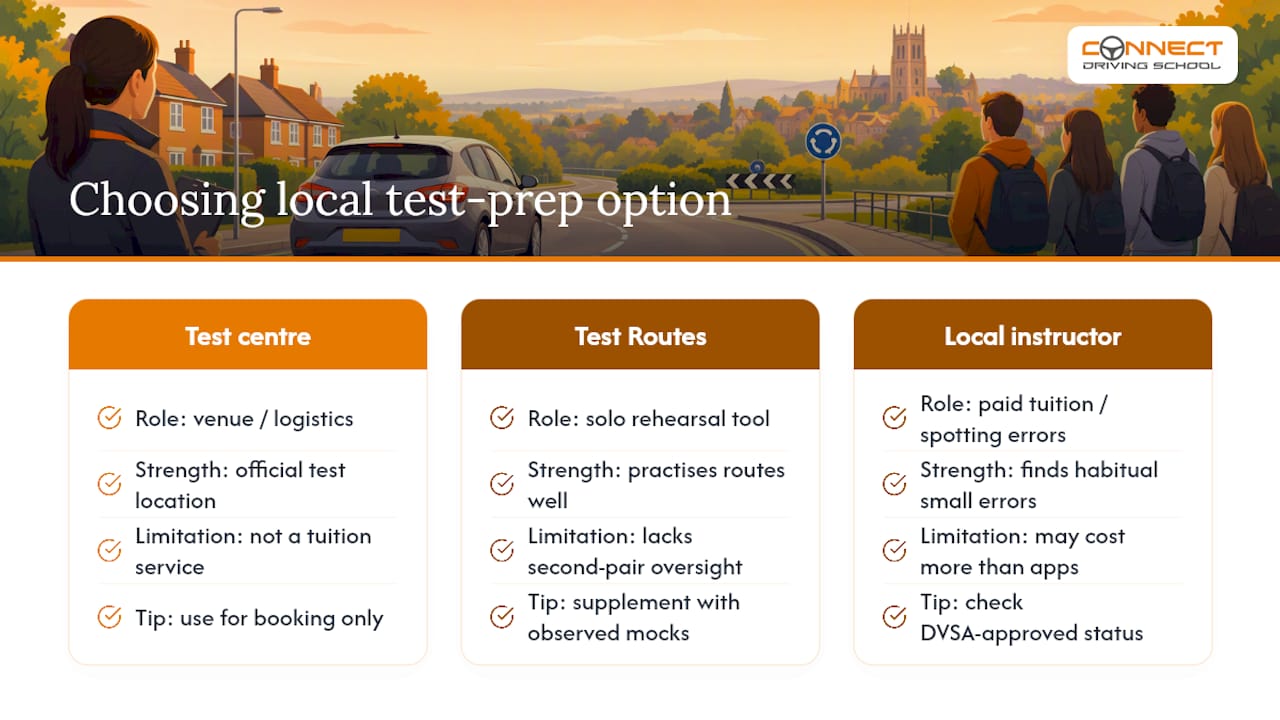
Three practical routes exist for Bromley preparation, and each does a different job.
The test centre itself isn’t a preparation service, it’s the venue, so its listing here is about logistics rather than tuition. Test Routes covers solo rehearsal well but can’t replace a second pair of eyes watching your observations. That’s where a local instructor earns their fee, spotting the small habitual errors that an app simply cannot see.
Before booking lessons or mock sessions anywhere, ask a few direct questions: how many hours of experience does the instructor have specifically on Bromley routes, will they run a proper mock test under test conditions, and are they DVSA-approved rather than just DVSA-registered (the two aren’t identical). Be sceptical of any pass-rate claim that isn’t backed by a real number.
Watch for a few red flags too: no DVSA-approved instructors on staff, vague or shifting refund and cancellation terms, and any instructor who resists doing mock tests or genuine route practice in favour of endless “just drive around” sessions.
How Connect Driving School prepares learners for Bromley
Connect Driving School runs First Driving Lessons, Intensive Courses, Pass Plus and Motorway Driving sessions with DVSA-approved instructors, and states pass rates above 92% across its learner base.
A sensible Bromley-focused sequence looks like this:
- Initial assessment to establish your current standard
- Mock test on a Bromley-style route to flag real weaknesses
- Four to six targeted lessons addressing those specific faults
- Final mock under full test conditions before booking the real thing
An instructor’s honest take on Bromley test day
The same errors repeat: rushed mirror checks near Sundridge Avenue and hesitation on multi-arm junctions. Morning-of checklist: paperwork and provisional licence sorted, sat nav and mirrors adjusted before moving, and two minutes of slow breathing while running through your junction priorities.
— Mudassar
Ready to book Bromley-focused lessons?
Connect Driving School is the local alternative to generic lesson packages for Bromley preparation, DVSA-approved instructors who already know Sundridge Avenue’s roundabouts and the A21 merge points, running mock-then-fix sessions rather than open-ended driving around.
Lessons start from £37.50 an hour, with Intensive Courses from £1,200 and Pass Plus from £270 for drivers who want extra motorway confidence after passing. Whether you need manual or automatic tuition, instructors build a plan around your actual weak points rather than a generic syllabus. Check current prices and packages and book a mock test on Bromley’s roads before your test date fills up.
Sources
- Top 10 reasons for failing the driving test in Great Britain
- Driving test marking, faults and results — Ready to Pass
- Test Routes
FAQ
How many test routes are there in Bromley?
DVSA doesn’t publish a fixed number of set routes for any centre, including Bromley, and varies them deliberately to stop rote memorisation. What stays consistent is the road mix, expect the A21, Burnt Ash Lane, Sundridge Avenue and residential streets to feature regardless of the exact path chosen.
Is Bromley easy to pass a driving test?
Bromley recorded a 52.90% pass rate in 2025/26, close to the national average rather than markedly easier or harder. Your result depends far more on preparation against DVSA’s common failure points than on the centre itself.
Where can I take a driving test in Bromley, London?
Tests are conducted at Bromley Driving Test Centre, and you can confirm the exact address and any local arrival instructions through GOV.UK’s test centre finder. Booking is done through the standard DVSA booking system using your provisional licence details.
Which driving test route in London is the easiest?
No London test route is officially rated “easiest”, since examiners vary paths and road combinations by design. Your best strategy is practising the specific junction types and road speeds used near your own test centre, which for Bromley means A-road merges, multi-arm roundabouts and pedestrian-heavy town centre roads, rather than searching for a shortcut route.
Related Posts
Comments (0)