
Clear UK explainer of 2026 Highway Code changes: the three statutory instruments, the vehicle safety decision, and what UK drivers and London learners...
Avoid Test Refusal: 7 Step DVSA Driving Test Car Requirements
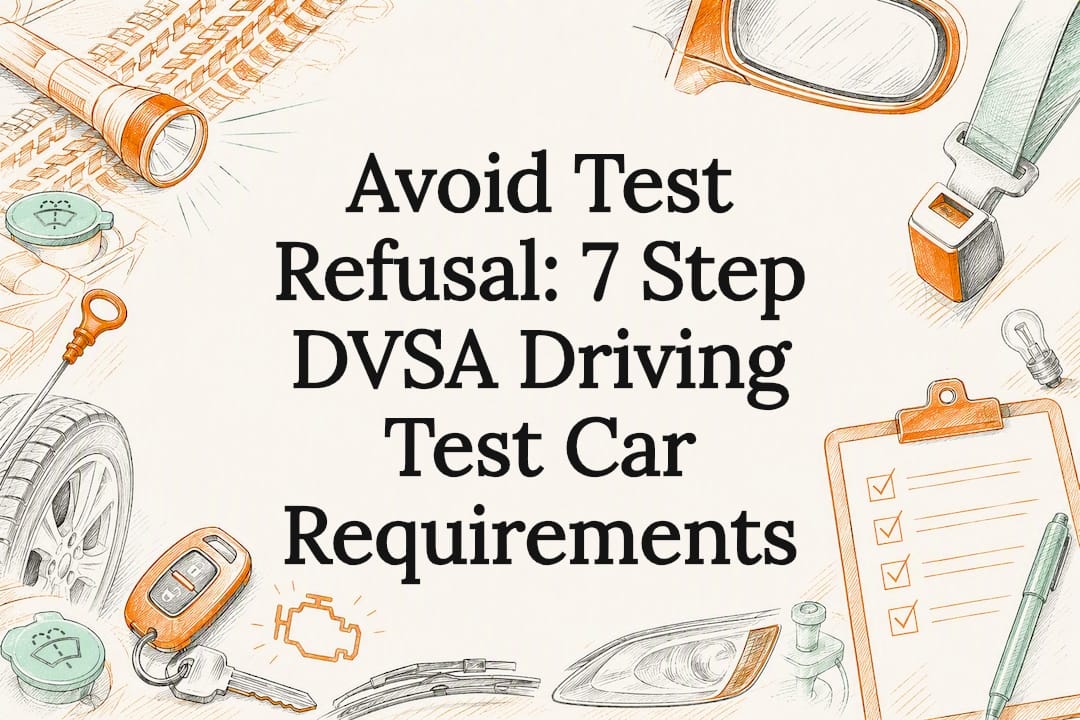
Yes, you can use your own car for your driving test, provided it meets DVSA rules: taxed, MOT’d if over three years old, insured specifically for the test, roadworthy, free of dashboard warning lights, fitted with legal tyres and an extra interior mirror for the examiner, and displaying L-plates front and rear. Miss any of these and the examiner can refuse to run the test, and you’ll lose your fee.
TL;DR:
- Your car must have valid road tax, an MOT if over three years old, and confirmed insurance that explicitly covers test use to avoid test refusal.
- The vehicle should have four wheels, a speedometer, and meet MAM limits under 3,500 kg, with a working rearview interior mirror for the examiner.
- Conduct a comprehensive walkaround check 24 to 48 hours before the test, including tyres, lights, glass, warning lights, and safety features, to prevent last-minute failures.
- Electronic driver aids like hill-start assist and parking sensors are permitted, but self-parking and semi-autonomous systems must be disabled for the test.
- Certain vehicle types, such as panel vans without rear seats, left-hand drive cars, and convertibles with restricted rear visibility, are often refused; proof of manufacturer recalls must also be up to date.
Table of Contents
- Driving test car requirements: tax, MOT, insurance and vehicle class
- The walkaround check every learner should copy from instructors
- Which vehicle features are allowed, and which must be switched off?
- Which cars get refused, and how do recall checks work?
- What to bring and how to present your car on the day
- What happens if your car fails to meet the rules on test day
- Connect Driving School’s instructor checklist for avoiding refusals
- Why the rules exist, and why they’re worth respecting
- Book a pre-test check with Connect Driving School
- Sources
- FAQ
Driving test car requirements: tax, MOT, insurance and vehicle class
Before you even think about mirrors and tyre tread, three paperwork checks decide whether your car is allowed on the test at all. Get any of these wrong and the examiner won’t even look at the bodywork.
Tax and MOT. Your car needs valid road tax on the day, no exceptions. If the car is over three years old, it also needs a current MOT certificate. The examiner can check this electronically, but it’s worth having the paperwork or a screenshot ready if there’s any doubt about the record.
Insurance that actually covers the test. This trips up more learners than any other rule. Standard learner insurance doesn’t automatically cover a driving test, and some policies exclude it outright. Call your insurer directly and ask them to confirm, in writing if possible, that your policy covers you for a DVSA practical test with an examiner in the car. Look out for wording around “named driver,” “provisional licence holder,” and “test use,” since insurers phrase this differently and assumptions here are expensive.
Vehicle construction rules. The car must have four wheels and a maximum authorised mass (MAM) of no more than 3,500 kg, according to Gov. It also needs a speedometer showing miles per hour and must be capable of reaching the speeds the test requires, including a stretch at around 50mph where the road allows.
One booking detail catches people out: since the 2026 update to the Motor Vehicles (Driving Licences) regulations, Category B practical test applications must be made by the candidate in person. Your instructor can advise and prepare you, but they can no longer book or amend the test on your behalf.
Quick reference before you head out:
- Valid road tax on the test date
- MOT certificate if the car is over three years old
- Insurance confirmed in writing to cover driving test use
- Four wheels, MAM under 3,500 kg
- Working mph speedometer
The walkaround check every learner should copy from instructors
Instructors run a near-identical routine before every test, and there’s no reason you can’t do the same the evening before. It takes about half an hour and catches almost every common refusal cause.
- Walk the tyres. Check tread depth and pressure on all four, and confirm there’s no space-saver spare fitted as a road wheel. A worn or damaged tyre is one of the fastest ways to lose your test fee.
- Check every light. Headlights, brake lights, indicators, fog lights. Ask someone to stand behind the car while you operate each one.
- Look at the glass. Windscreen free of chips in the driver’s line of sight, wipers working, washer fluid topped up.
- Sit inside and check the dash. No warning lights should be showing, particularly the airbag or engine management light. If one’s on, don’t risk it. Get it looked at before test day.
- Fit and check both mirrors. You need your standard mirrors plus an additional interior rear-view mirror so the examiner can watch your observations.
- Check seatbelts and head restraints. Make sure the examiner’s seatbelt and head restraint are properly fitted and adjusted, not just resting in place.
- Test the brakes, steering and acceleration. A short drive beforehand confirms the car pulls away cleanly and can safely reach motorway-adjacent speeds without hesitation or new warning lights appearing.
Pro Tip: Do this walkaround 24 to 48 hours before your test, not the morning of. That gives you time to book a garage slot or swap a tyre if something’s wrong, rather than discovering a problem in the test centre car park with ten minutes to spare.
Which vehicle features are allowed, and which must be switched off?
Modern cars come loaded with driver aids, and the rules on these are more relaxed than most learners expect, with one important exception.
Features that are fine to keep running during your test include:
- Hill-start assist
- Electronic parking brakes
- Parking sensors
- Lane-keeping assist
- Automatic emergency braking
The catch is that you still have to complete manoeuvres like reverse parking or parallel parking manually. Examiner guidance confirms that electronic aids are acceptable provided the candidate demonstrates the manoeuvre themselves, rather than letting the car do the work.
Self-parking systems and semi-autonomous features, such as Tesla Autopilot or similar hands-off driving assistants, must be disabled for the entire test. Dashcams are permitted, but only if they face outward and don’t record interior audio or footage of you or the examiner. Remove or cover any personal sat-nav that gives turn-by-turn prompts, since the examiner sets the route, not your device.
Which cars get refused, and how do recall checks work?
DVSA examiners commonly turn away certain vehicle types because they restrict the examiner’s view of your driving, which is the core standard behind the DT1 examiner guidance. Typical problem categories include:
- Panel vans with no rear seats or side windows
- Many convertibles, particularly with the roof up restricting rear visibility
- Left-hand drive cars
- Very small city cars with limited rear observation
These categories aren’t exhaustive, and GOV.UK maintains updated guidance on unsuitable vehicles, so always check with your local test centre if you’re unsure about a specific model before booking.
Recalls are a separate and increasingly strict check. If your car has been subject to a manufacturer safety recall, particularly for airbag faults, you’ll need proof that the remedial work was carried out before the examiner will accept the car. Acceptable proof includes a stamped dealer letter, official recall paperwork, or a screenshot from an official VIN checker confirming the recall status is clear. Verify your VIN against the manufacturer’s recall database a week or so ahead, not the night before.
What to bring and how to present your car on the day
Presentation matters almost as much as paperwork. An examiner walking up to a cluttered car with mismatched mirrors is already forming an impression before you’ve said a word.
- Bring your provisional licence, your theory test pass certificate if you haven’t already linked it, and proof of MOT or tax if there’s any doubt about the digital record, as outlined in the official checklist of what to bring to your driving test.
- Fit L-plates clearly on the front and rear of the car, not just one or the other.
- Clear loose items from the footwells and dashboard. Nothing should roll under the pedals or obstruct the examiner’s view.
- Keep the car smoke-free, both on the day and generally, since the smell alone can be grounds for concern.
- If you’re borrowing an instructor’s car or a hire car, confirm dual controls are correctly fitted and get written confirmation the insurance covers the test.
What happens if your car fails to meet the rules on test day
If the examiner judges your car unsuitable, the test is cancelled on the spot and you don’t get your fee back. That’s the blunt reality, and it’s why the checks above exist.
If this happens to you:
- Ask the examiner directly for the specific reason, and note any code or wording they give you.
- Contact DVSA customer services promptly if you believe the refusal was unfair or based on a misunderstanding.
- Rebook only once the issue is genuinely fixed, not just patched over.
The best mitigation remains the same one instructors have always pushed: pre-test vehicle checks, proof of compliance ready in hand, and a same-week check with a qualified instructor if you’re at all unsure about the car’s condition.
Connect Driving School’s instructor checklist for avoiding refusals
DVSA-approved instructors often run pre-test lessons around a tight checklist: a full walkaround 24 to 48 hours before test day, followed by an in-car check of warning lights, both mirrors, seatbelt and head restraint fit, and L-plates. Common oversights caught include unclear insurance wording, missing recall paperwork, a slip-on head restraint that’s not properly seated, and a space-saver spare masquerading as a full tyre.
Pro Tip: Book a short pre-test check lesson rather than relying on a quick glance in the driveway. It’s the fastest way to catch a fault before an examiner does.
Why the rules exist, and why they’re worth respecting
Examiners insist on clear sightlines and verifiable safety standards because a test they can’t properly observe isn’t a fair test for anyone, candidate or examiner. Turning up with a car you’ve genuinely checked over removes one entire source of test-day nerves. Chase your insurance confirmation and recall status early. Leave it to the morning and you’re gambling with your fee.
— Mudassar
Book a pre-test check with Connect Driving School
Connect Driving School is the practical alternative to guessing whether your car will pass muster on test day. Rather than relying on a rushed driveway glance, our DVSA-approved instructors run the same walkaround and in-car checks examiners use, so you find out about a problem days before your test, not in the test centre car park.
Whether you’re driving a manual or an automatic, instructors often know roads around areas including SW4, SW11, SW12, SW15 through to SW20, the KT1 to KT6 postcodes, SM1 to SM5, and CR4, along with Yorkshire and Hull. First lessons start from £37.50 per hour, and for those closer to test date, Intensive Driving Course packages typically combine test preparation and vehicle readiness into one block. Learners nearer London can also check current slot availability at test centres like the Isleworth driving test centre while planning around this checklist.
Book a pre-test check lesson through our prices page this week, and go into your test knowing your car has already passed the examiner’s real standard.
Sources
- Driving test: cars: Using your own car for your test
- Motor Vehicles (Driving Licences) (Amendment) Regulations 2026 — Explanatory Note
FAQ
What do I need in my car for a UK driving test?
You need valid tax, an MOT if the car is over three years old, insurance confirmed for test use, no dashboard warning lights, legal tyre tread, an extra interior mirror for the examiner, and L-plates front and rear, according to GOV.UK. Bring your provisional licence and theory pass certificate too.
What are the new driving test rules for 2026?
The main change is that Category B practical test applications must now be made by the candidate in person, under the 2026 amendment to the driving licence regulations. Instructors can no longer book or amend tests on a learner’s behalf.
Can I drive my partner’s car if I’m fully comprehensive?
Fully comprehensive insurance on someone else’s car doesn’t automatically cover a DVSA driving test. You need explicit written confirmation from the insurer that the policy covers test use with an examiner present, regardless of your usual comprehensive cover.
Which cars are banned from being used for the UK driving test?
Examiners commonly refuse panel vans without rear seats, many convertibles with restricted rear visibility, left-hand drive cars, and very small city cars with poor rear observation, per GOV.UK guidance. Always confirm with your test centre if you’re unsure about a specific model.
How much does a UK driving test cost, and do I lose the fee if my car is refused?
The practical test costs £62 on weekdays or £75 on evenings, weekends and bank holidays, as listed on GOV.UK. If your car is deemed unsuitable on the day, the test is cancelled and the fee is not refunded.
Related Posts
Comments (0)