
Clear UK explainer of 2026 Highway Code changes: the three statutory instruments, the vehicle safety decision, and what UK drivers and London learners...
Test Ready Manual Hill Start: DVSA Steps and Instructor Drills
The safe, test-ready way to do a manual hill start is: handbrake on, first gear selected, find and hold the clutch biting point, add gentle throttle, then release the handbrake smoothly as the car begins to move. This exact sequence stops rollback and stalling on a slope. It is a skill DVSA examiners look for wherever possible on the practical test, and Hill Start Assist can help but never replaces it.
TL;DR:
- Mastery of the clutch biting point and smooth handbrake release are crucial to prevent rollback or stalling during a hill start.
- Practicing on varied gradients helps build muscle memory and confidence, especially on steeper slopes and with different traffic conditions.
- Hill Start Assist can aid beginners, but relying solely on it is risky because systems vary and do not replace manual technique.
- Examiners expect smooth observation, controlled throttle use, and no unnecessary revving during a hill start test, whether as an exercise or part of independent driving.
- Consistent practice with an instructor enhances skill retention and reduces surprises on actual test day or in real driving situations.
Table of Contents
- The step-by-step method for a manual hill start
- Why hill starts go wrong: stalling, rollback and revving too high
- Hill Start Assist: useful help, not a substitute for skill
- What DVSA examiners expect during a hill start
- Practice drills to build hill-start confidence
- How Connect Driving School builds hill-start skills into lessons
- Why hill-start skill matters beyond the test
- Manual driving lessons and hill-start practice with Connect Driving School
- Sources
- FAQ
The step-by-step method for a manual hill start
Before you touch the controls, check your mirrors and decide whether a signal is needed, following essential driving in UK tips for safe positioning and awareness. On a hill, you also need to judge whether it is safe to move off at all, since visibility and following traffic can behave differently on a slope than on flat ground.
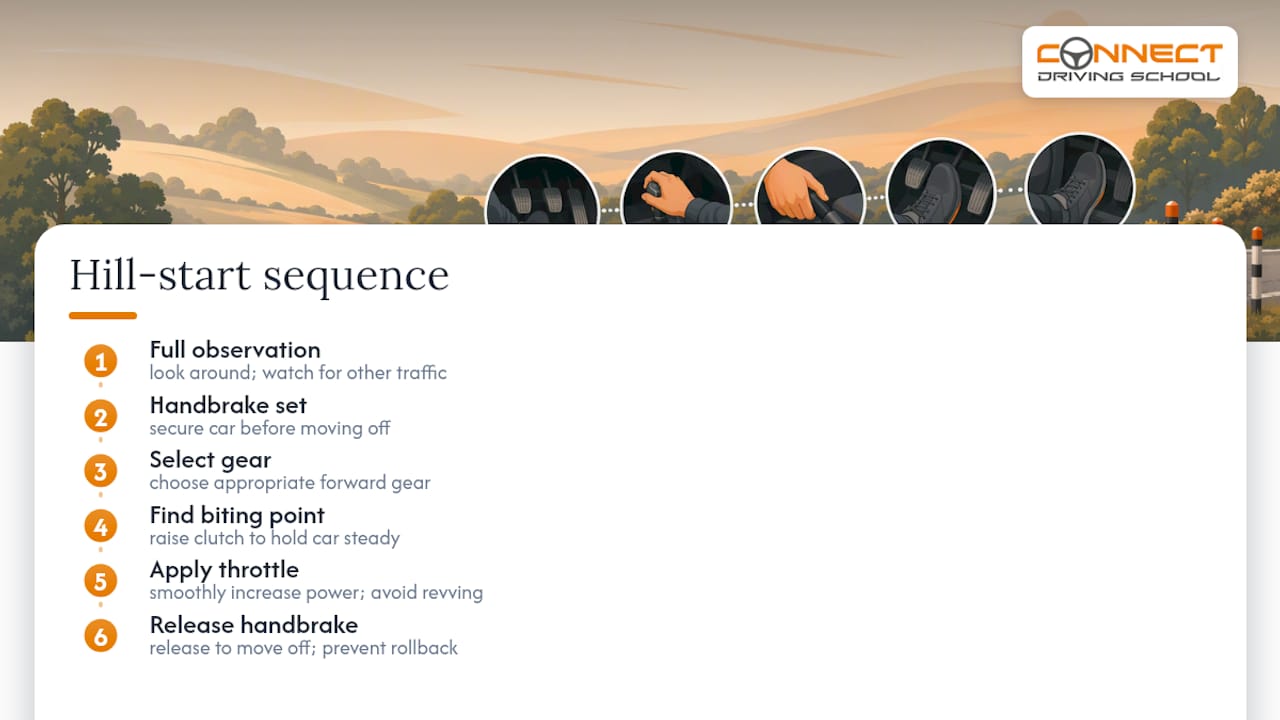
Once you are sure it is safe, work through the sequence in order.
- With the engine running, press the clutch fully to the floor and select first gear.
- Apply the handbrake firmly so the car cannot roll while your feet are busy.
- Find the clutch biting point: the exact spot where you feel the engine start to “grab” the drivetrain, usually shown by a slight drop in engine note and a faint pull forward.
- Hold that point steady while gently pressing the accelerator to raise the revs slightly, giving the engine enough power to carry the car’s weight uphill.
- Release the handbrake smoothly as you feel the car start to take up drive, then ease the clutch up the rest of the way while adding a touch more gas.
The RAC’s guide to hill starts describes this as the standard, safe procedure for a manual car, and it works the same way whether you are on a gentle slope or a steep one. The difference is timing: on a steeper gradient, hold the biting point a fraction longer and add slightly more throttle before releasing the handbrake, since gravity has more to fight against. On a shallow slope, you can afford to release the handbrake a little sooner because the car has less weight to hold back.
If the gradient is severe or you are stopped close behind another vehicle, some instructors suggest using the footbrake instead of the handbrake for the final moment before moving off, switching from brake to accelerator in one smooth motion. This takes more practice to time correctly, so most learners are better served mastering the handbrake method first.
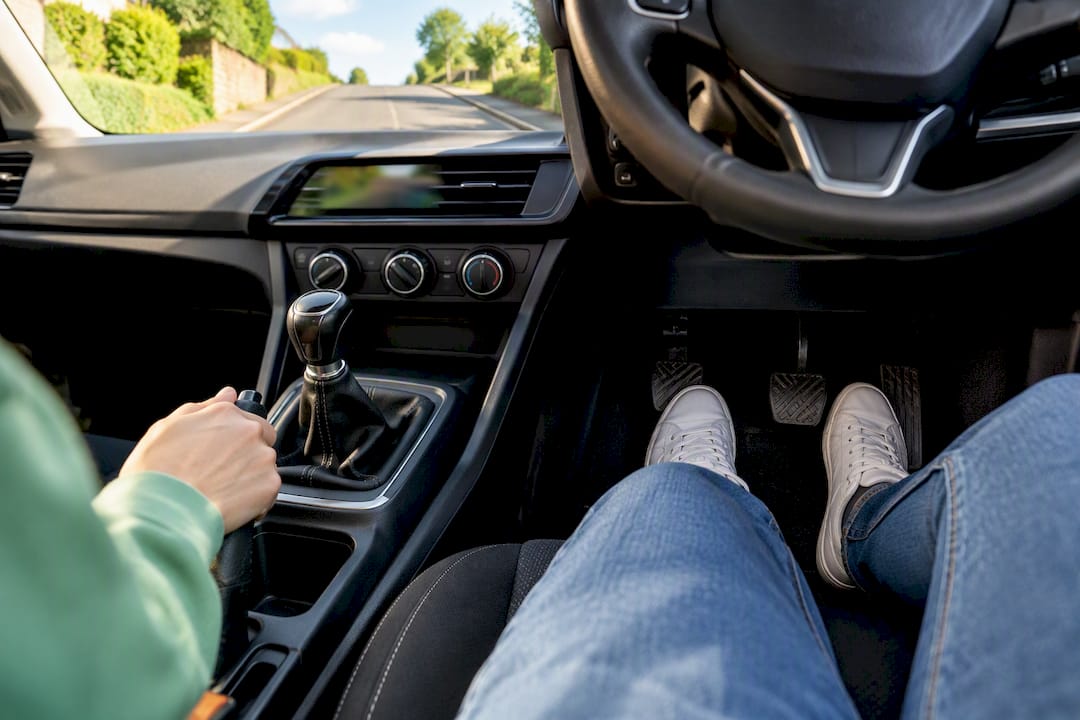
Pro Tip: Listen to the engine rather than watching the speedometer. A small dip in revs tells you that you have found the biting point far more reliably than trying to judge it by feel alone.
Why hill starts go wrong: stalling, rollback and revving too high
Stalling on a hill usually happens because the clutch comes up faster than the revs build, so the engine cannot cope with the extra load of the slope and cuts out. Rollback happens for the opposite reason: the handbrake gets released before the biting point is properly established, so nothing is holding the car in the gap between brake and clutch.
- If you stall, reapply the handbrake immediately, put the gearbox back in neutral, restart the engine and repeat the sequence calmly.
- If you feel the car roll back even slightly, reapply the handbrake at once rather than trying to fight it with the clutch.
- Revving too high for too long without releasing the handbrake is treated as poor control, even though it will not cause you to roll backwards.
According to DVSA’s guidance on recording faults, a controlled stall followed by a safe restart is typically marked as a minor driving fault, while a rollback that endangers another road user or vehicle can be marked as serious. Short, repeated biting point drills on a mild slope build the muscle memory that prevents both problems before they start.
Hill Start Assist: useful help, not a substitute for skill
Hill Start Assist (HSA) is a system fitted to many newer cars that briefly holds the brakes for a second or two after you release the footbrake on a slope, giving you a moment to move your foot to the accelerator without rolling back.
- HSA is designed as a temporary hold, not a permanent one, so you still need to move off within a couple of seconds.
- The national standard for driving cars notes that hill assist systems have limitations and that different vehicles have different starting mechanisms, so relying on one system across all cars is risky.
- Examiners need to see that you can control the car yourself, so leaning on HSA during a lesson or test can mask a gap in your technique rather than close it.
- If your test car happens to have HSA, ask your instructor to spend time practising the manual method without it so you are not caught out in an older or hired vehicle that lacks the feature.
Not every car handles HSA the same way, and older manuals may have no such system at all, so the handbrake and biting point method remains the one skill that works in every car you will ever drive.
What DVSA examiners expect during a hill start
DVSA’s own guidance states that wherever possible, the ability to move off on a reasonably steep uphill gradient should be tested, and that a candidate starting on a hill should be capable of watching for other traffic while moving away without rollback or excessive engine revolutions.
In practice, examiners are watching for a proper look around before moving off, a smooth transition from stationary to moving, and no unnecessary revving or creeping backwards. A hill start can come up as a set exercise near the start of the test or naturally during the independent driving section if your route happens to include a gradient.
The safest preparation is treating every hill start, in lessons and on test routes, exactly the same way: full observation, then the handbrake, gear, biting point, throttle, release sequence without shortcuts. Practising this on varied gradients around your local test routes builds the consistency examiners are trained to look for.
Practice drills to build hill-start confidence
Confidence with hill starts comes from repetition on real gradients, not from reading about the technique. A short, structured plan works better than random practice.
- On a gentle slope, practise finding and holding the biting point for five to ten seconds at a time, without adding gas, until it feels automatic.
- On the same slope, add the handbrake release timing: hold the bite, add light throttle, then release the handbrake and move off, repeating ten to fifteen times over a 20-minute session.
- Move to a steeper hill and run the full sequence from a complete stop, including mirror checks, until you can do it without hesitating.
Ask your instructor to watch your foot movements and clutch control rather than just the outcome, since small posture or pedal-pressure errors are often the real cause of a rough start.
Pro Tip: Pick one fixed point ahead of the car before you move off and keep your eyes on it as you release the handbrake. It stops you glancing down at your feet, which is a common cause of drifting off line.
How Connect Driving School builds hill-start skills into lessons
Our manual driving lessons are taught by DVSA-approved instructors who build hill starts into early sessions rather than leaving them until test week. A typical hill-start lesson includes a demonstration, guided practice on a quiet gradient, an examiner-style briefing so you know what will be assessed, and follow-up drills on steeper routes as your control improves. Connect Driving School has a track record of pass rates above 92% and strong Trustpilot reviews, and learners across our London service areas can book focused sessions that target hill starts near their local test routes.
Why hill-start skill matters beyond the test
Confident clutch control on a hill is not just a test box to tick, it is what stops you rolling into the car behind you at a junction for years afterward. The one habit worth drilling immediately is holding the biting point steady before you even think about the handbrake.
— Mudassar
Manual driving lessons and hill-start practice with Connect Driving School
Hill starts feel far less daunting with an instructor sitting beside you correcting small errors before they become habits. Our manual driving lessons cover hill starts on the same gradients used on local test routes, so the technique you practise is the one you will need on the day.

- Instructor-led sessions give you exam-style feedback on biting point control and observation, not just a general run-through.
- Familiarity with local hills and junctions near your test centre reduces surprises on test day.
- Full pricing for lessons and courses, including the Intensive Driving Course and Pass Plus, is listed on our prices page.
Book a session through our manual driving lessons page and work through the full hill-start sequence with a DVSA-approved instructor.
Sources
FAQ
How to do a hill start in a manual?
Apply the handbrake, select first gear, find the clutch biting point, add gentle throttle, then release the handbrake smoothly as the car takes up drive. This is the standard method described by the RAC and it applies to virtually every manual car on the road.
How to do a hill start in an automatic car in the UK?
In most automatics, you simply hold the footbrake, select drive, and ease onto the accelerator while releasing the brake, since there is no clutch to manage. Cars fitted with Hill Start Assist add a brief automatic brake hold, but you should still be ready to move off promptly rather than relying on it.
Do manual cars have hill-start assist?
Many newer manual cars include Hill Start Assist, which briefly holds the brakes after you release the footbrake on a slope, but the national standard for driving cars notes that these systems have limitations and vary between vehicles. Older or budget models may not have it at all, so learning the manual clutch and handbrake technique remains essential.
Is a hill start required in the UK driving test?
DVSA guidance states that wherever possible, examiners should test your ability to move off on a reasonably steep uphill gradient, so it is a genuine possibility on your test route. It may appear as a set exercise or naturally during the independent driving section, and examiners will be watching for smooth control without rollback or excessive revving, as set out in DVSA’s examiner guidance.
Related Posts
Comments (0)