
Instructor‑backed, action‑first plan to pass the UK theory test: run 57‑minute timed mocks, drill hazard‑perception timing, and follow a 2–6‑week study...
Nail Goodmayes Test Routes: 3 Mock Runs for Barley Lane and A12
DVSA does not publish official Goodmayes test routes, so any list you find online is unofficial guesswork. That does not mean you go in blind. Goodmayes Driving Test Centre sits on a mix of residential streets, busy junctions, and a stretch of the A12, and preparing well means rehearsing those road types with an app such as Test Routes, or better still, targeted mock tests with an instructor at somewhere like Connect Driving School. Focus your last few weeks on road types, independent driving, and full mock tests rather than chasing a “secret” route.
TL;DR:
- Practising specific road types such as bus lanes, roundabouts, and dual carriageways is crucial, as they feature frequently in Goodmayes tests.
- Mock tests should replicate real test structure and timing, including independent driving and manoeuvres, to build confidence and reduce examiner faults.
- Learning local hazards like bus lane times and roundabout exits helps avoid common faults and improves overall performance.
- Season and weather conditions, especially rain and low sun, significantly impact driving, so practice should match your test timing and weather.
- Nowhere near as important as your own preparation, understanding that Goodmayes routes are not officially published underscores the value of structured, local-specific lessons.
Table of Contents
- Goodmayes test centre: location, common road types and named streets to practise
- Three sample (unofficial) route sketches you can copy for mock tests
- Independent driving at Goodmayes: how it works and how to practise it
- Mock tests and practise plan: what to include and how to use instructor feedback
- Test logistics: what to bring, duration and fees for UK practical tests
- Local pitfalls and examiner focus around Goodmayes (what commonly causes faults)
- How local lessons and mock tests speed progress
- Timing your practice for realistic traffic conditions
- Common examiner instructions specific to Goodmayes test routes
- Manoeuvres examiners test around Goodmayes
- How weather and seasons affect Goodmayes test routes
- A short view from inside a Goodmayes mock test
- Ready to book test-focused lessons near Goodmayes?
- Authoritative GOV.UK and practice resources
- Sources
- FAQ
Goodmayes test centre: location, common road types and named streets to practise
Goodmayes Driving Test Centre operates from 98 Goodmayes Road, Ilford, IG3 9UZ, a busy, high-volume site that sends examiners out onto some genuinely testing roads. It is not a sleepy suburban centre where you cruise around quiet cul-de-sacs. Expect a proper mix within a single test.
Most routes touch on residential 30 mph streets with parked cars and pedestrians stepping out between vehicles, short high-street sections with buses pulling in and out, at least one multi-lane roundabout, and a brief taste of dual carriageway driving on the A12. That last part catches learners out because it demands a confident lane change and a realistic merging speed, not a cautious crawl.
Local roads and junctions that come up again and again in learner accounts and instructor notes include:
- Goodmayes Road itself, right by the test centre, with constant pedestrian activity and cars pulling out of side streets.
- Green Lane, a busier through route with bus stops and pedestrian crossings that demand early observation.
- Longbridge Road, which mixes retail traffic with residential turnings.
- Barley Lane roundabout, a multi-lane roundabout where lane discipline and mirror checks matter more than speed.
- Becontree Avenue, a longer residential stretch useful for practising steady progress and hazard awareness.
None of these are guaranteed to appear on your test. They are simply the road types and junctions Goodmayes learners meet often enough that practising them pays off.
Three sample (unofficial) route sketches you can copy for mock tests
These sketches are not DVSA routes. Nobody outside DVSA publishes those, and anyone claiming otherwise is guessing. What follows are realistic templates built from the road types Goodmayes tests commonly use, designed to give you a 20 to 30 minute mock test that feels like the real thing.
-
The roundabout and dual carriageway loop. Start on Goodmayes Road, work through the residential streets towards Barley Lane roundabout, then take a short A12 slip to practise a lane change at speed before coming off and heading back through quieter streets. Good spot for a bay park manoeuvre near a supermarket car park en route.
-
The high-street and bus lane run. Start near the test centre, head along Green Lane through the shopping stretch, dealing with buses and pedestrian crossings, then cut into residential roads for a parallel park exercise before finishing with ten minutes of independent driving using sat nav.
-
The residential and hill-start circuit. Loop through Becontree Avenue and the surrounding streets, find a gentle incline for a hill start, then run an independent driving section following traffic signs only, finishing back near Longbridge Road.
Time each sketch with a stopwatch. Aim for 20 to 30 minutes total, with a clear 20-minute block dedicated purely to independent driving so the exercise mirrors what actually happens on test day.
Independent driving at Goodmayes: how it works and how to practise it
Independent driving runs for roughly 20 to 35 minutes of the 40-minute test and uses either a sat nav the examiner sets up or a short series of traffic signs to follow. You choose neither. The examiner decides on the day.
A single missed turn is not an automatic fail if you keep driving safely and make a sensible decision to correct course. Panicking and making an unsafe manoeuvre to force yourself back onto the “right” road is what actually costs marks.
Practise this properly:
- Run one session following road signs only, with no sat nav at all.
- Run another following a fixed sat nav route your instructor sets, ignoring your own instincts.
- Deliberately miss a turn once and practise recovering calmly rather than swerving back.
Pro Tip: Say your plan out loud as you drive during practice (“roundabout ahead, taking the second exit”). It trains the same running commentary examiners want to see reflected in your positioning and timing, and it stops silent panic from creeping in.
Mock tests and practise plan: what to include and how to use instructor feedback
A proper mock test mirrors the real thing structurally, not just in road choice. Build yours around this sequence:
- Eyesight check and a “tell me” question, exactly as the real test opens.
- General driving through a mix of the road types covered above, roughly 20 minutes.
- Independent driving, sat nav or signs, timed at 20 to 35 minutes.
- One manoeuvre, such as bay parking or a parallel park.
- A reverse or bay-parking exercise, plus an emergency stop if your instructor includes one.
DVSA’s own guidance for instructors running mock tests recommends covering urban streets, rural roads, dual carriageways, and multi-lane roundabouts within that structure, which lines up closely with what Goodmayes throws at learners.
If mock tests are still inconsistent, with different faults appearing each time rather than the same one or two you are actively fixing, that is the signal to delay your booking rather than hope for a lucky day.
Test logistics: what to bring, duration and fees for UK practical tests
The practical test itself runs for about 40 minutes. Bring your photocard driving licence, or a valid alternative if you hold an older-style licence, and make sure any vehicle you supply yourself is taxed, insured, and displays L plates correctly.
- Photocard driving licence (or accepted alternative document).
- Confirmation of your theory test pass, if applicable.
- Valid vehicle documents if you are not using your instructor’s car.
Current test fees are generally around sixty-two pounds for a weekday test and typically higher for evening or weekend slots, though you should always check GOV.UK for the exact current fee before booking. Rescheduling is free if you move your test at least 10 full working days in advance. Arrive at the centre with time to spare; a flustered start rarely helps a nervous drive.
Local pitfalls and examiner focus around Goodmayes (what commonly causes faults)
A handful of local features trip up learners more than anything else. Bus lanes near Green Lane operate on time restrictions that catch out drivers who assume they are permanent. Barley Lane roundabout punishes poor lane discipline, particularly drifting wide on the exit. Speed limit changes along the A12 approach and departure catch drivers who accelerate too eagerly or brake too late.
Practise each weakness specifically rather than hoping general driving fixes it:
- At bus lanes, check the times printed on the sign before you commit to the lane.
- On Barley Lane roundabout, pick your lane early and hold it, checking mirrors rather than swerving.
- Approaching the A12, watch for the reduced limit signs well before the junction, not at the last second.
- Near the test centre entrance, expect pedestrians and slow-moving traffic even outside peak hours.
Pro Tip: Run a two-minute mental checklist before any mock test: mirrors, bus lane times, roundabout lane choice, speed signs. It takes seconds and catches the mistakes examiners flag most often.
How local lessons and mock tests speed progress
Local knowledge genuinely narrows the gap between “practising generally” and “practising what Goodmayes actually tests.” Connect Driving School’s instructors are DVSA-approved and build lessons around the test centres their students are booked at, which means Goodmayes-specific hazards like Barley Lane roundabout or the A12 merge get deliberate attention rather than a hopeful drive-past. Turning the guidance in this article into muscle memory is where an instructor who already knows these roads earns their keep.
Timing your practice for realistic traffic conditions
When you practise matters almost as much as where. A quiet Sunday morning loop around Becontree Avenue teaches you nothing about the queue that builds along Green Lane at half past four on a weekday. If your test is booked for a weekday morning, practise at that time, not in the evening calm.
Rush hour sessions, roughly 7:30 to 9:30 AM and 4:00 to 6:30 PM on weekdays, expose you to the bus congestion and stop-start traffic around the high-street sections near the test centre. That is uncomfortable, but it is also exactly the kind of pressure that catches learners out on the day if they have never faced it before.
School run periods, particularly around 8:30 AM and 3:15 PM, add sudden pedestrian activity near residential streets like Becontree Avenue, with children crossing without much warning. Practising through these windows sharpens the observation habits examiners are actively marking.
Weekend mid-morning tends to be the calmest slot around Goodmayes, useful early in your learning when you are still building confidence with clutch control or roundabout positioning. As your test date nears, though, shift practice sessions to mirror your actual booking time. RAC guidance suggests some learners do benefit from booking tests outside the busiest rush-hour windows if flexibility allows it, since lower congestion means fewer split-second decisions to manage on top of test nerves.
Match your final two or three mock tests to your actual appointment time. If your test is at 9:15 AM on a Tuesday, that is when your last mock test should happen too.
Common examiner instructions specific to Goodmayes test routes
Examiners at Goodmayes give the same broad style of instructions used nationwide, but the local road layout shapes how often certain ones come up. Expect frequent right-turn instructions onto busier roads like Green Lane and Longbridge Road, which force you to judge gaps in fast-moving traffic rather than pulling out into a gap that is simply handed to you.
Roundabout instructions at Barley Lane typically specify an exit number rather than a landmark, so listening precisely, not assuming, matters. Getting the exit count right while managing lane position is a common source of hesitation.
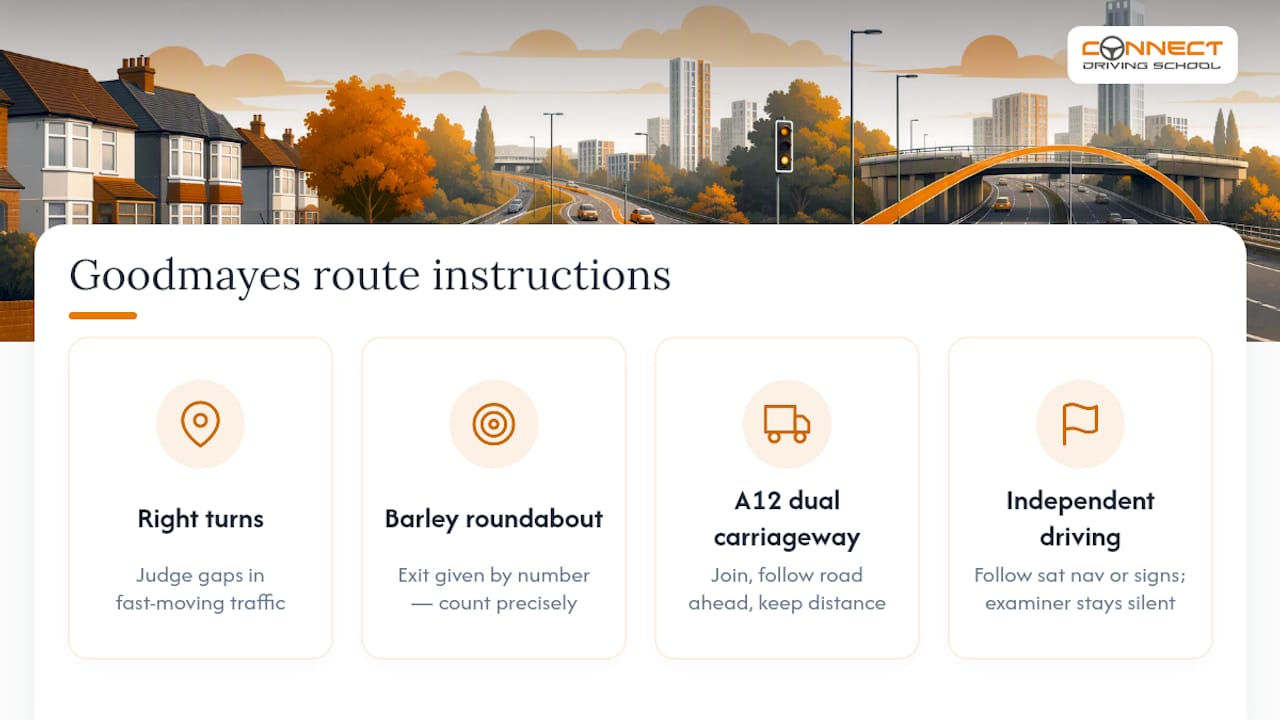
On the A12 section, instructions usually involve joining, maintaining a safe following distance, and then leaving at a specified point, often phrased as “follow the road ahead” rather than a named turning, since dual carriageways don’t offer many turning choices. That phrasing catches learners who expect a specific instruction and hesitate when none comes.
During independent driving, instructions shift entirely to either “follow the sat nav” or “follow the signs for [a specific place],” and the examiner will not intervene unless you make an unsafe decision. If you miss a sign or take a wrong turn, the examiner will simply let you continue and may ask you to pull over safely to reset the sat nav, rather than correcting you mid-manoeuvre. That silence unsettles learners who expect guidance, so practising without prompts is genuinely useful preparation.
Manoeuvres examiners test around Goodmayes
Every practical test includes one of the standard manoeuvres, and the roads around Goodmayes give examiners plenty of realistic locations to choose from. Bay parking often happens in a supermarket car park a short drive from the test centre, where spaces are narrower than they look and cars either side make accurate steering essential.
Parallel parking tends to use quieter side streets off Green Lane or Longbridge Road, where kerb space is available without heavy traffic passing constantly. The key local challenge is judging distance from the kerb while a stream of cars may still pass on the through road nearby.
Hill starts, when included, typically use one of the gentle inclines found on residential streets branching off Becontree Avenue. These are not steep hills by London standards, but a shallow gradient is often harder to judge than a dramatic one, since the biting point feels less obvious and learners either stall or roll back slightly before finding it.
Reverse bay parking, where you reverse into a marked space, follows the same car park locations used for the standard bay park exercise. Whichever manoeuvre comes up, examiners are watching your observation routine, not just the end result. Checking mirrors and blind spots before and during the manoeuvre matters as much as parking within the lines.
How weather and seasons affect Goodmayes test routes
Wet weather changes the character of every route around Goodmayes, particularly on the A12 section, where standing water and spray from other vehicles reduce visibility and grip. Braking distances lengthen, and examiners expect you to adjust your following distance and speed accordingly rather than driving as though conditions are dry.
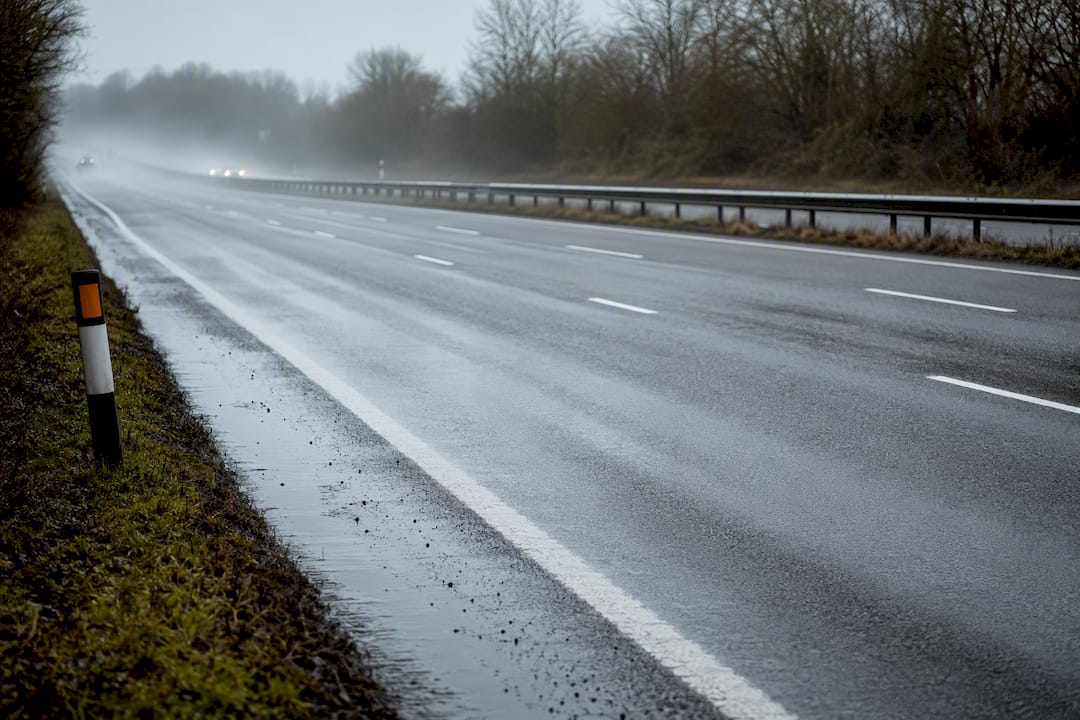
Winter brings shorter daylight hours, which matters if your test slot falls in late afternoon. Driving into low winter sun along east-facing stretches of Green Lane can genuinely dazzle you, and knowing when to use a sun visor without fumbling for it mid-manoeuvre is worth rehearsing in advance.
Autumn leaf fall on the quieter residential streets near Becontree Avenue can hide potholes and create slippery patches, particularly after rain. Summer, by contrast, tends to bring heavier tourist and school-holiday traffic through the high-street sections, along with more cyclists on routes like Longbridge Road, which changes your overtaking and passing distance calculations.
None of this changes the fundamental road layout, but it does change what a safe, competent drive looks like on any given day. Practising in the same season and, where possible, the same weather pattern as your booked test date closes a gap that a purely dry, sunny mock test session cannot.
A short view from inside a Goodmayes mock test
The stress usually peaks in the car park, not on the road. One steady breath before pulling off tends to matter more than any last-minute route tip.
— Mudassar
Ready to book test-focused lessons near Goodmayes?
Lessons built around the actual road types Goodmayes throws at learners, run by instructors familiar with Barley Lane roundabout and the A12 merge, help prepare learners more effectively than guessing routes.
Test preparation lessons focus on the manoeuvres and independent driving skills covered in this guide, while intensive courses suit learners who want to get test-ready more quickly. Motorway driving lessons can help with challenging dual carriageway sections, and refresher lessons support those returning after a break. Tuition is typically available for both manual and automatic vehicles, allowing learners to practice in the car they plan to drive for their test.
A local instructor who already knows which bus lane times catch people out on Green Lane, or how tight that supermarket bay parking space really is, saves you from learning it the hard way during a mock test that should have caught it. Full current pricing for lessons and courses, including the Intensive Driving Course and Pass Plus, sits on the prices page, where you can book your first lesson and start working towards a test date with a plan behind it rather than a guess.
Authoritative GOV.UK and practice resources
- DSA scraps publication of test routes: the official confirmation that route lists are unofficial.
- What happens during the practical driving test: the definitive breakdown of test structure and timing.
- Carry out mock driving tests for your pupils: DVSA’s own mock test framework.
- Ready to pass?: a readiness checklist before booking.
Sources
FAQ
Is Goodmayes easy to pass?
Goodmayes is not considered an easy test centre because its routes mix busy high streets, a multi-lane roundabout, and a short A12 dual carriageway section. Learners who specifically rehearse those road types with structured mock tests tend to fare far better than those relying on general practice alone.
Which driving test route in London is the easiest?
No test centre in London has an officially “easiest” route, since DVSA does not publish or rank routes at all. Difficulty depends far more on your own preparation and familiarity with local road types than on which centre you are booked at.
What are the driving test routes in Goodmayes?
There is no official published list of Goodmayes test routes; any such list found online is unofficial and should be treated as a guide to likely road types, not a script to memorise. Expect residential 30 mph streets, busy junctions like Barley Lane roundabout, and a short A12 stretch, as covered in the sample sketches above.
Which test centre in London has the highest pass rate?
Pass rates vary by test centre and change over time, and comparing them is less useful than focusing on your own readiness. A structured practice plan covering the road types at your booked centre, ideally supported by an instructor familiar with those local roads such as those at Connect Driving School, matters far more than which centre happens to top a league table.
How long is the Goodmayes driving test and what does it cost?
The practical test lasts about 40 minutes, including 20 to 35 minutes of independent driving. The standard weekday fee is £62, with evening and weekend slots typically higher, so confirm the current fee on GOV.UK before booking.
Related Posts
Comments (0)