
DVSA aligned driving lesson plan for learners, supervisors and instructors. One session template and a 27 skill tracker to log progress.
Master 4–5 Second Merges: Dual Carriageway vs Motorway for Learners
A motorway is a controlled-access road you can only join or leave via a slip road, built to strict design standards for sustained high-speed travel. A dual carriageway is any road with a central reservation separating opposing traffic, which can have roundabouts, direct driveways, and pedestrian crossings a motorway would never allow. Both often carry the same national speed limit of up to 70 mph, but access, signage, and who’s allowed to drive on them differ sharply.
TL;DR:
- Dual carriageways can vary widely in layout and access points, requiring drivers to stay alert for unexpected junctions, crossings, and farm entrances.
- Motorways are designed for high-volume, long-distance travel with restricted access and no pedestrian or cyclist presence, and certain vehicles and learners are banned.
- Both roads have a 70 mph speed limit, but motorways require use of slip roads for entry and exit, with different signage and vehicle restrictions.
- Safe driving involves early planning, proper lane discipline, maintaining good observation habits, and using designated refuge areas if breakdowns occur.
- Learners can drive on dual carriageways with supervision, but motorway practice requires an instructor with dual controls following the 2018 rule change.
Table of Contents
- What is a dual carriageway?
- What is a motorway?
- Dual carriageway vs motorway: the key differences
- How to drive safely on both road types
- Learner rules and what examiners actually check
- Signage and road markings to watch for
- How Connect Driving School builds motorway and dual carriageway confidence
- Instructor perspective: fixing the two faults I see most
- Ready to practise on real dual carriageways and motorways?
- Sources
- FAQ
What is a dual carriageway?
A dual carriageway is defined by one feature alone: a central reservation physically separating traffic travelling in opposite directions. That’s it. It says nothing about how many lanes run in each direction, which is where most learners trip up. A single lane in each direction, split by a strip of grass or a metal barrier, still counts as a dual carriageway. So do wider roads with multiple lanes per direction.
Because dual carriageways aren’t built to one uniform standard, their layouts vary enormously:
- Some have roundabouts at every major junction; others have signal-controlled crossroads.
- Many allow direct access from driveways, farm entrances, or side roads.
- Lay-bys and bus stops can appear without warning, sometimes right on the nearside lane.
- Pedestrian crossings and cyclists are legally permitted on most dual carriageways, unlike motorways.
You’ll meet plenty of these roads on local test routes around Kingston, Sutton, and Wandsworth, where examiners often route candidates along the A3 or A24 to assess overtaking judgement and lane discipline. The Highway Code requires you to stay in the left-hand lane unless overtaking, then return left as soon as it’s safe (Rules 137 and 138), and that rule applies just as firmly here as on a motorway.
Pro Tip: Never assume a dual carriageway is quiet just because it looks rural. Field access points and unmarked junctions catch out far more learners than roundabouts do, because there’s no signage warning you a tractor might pull out.
What is a motorway?
A motorway is built for one job: moving high volumes of traffic quickly and safely over long distances, with almost nothing interrupting the flow. You join and leave only through slip roads. There are no roundabouts, no pedestrian crossings, no direct driveways, and no traffic lights. Blue signs with white lettering mark motorways (M1, M25, or the hybrid A(M) roads like the A1(M)), while green signs mark most primary dual carriageways.
The engineering reflects that purpose:
- Longer acceleration and deceleration lanes give you time to match motorway speed before merging.
- Hard shoulders or, on some sections, emergency refuge areas provide a place to stop if something goes wrong.
- Multiple running lanes are designed for steady cruising rather than stop-start manoeuvring.
- Gantries overhead carry variable speed limits and lane closures on “smart motorway” sections, which have converted some hard shoulders into a running lane during busy periods.
Certain road users simply aren’t allowed: learners driving solo, cyclists, horse riders, pedestrians, and most mopeds under 50cc are all banned from motorways by law. That restriction alone tells you how different the driving environment is from a dual carriageway just a mile down the road.
Dual carriageway vs motorway: the key differences
Both road types can carry the same speed limit, yet the rules governing how you use them diverge in ways that matter for your test and your safety.
Speed limits: the national speed limit for cars and motorcycles is 70 mph on both motorways and dual carriageways. Vehicles towing a trailer or caravan are capped at 60 mph on both road types, so towing doesn’t change once you’re on a motorway rather than a dual carriageway.
Where they genuinely part ways:
- Access: motorways only via slip roads; dual carriageways often via roundabouts, traffic lights, or direct junctions.
- Lane discipline: both require you to stay left unless overtaking, but motorway lane changes tend to happen at higher relative speeds with less warning.
- Signage: blue signage and motorway-specific numbering (M, A(M)) versus green signage for most A-road dual carriageways.
- Who can use them: cyclists, pedestrians, and learners driving unaccompanied are barred from motorways but generally permitted on dual carriageways.
- Vehicle restrictions: certain slow-moving or agricultural vehicles that can legally use a dual carriageway are banned outright from motorways.
The practical upshot is that a dual carriageway demands constant vigilance for the unexpected, junctions, crossings, slower vehicles pulling out, while a motorway demands sustained concentration over distance and quicker reaction to gantry instructions. Different skill, same 70 mph limit.
How to drive safely on both road types
Getting this right comes down to routine, not instinct. Build these habits during lessons and they’ll hold up under test pressure.
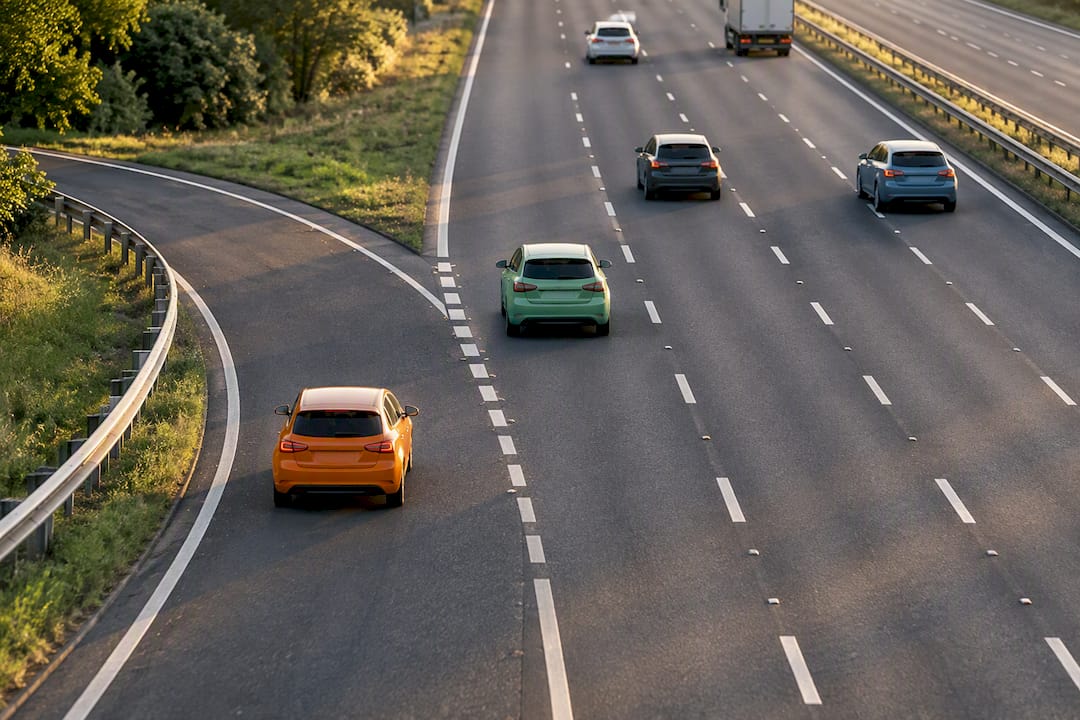
- Joining: use the acceleration lane to build speed before merging, checking mirrors and blind spot, then signal and merge into a gap rather than forcing one. On a dual carriageway roundabout, the same mirror-signal-manoeuvre (MSM) routine applies before you commit to the exit.
- Choosing your lane: stay left unless overtaking, and move back over once you’ve cleared the vehicle, per Rule 137. On three-lane motorways, don’t camp in the middle lane, it blocks faster traffic and is a common test fault.
- Planning ahead: look further down the road than you would in town. At motorway speeds your stopping distance grows fast, so spot brake lights and gantry warnings early rather than reacting late.
- Leaving: move into the deceleration lane in good time, checking your speedometer since motorway speeds can feel deceptively slow once you’re used to them.
- If something goes wrong: use hazard lights immediately if you’re forced to slow suddenly, and if you break down, aim for a refuge area or hard shoulder, get out on the left where possible, and call for help rather than attempting a roadside fix.
Ready to Pass guidance for learners frames this as the MSM/PSL routine, mirror, signal, manoeuvre paired with position, speed, look, and it’s worth drilling until it becomes automatic rather than something you consciously think through at 70 mph.
Pro Tip: Practise treating every slip road as a timed exercise, aim to reach motorway speed with roughly four to five seconds of clear road ahead before you merge. That habit alone solves most joining faults.
Learner rules and what examiners actually check
You can drive on dual carriageways as a learner under normal L-plate conditions, with your instructor or a supervising driver, same as any other road. Motorways are different. Since the rules changed in 2018, learner drivers may only drive on a motorway when accompanied by an approved driving instructor in a car fitted with dual controls, never with a family member or friend supervising.
Motorway driving isn’t part of the practical test itself, but examiners do assess your handling of dual carriageways heavily, particularly:
- Overtaking judgement and returning to the left promptly.
- Correct use of MSM/PSL when joining from a slip road or roundabout.
- Speed awareness on approach to changing limits or roadworks.
- Observation at junctions where vehicles may pull out unexpectedly.
If you’re not confident with high-speed roads before your test, or want motorway experience once you’ve passed, Pass Plus and dedicated motorway lessons exist for exactly that gap.
Signage and road markings to watch for
Reflective studs give you lane position cues that painted lines can’t match in rain or darkness, and the Highway Code sets out what each colour means:
- Amber studs mark the central reservation.
- Red studs mark the left-hand edge of the carriageway.
- Green studs mark slip roads and lay-bys.
- White studs separate the running lanes.
A hard shoulder is for emergencies only, not for dropping off, checking your phone, or taking a break. Where smart motorways have removed the hard shoulder, emergency refuge areas take its place, spaced further apart, so get off the live lanes as quickly as possible if you’re in trouble. Variable message signs on overhead gantries aren’t decorative; a red X over a lane means it’s closed, and a lower speed limit shown there is enforceable exactly like a fixed sign.
How Connect Driving School builds motorway and dual carriageway confidence
Reading the rules is one thing. Merging at 70 mph in real traffic on the A3 or A24 with someone next to you who can intervene is another. Connect Driving School’s motorway lessons and Pass Plus course are built specifically around the skills covered above: judging gaps on slip roads, holding lane discipline through three-lane sections, and reading gantry signs under pressure.
Every instructor is DVSA-approved, and Connect Driving School reports pass rates above 92%, backed by strong ratings on Trustpilot. If you’re booking a motorway lesson, ask your instructor to run you through joining, overtaking, and emergency refuge procedures in a single session so you leave with the full picture, not just half of it.
Instructor perspective: fixing the two faults I see most
The two faults that come up again and again are late observation before joining, and drifting between lanes without a clear reason to move.
For late observation, the fix is a habit, not a lecture: call out “mirror, signal, blind spot” out loud every single time you approach a slip road, even after you’ve passed your test. For lane drifting, practise holding a chosen lane for a full minute before you’re allowed to move, which sounds tedious and works precisely because it is.
Neither fault means you’re not ready. Motorway and dual carriageway confidence builds in layers, and every learner needs supervised practice before it clicks.
— Mudassar
Ready to practise on real dual carriageways and motorways?
Connect Driving School is the alternative to guessing your way through high-speed roads on your own: rather than a generic lesson package, you get DVSA-approved instructors who build motorway and dual carriageway practice directly into your training, with honest pricing and no hidden catches.
Lessons start from £37.50 per hour, with motorway-specific sessions available from £135 and Pass Plus from £270, covering learners across SW London, Kingston, Sutton, Croydon, and beyond. Whether you’re building confidence in a manual or automatic car, your first lesson comes with a refund guarantee if you’re not satisfied. Check current prices and availability and book a motorway or Pass Plus session with a local instructor today.
Sources
FAQ
Is a dual carriageway 60 or 70 mph?
The national speed limit for cars and motorcycles on a dual carriageway is 70 mph, dropping to 60 mph if you’re towing a trailer or caravan. The same limits apply on motorways, so towing doesn’t change once you cross from one road type to the other.
Is a dual carriageway considered a motorway?
No. A dual carriageway is defined only by its central reservation, and can include roundabouts, direct access, and pedestrian crossings. A motorway is a separate legal category with controlled access via slip roads only, and features like these are banned by design.
Is the A1 a dual carriageway or motorway?
The A1 is mostly a dual carriageway, though sections around Leeds and further north are upgraded to full motorway standard and signed as the A1(M). Blue signage marks the motorway sections; green signage marks the dual carriageway stretches.
Is it called a motorway in the UK?
Yes. “Motorway” is the correct UK term for controlled-access, high-speed roads such as the M1 or M25, distinct from dual carriageways, which are simply any road split by a central reservation regardless of access type.
Can learner drivers practise on motorways?
Only when accompanied by an approved driving instructor in a dual-control car, following the 2018 rule change. Connect Driving School offers motorway lessons built around exactly this requirement, from £135.
Related Posts
Comments (0)