
A UK test‑ready manual hill‑start method that prevents rollback and stalling. Step‑by‑step DVSA checks plus instructor drills to build confident clutch...
Three 2026 Highway Code Changes UK Drivers Must Know
There was no single, nationwide Highway Code rewrite published in 2026. Instead, GOV.UK’s updates page records its last substantive amendments in October and April 2025, and 2026 brought four specific, named regulations: a new in-person rule for booking your practical test (SI 2026/326), a licence provision for certain Ukrainian licence holders (SI 2026/741), a variable-speed order on the M27 (SI 2026/578), and a government decision on future vehicle safety technology. Each applies to a narrow group or location, not to every driver.
TL;DR:
- Only three specific regulations were enacted in 2026, targeting test booking procedures, Ukrainian licence provisions, and a motorway speed limit change.
- The upcoming vehicle safety technology mandate affects new vehicle type approval, not current cars or owner retrofitting.
- The Highway Code’s core rules like pedestrian priority, safe passing distances, and junction positioning remain unchanged and most critical for driver testing.
- The in-person test booking rule requires learners to apply directly, ending third-party booking arrangements for practical tests in the UK.
- Drivers should focus on primary sources like legislation and official guidance rather than headlines, as most rule changes are narrowly confined and do not alter daily driving standards.
Table of Contents
- Official Highway Code updates and the table of changes
- The concrete 2026 regulations you actually need to know
- What the vehicle safety technology decision means for your car
- What drivers and learners should actually do now
- An instructor’s view on what matters for London learners
- The gap between headline and substance
- Book test-ready lessons that account for the 2026 booking rule
- Sources
- FAQ
Official Highway Code updates and the table of changes
If you’re expecting a wholesale rewrite of the Highway Code for 2026, you won’t find one. GOV.UK’s own updates log shows its two most recent entries dated 22 October 2025 and 10 April 2025, and nothing broader has landed since. The October 2025 update revised traffic sign guidance covering buses-and-cycles-only and trams-only markings, while the April 2025 entry clarified pavement and kerb parking rules specifically for Scotland. That’s the official record, and it’s worth checking directly if you want to confirm nothing has slipped past this article.
What those 2025 amendments sit on top of is a bigger set of revisions carried in the official table of changes to the Highway Code, the document that tracks every wording change rule by rule. For anyone learning to drive or brushing up on their knowledge, this is the file that actually matters, because it shows where the Code tightened protections for people outside cars.
The table highlights several areas that regularly trip up learners and experienced drivers alike:
- Pedestrian priority at junctions — Rule H2 gives pedestrians priority when a vehicle is turning into or out of a junction, even if they haven’t started crossing yet.
- Cyclist junction guidance — revised wording around Rules 72 to 77 clarifies how cyclists should position themselves at junctions and how drivers should anticipate that positioning.
- Two-stage turns — guidance for cyclists making a two-stage right turn at busy junctions, designed to keep them out of fast-moving traffic streams.
- Safe passing distances — clearer expectations for how much room a driver should leave when overtaking a cyclist or horse rider, particularly at low speeds.
None of this is abstract for a learner. If you’re practising around junctions anywhere from Wimbledon to Kingston, examiners will be watching for exactly this kind of awareness: do you yield to a pedestrian who’s stepped off the kerb, and do you give a cyclist room rather than squeezing past?
The other point worth understanding, because it comes up constantly in disputes and even court cases, is how the Code signals what’s actually law versus what’s simply best practice. Wording that says a driver “MUST” or “MUST NOT” do something reflects an actual legal requirement, usually backed by a specific Act or regulation named in brackets at the end of the rule. Wording that says a driver “should” is advisory rather than a strict legal duty. That distinction matters in practice: advisory rules aren’t offences in themselves, but the table of changes notes that courts can and do treat a breach of “should” guidance as evidence of careless or inconsiderate driving. Ignoring an advisory rule won’t get you an automatic fine, but it can still sink your case if something goes wrong.
The concrete 2026 regulations you actually need to know
Three statutory instruments came into force in 2026, and each does something narrow and specific rather than rewriting the rules of the road generally.
SI 2026/326: apply for your test in person. The Motor Vehicles (Driving Licences) (Amendment) Regulations 2026 require that an application for a category B (car) practical test must be made by the applicant themselves, not through a third party. The regulations were made on 17 March 2026 and came into force on 27 April 2026, applying across England, Wales and Scotland. This is an operational change, not a shift in what’s tested on the day. If you’ve heard about instructors or agencies booking test slots on a learner’s behalf, that route is now closed for the practical car test, and the change is a response to bulk-booking practices that were squeezing genuine learners out of slots.
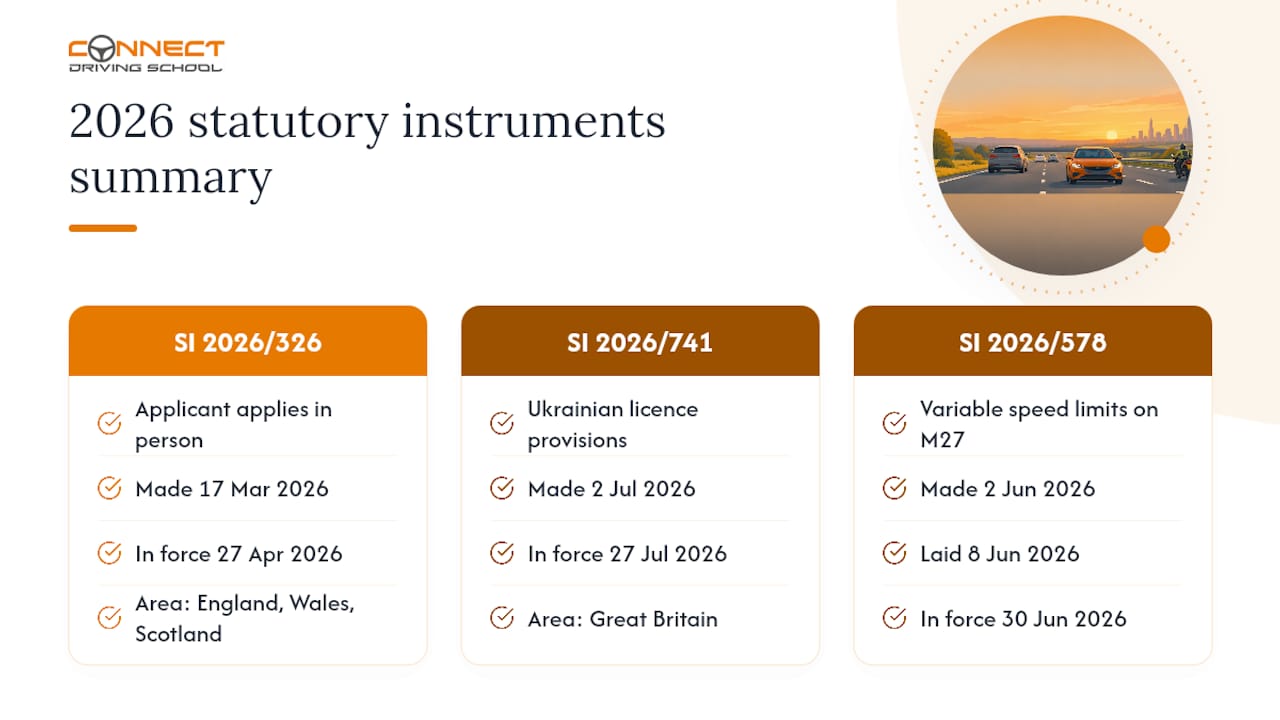
SI 2026/741: a licence provision for some Ukrainian licence holders. The Motor Vehicles (Driving Licences) (Amendment) (No. 2) Regulations 2026 create specific Great Britain driving-entitlement provisions for Ukrainian licence holders whose immigration status has changed. Depending on the exact scenario, qualifying drivers may retain entitlement to drive for up to five years, or in some cases six years and six months. The regulations were made on 2 July 2026 and come into force on 27 July 2026. Eligibility depends entirely on individual leave-to-remain history, so this isn’t something to self-assess from a summary; check the SI itself or speak to DVLA or an immigration adviser if it might apply to you.
SI 2026/578: variable speed limits on the M27. The M27 Motorway (Junctions 4 to 11) (Variable Speed Limits) (Amendment) Regulations 2026 change how variable speed limits operate on that stretch of motorway. The instrument was made on 2 June 2026, laid before Parliament on 8 June 2026, and came into force on 30 June 2026.
Only three named statutory instruments changed driving rules in 2026, each covering a different, narrow slice of road use: test booking, a specific licence group, and one motorway corridor.
None of these three regulations touch the general rules most drivers rely on day to day. They’re targeted fixes: one closes a booking loophole, one addresses a specific immigration scenario, and one governs signage on a single stretch of the M27. If you don’t book category B tests, aren’t affected by the Ukrainian licence provision, and don’t drive that section of motorway regularly, none of them changes your daily driving.
What the vehicle safety technology decision means for your car
On 16 July 2026, the government published its response to the consultation on mandating vehicle safety technologies in GB type approval, confirming it intends to proceed with requiring 18 safety technologies for new vehicles seeking type approval in Great Britain. The response also revised some of the original implementation timings, giving manufacturers more time to comply, and indicated that certain special-purpose vehicles may be excluded from parts of the requirement.
This is the headline most likely to be misread, so it’s worth being precise about what it does and doesn’t do. Type approval governs what a manufacturer must build into a new vehicle before it can legally be sold in Great Britain. It is not a requirement on you, the owner of an existing car, to retrofit anything.
- Manufacturers, not private owners, carry the compliance burden for these 18 technologies.
- There’s no obligation to add safety tech to a car you already own because of this decision.
- New-car buyers should expect the relevant technologies to appear progressively as manufacturers roll out compliant models, not overnight.
- DVSA guidance on MOT testing may eventually reflect any new features fitted as standard, but that follows manufacturer rollout rather than driving it.
Pro Tip: If you’re buying a new car in the next year or two, ask the dealer directly which of the 18 mandated safety technologies come fitted as standard and from which model year. Don’t assume every new registration already has them, because the rollout is staged.
The practical read here is patience. Watch for DVSA and MOT guidance updates as manufacturers catch up, rather than treating this as a rule that affects your driving tomorrow.
What drivers and learners should actually do now
Reading about regulations is one thing. Acting on them correctly is another, and this is where most confusion actually happens.
- If you’re booking a category B practical test, apply in person. Since 27 April 2026, third-party bookings on your behalf aren’t valid for the car test. Book directly through the official DVSA booking service, keep confirmation of your own application, and build this into your lesson schedule with plenty of runways, since slots can still move quickly in busy areas.
- Treat displayed motorway signage as the actual law, not the national default. On the M27 between junctions 4 and 11, the variable speed limit order means the number on the gantry overhead is what governs your speed at that moment, not a general assumption about motorway limits. The same logic applies to red-X lane closures anywhere on the motorway network: a red X means that lane is closed, full stop, and driving in it is both dangerous and an offence.
- Check your own eligibility rather than relying on headlines if the Ukrainian licence provision might apply to you. Because SI 2026/741 turns on specific immigration and leave-to-remain circumstances, a general summary can’t tell you whether you qualify. Read the regulation itself or get advice from DVLA or an immigration adviser.
- Don’t panic-buy retrofit kits over the vehicle technology announcement. The 18 mandated technologies apply to new vehicles seeking type approval, not to the car sitting on your driveway.
- When in doubt, go to the primary source. For Code wording, that’s the official table of changes; for legal force, that’s the actual statutory instrument on legislation.gov.uk, checked for its extent (England, Wales, Scotland) and commencement date.
Pro Tip: Bookmark the SI itself rather than a news summary of it. Regulations sometimes get amended again before commencement, and the legislation.gov.uk page always shows the current, in-force version.
An instructor’s view on what matters for London learners
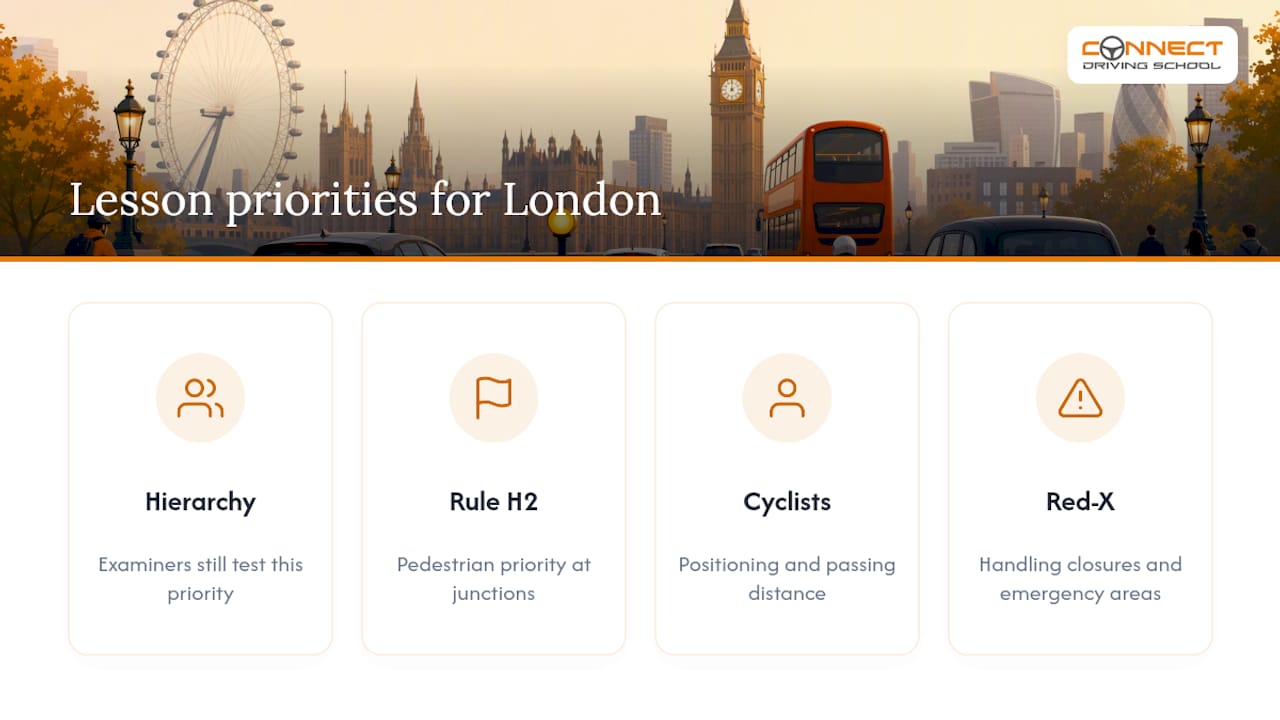
None of the 2026 changes above rewrites what examiners assess on test day, and that’s exactly why Connect Driving School’s lesson priorities haven’t shifted either. What we drill into learners across our London service areas remains the hierarchy of road users, pedestrian priority at junctions under Rule H2, correct positioning and passing distance around cyclists, and confident handling of red-X closures and emergency areas on faster roads. Those are the fundamentals examiners keep testing, whatever regulation lands in a given year.
The one operational change we do build into scheduling is the in-person test-booking rule. We now plan Pass Plus and motorway sessions around a learner’s own confirmed booking date rather than assuming a slot can be secured on their behalf, which matters most for students preparing around Kingston, Sutton and the wider SW postcodes we serve. Getting that sequencing right avoids the awkward gap of finishing lessons early and losing sharpness before test day, or booking too late and rushing preparation.
The gap between headline and substance
The loudest “Highway Code changes 2026” headlines oversell what actually happened this year. The real story is duller and more useful: three narrow statutory instruments and one forward-looking manufacturer decision, none of which touch the core rules tested on a driving exam. Where the conventional advice goes wrong is treating every SI as if it rewrites the Code for everyone.
What should worry a driver more than any 2026 headline is the stuff that never changes and never makes the news: pedestrian priority at junctions, safe passing distance, correct positioning at roundabouts. Those rules from the table of changes get more people into trouble on test day and on real roads than any statutory instrument published this year. Read the primary sources when a headline grabs you, but spend most of your revision time on fundamentals that don’t have a commencement date.
— Mudassar
Book test-ready lessons that account for the 2026 booking rule
Connect Driving School is the alternative to piecing together test prep yourself: our DVSA-approved instructors already build lesson schedules around the in-person booking requirement, so you’re not caught out planning your test date around a slot someone else arranged.

Whether you’re starting from scratch with a First Driving Lesson, want to compress your learning with an Intensive Driving Course, or need to top up with motorway driving practice before tackling variable-limit stretches like the M27, our instructors tailor lessons to where you actually need the work. Learners who prefer automatic tuition can go straight to our automatic driving lessons page, while those sticking with manual gears can check our manual driving lessons service. Already passed but want to build confidence on faster roads? Pass Plus is built for exactly that. Get in touch to schedule lessons around your own confirmed test booking, and let a patient, DVSA-approved instructor take it from there.
Sources
- Gov
- The Motor Vehicles (Driving Licences) (Amendment) Regulations 2026
- Table of changes to the Highway Code (official PDF)
FAQ
Are 70 year olds going to have to take a driving test?
No. Drivers must renew their licence regularly by declaring they are medically fit to drive, but this is a self-declaration process, not a retest. None of the 2026 regulations changed this.
What is the 4-hour rule for driving?
There isn’t an official “4-hour rule” in the Highway Code or in UK driving law for private car journeys; that concept applies to commercial drivers under separate hours regulations, not to learner or everyday motorists. If you’ve seen this phrase applied to driving tests, it isn’t part of any 2026 change and isn’t reflected in the official Code.
Is there a 90 mph speed limit in the UK?
No, the national speed limit on motorways for cars remains unchanged, and nothing in the 2026 regulations introduced a higher speed limit anywhere. The 2026 M27 order changes how variable limits are displayed and enforced on that specific corridor, but the limits shown remain within the existing national framework.
Does Connect Driving School help with test bookings under the new rule?
Yes. Connect Driving School’s instructors schedule lessons around your own confirmed practical test date, since the in-person booking requirement means you must apply for your category B test yourself. Current lesson and course prices, including Pass Plus and intensive courses, are listed on the pricing page.
Related Posts
Comments (0)