
DVSA doesn’t publish Goodmayes routes. This local guide names street hazards, shows what to practise, and gives three ready 20–30 minute mock routes to run.
Hit 47/50 on Your UK Theory Test in 2–6 Weeks With an Instructor’s Plan
The fastest way to pass is deceptively simple: run repeated timed mock tests until you consistently score in the mid to high 40s out of 50, and drill hazard perception clips until you’re spotting developing hazards early rather than clicking on instinct. Do a full 57-minute, 50-question mock on the official DVSA kit tonight. That single session tells you more about your readiness than another week of passive reading.
TL;DR:
- Consistently scoring in the mid to high 40s out of 50 on full timed mock tests indicates strong test readiness and is more reliable than a single good score.
- Prioritize deliberate hazard perception practice by focusing on early hazard detection and timing responses accurately rather than habitually clicking randomly.
- Review weak topics by revisiting specific sections of the Highway Code rather than endlessly repeating random question banks, and use targeted short daily revision sessions.
- Booking the test on the official GOV.UK site costs £23, and arriving early with proper ID, especially if requesting adjustments, improves the test experience.
- A structured six-week study plan combining foundation reading, targeted revision, full mocks, and practical lessons creates better long-term results than last-minute cramming.
Table of Contents
- Theory test tips that lift your score fastest
- A two to six week study plan that actually fits your life
- Hazard perception: why pattern-clicking costs you the clip
- Booking your test and avoiding administrative traps
- The best study resources and how to actually use them
- An instructor’s view: what actually shows up in lessons
- The gap between revision advice and what actually works
- Book a lesson that turns theory into a pass
- Where to check the official rules
- Sources
- FAQ
Theory test tips that lift your score fastest
Some revision habits do far more work than others. If you only have time for a handful of tactics before booking, these are the ones worth prioritising.
-
Read the Highway Code properly, not skim it. The official test questions are drawn directly from it, alongside the Official DVSA Theory Test kit, so treat both as your primary source rather than a backup.
-
Use active recall, not re-reading. Answering questions cold and checking afterwards embeds knowledge far better than rereading a chapter you already recognise.
-
Run full timed mocks under real conditions. Give yourself the actual 57 minutes for 50 questions, no phone, no pausing. This builds the pacing and focus you’ll need on the day.
-
Flag and review, don’t fix as you go. Mark uncertain answers, keep moving, then use your remaining minutes to revisit flags. Aim for consistent scores in the mid to high 40s before you consider yourself test ready.
-
Practise hazard perception deliberately, not habitually. Random clicking during clips wrecks your score. Watch for genuinely developing situations and respond once, early.
-
Protect your review window. Leave five to ten minutes at the end of the multiple-choice section for flagged questions, and use the optional break before hazard perception to reset your concentration.
-
Track your weak topics and revisit the source. If you keep missing questions on stopping distances or road signs, go back to that exact section of the Highway Code rather than grinding random question banks.
A two to six week study plan that actually fits your life
Cramming the night before rarely works for this test. A phased approach, moving from foundation reading to targeted drilling to full mock exams, tends to produce steadier results, and a six-week strategy built on roughly 30 to 60 total hours suits most learners fitting revision around school, work, or driving lessons.
Here’s how that breaks down in practice:
- Weeks 1 to 2 (foundation): Read the Highway Code cover to cover, then take one diagnostic mock test to see where you genuinely stand.
- Weeks 3 to 4 (targeted revision): Focus your remaining time on the topics your diagnostic mock exposed, using 30 to 45 minutes daily rather than long, tired sessions.
- Week 5 (intensive mocks): Run full timed mock tests every other day. You should be closing in on 47 or more out of 50, with hazard perception scores settling around 50 or higher out of 75.
- Week 6 (taper): Reduce volume, keep sharp with short daily reviews, and stop cramming new material 48 hours before your test.
If you’re compressed into one or two weeks because your test is already booked, the same phases still apply, just condensed, though expect less margin for error and more reliance on the diagnostic mock to direct your time.
Pro Tip: Don’t judge readiness by a single good mock. Three consecutive scores above 45 out of 50 tell you far more than one lucky run.
National pass rates sit lower than most learners expect, and focused, spaced revision correlates with a noticeably higher first-time pass rate than last-minute cramming.
Hazard perception: why pattern-clicking costs you the clip
A developing hazard is anything that’s starting to change the road situation and might require you to act. A parked car with its indicator flashing before it pulls out. A pedestrian stepping towards the kerb before they cross. The test rewards spotting these early, not reacting once they’re already obvious.
The scoring mechanics matter more than most learners realise:
- There are 14 clips, worth up to 75 points in total, and one of those clips contains two hazards rather than one.
- Each hazard can earn up to 5 points, with earlier, well-timed clicks scoring higher than late ones.
- Clicking continuously or in an obvious pattern scores nothing for that clip, because the system is built to detect and disqualify indiscriminate clicking.
Train the timing specifically. Watch full clips without clicking first, note where the hazard actually begins to develop, then replay and click at that exact moment. Repetition against a stopwatch, not volume of clips watched, is what improves this skill.
Booking your test and avoiding administrative traps
Booking the theory test directly through GOV.UK costs £23. Third-party booking sites often add a markup for the same slot, so always book on the official page first.
A few practical points worth knowing before test day:
- Bring your provisional driving licence; you won’t be let in without valid photo ID.
- Arrive early enough to check in and settle, since the full appointment, including both sections, runs to roughly 90 minutes.
- If you have a reading difficulty, disability, or health condition, you can request reasonable adjustments such as extra time or a voiceover version when you book, but you’ll need supporting evidence ready.
- If you fail either section, you must retake both together, and you’ll need to wait at least three working days before rebooking.
- A pass certificate stays valid for two years, and its number is what you’ll need to book your practical test.
Learners short on test slots sometimes turn to a service like EarlyCarTest to find earlier cancellations once they’re confident and ready to book sooner than the standard waiting list allows.
The best study resources and how to actually use them
The Official DVSA Theory Test kit, available as an app and a book, remains the strongest resource because its questions and hazard clips are drawn straight from the same source material the real test uses. Pair it with the Highway Code for the underlying rules behind every question.
If you add a third-party app, check that it states DVSA licensing or a full official question set, includes realistic hazard clips rather than crude simulations, and tracks your progress by topic. Structure your sessions around short daily drills on weak areas, then two full timed mocks a week once you enter your final revision phase.
An instructor’s view: what actually shows up in lessons
Learners who revise hazard perception properly notice it on the road almost immediately, spotting brake lights and pedestrians a beat sooner than those who haven’t. Instructors regularly see the same gap repeated: strong theory knowledge that doesn’t translate into anticipation behind the wheel, usually fixed by talking through hazards out loud during a lesson rather than reacting silently.
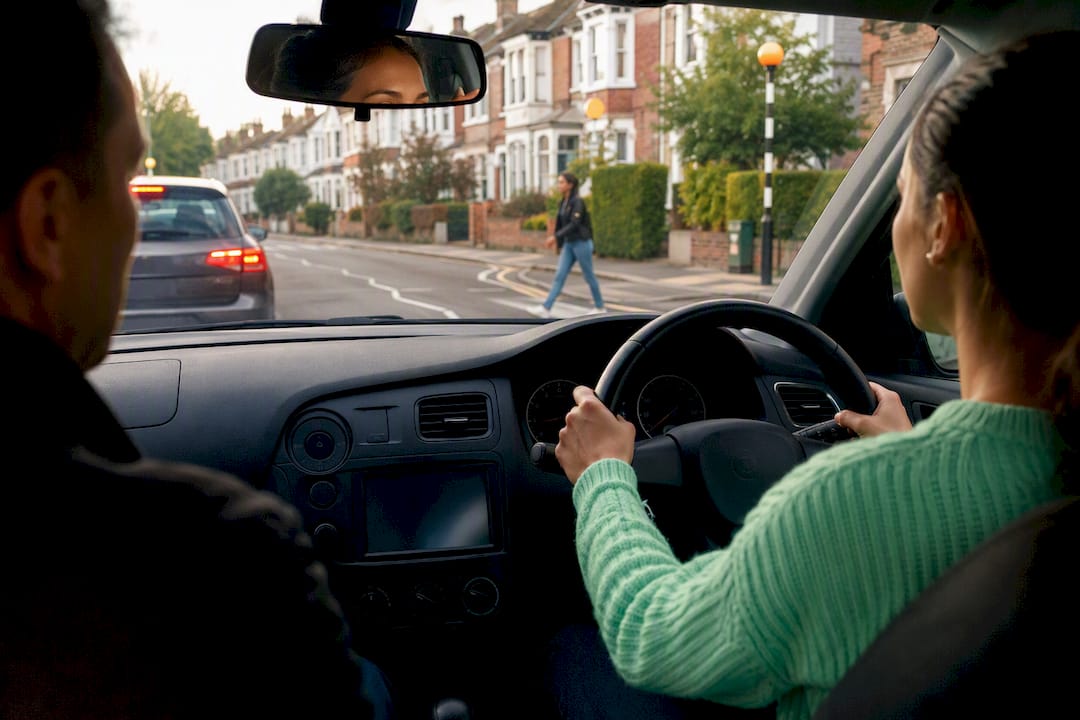
The gap between revision advice and what actually works
Most theory test advice online treats revision as a memory exercise: read enough, remember enough, pass. That’s only half true. The hazard perception section punishes exactly the kind of behaviour that memorising questions encourages, quick, reflexive responses instead of genuine observation.
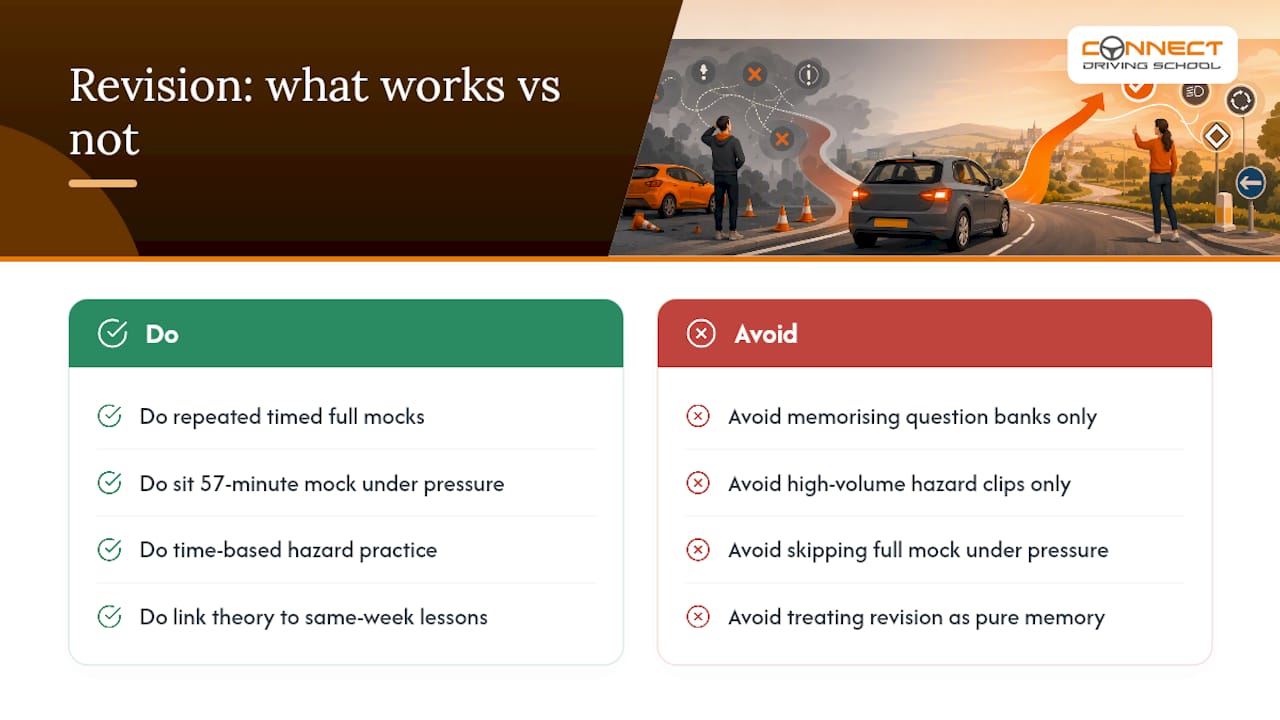
What the evidence actually supports is less exciting than a shortcut but more reliable: repeated timed mocks that mimic real conditions, and hazard perception practice built around timing rather than volume. Learners who chase question banks without ever sitting a full 57-minute mock under pressure tend to be the ones caught out by nerves on the day, not knowledge gaps.
The other thing conventional advice underplays is how much revision and practical lessons should talk to each other. A theory session on stopping distances means far more once you’ve actually felt how long it takes to brake at 30mph in a real car. If you’re learning in south or south west London, or across the Kingston, Sutton, Croydon or Huddersfield and Hull areas Connect Driving School covers, ask your instructor to connect that week’s theory revision to that week’s lesson. It’s a small ask that pays off far more than another hour of question banks.
— Mudassar
Book a lesson that turns theory into a pass
Passing the theory test is only half the job. Connect Driving School’s real advantage is bridging that knowledge into practical readiness faster, so the hours you spend revising hazard perception and road rules translate directly into confident driving, not separate skills you have to reconcile on the road.

DVSA-approved instructors build lessons around exactly the topics that trip learners up in mocks, whether that’s junctions, roundabouts, or reading developing hazards in real traffic across areas like Wimbledon, Kingston, Sutton, or Croydon. A First Driving Lesson from £37.50 an hour is the natural next step once your theory revision is on track, and the Intensive Driving Course suits learners who want to move from theory pass to practical test in a compressed timeframe. Prefer to learn in an automatic? Check the automatic driving lessons page for details. Book a session and tell your instructor which theory topics you’re still shaky on, they’ll build the lesson around fixing exactly that.
Where to check the official rules
For the latest fees, booking slots and pass mark details, always check GOV.UK directly rather than relying on third-party guides. Start with the theory test booking page and the pass mark and result page for anything time-sensitive.
FAQ
How can I pass the UK driving theory test easily?
There’s no shortcut that skips preparation, but the most reliable route is repeated timed mock tests alongside deliberate hazard perception practice rather than passive reading. Aim to consistently score in the mid to high 40s out of 50 on multiple-choice mocks before booking your test.
Is 47 out of 50 a good theory test score?
Yes, 47 out of 50 comfortably clears the pass mark of 43 and suggests solid readiness rather than a lucky pass. Treat it as a strong benchmark to hit consistently across several mocks, not just once.
Can I pass the theory test in three days?
It’s possible if you already have reasonable road knowledge, but it means compressing the diagnostic, revision and mock-test phases into a very short window. A phased six-week approach generally produces steadier results, so treat a three-day crash plan as a last resort rather than a strategy.
What’s the best way to prepare for the theory test?
Combine the Highway Code and the Official DVSA Theory Test kit for authentic questions and hazard clips, then reinforce that knowledge with full timed mock tests and targeted revision on your weakest topics. Structured revision built around real driving lessons, where theory gets applied on the road, tends to close the gap between knowing the rules and actually using them.
What happens if I fail one part of the theory test?
You must retake both the multiple-choice and hazard perception sections together, even if you only failed one, and you’ll need to wait at least three working days before rebooking. A pass certificate, once earned, stays valid for two years.
Related Posts
Comments (0)