
Master Barnet test routes with instructor Mudassar's three drills and five local roads to practise. DVSA-aligned tips, mock tests, and practical prep options.
27 Skills: DVSA Driving Lesson Plan for Learners, Adults & Instructors
This article gives you a DVSA-aligned driving lesson plan template you can run today, whether you’re a learner practising with a parent or an instructor structuring a course. Follow the supervision and insurance rules below before you start the engine, and use the DVSA’s 27 skills and five competence levels to track real progress from lesson to lesson.
TL;DR:
- Learner drivers must be supervised by someone over 21 with a full license for at least three years and operating a car insured for learners; supervision is limited to certain conditions.
- Private supervision cannot include motorway driving, payment, or supervision by license holders under three years, and should focus on reinforcing instructor-led methods rather than teaching new techniques.
- Progress should be tracked across five competence levels for each of the 27 DVSA skills, using a shared record to ensure consistent teaching and realistic mock test readiness.
- Delaying a real test is advisable if a learner is only occasionally independent during mock tests, and confidence develops best through varied practice locations and measurable, specific goals.
Table of Contents
- Who can legally supervise a learner driver?
- A step-by-step driving lesson plan for one session
- How do instructors adapt this plan to each learner?
- What are the DVSA’s 27 skills and how do you track them?
- When is a learner ready for a mock test?
- How Connect Driving School applies this lesson plan structure
- How to run a safety briefing before every lesson
- Common hazards during lessons and how to handle them
- What to do in an emergency or unexpected situation
- Adapting the plan to different learners and learning styles
- Why structured, measurable lessons actually work
- Book lessons with Connect Driving School
- Sources
- FAQ
Who can legally supervise a learner driver?
Anyone supervising private practice must be at least 21 and have held a full manual or automatic licence for a minimum of three years, and that licence needs to cover the same transmission type the learner is driving. Skip this check and you risk invalidating the trip entirely.
Insurance is the part people forget. The learner’s car needs cover that explicitly includes learner drivers, and the supervisor should confirm this before any private practice, not after a knock at the door from a claims handler. Driving without proper insurance carries penalty points and a fine, and the consequences fall on both the learner and the supervisor.
A few things private practice cannot legally include:
- Motorway driving, which is restricted to lessons with an ADI in a dual control car
- Any payment to the supervisor, even informal fuel money framed as a “lesson fee”
- Supervision by someone who has held their licence for less than three years, even if they passed young
Private supervisors work best as reinforcement, not reinvention. Ready to Pass notes that learner drivers progress fastest when supervisors back up an instructor’s existing methods rather than teaching a different technique for the same manoeuvre.
A step-by-step driving lesson plan for one session
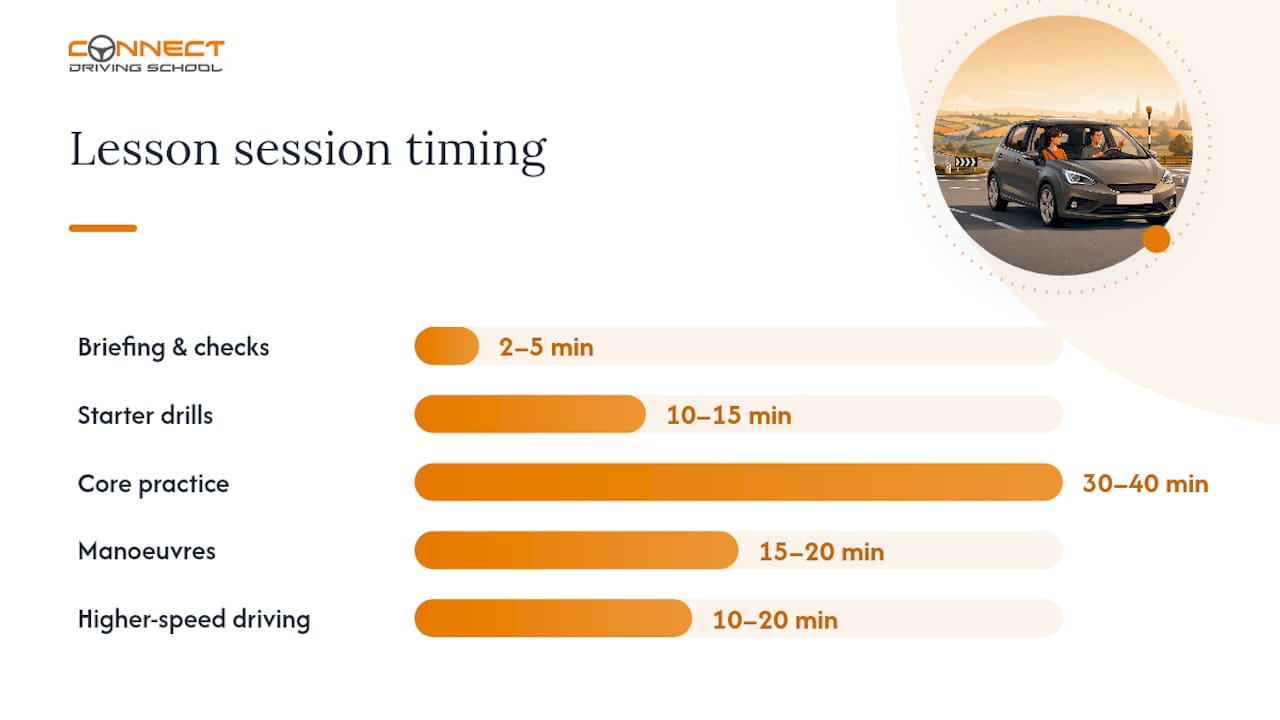
A single session runs best as a time-boxed structure, adjusted up or down depending on whether the learner is a complete beginner or close to test standard.
- Briefing and cockpit checks (2 to 5 minutes). Confirm the learner holds a valid provisional licence, check mirrors, seat position and controls, and agree what the session will focus on.
- Starter drills (10 to 15 minutes). In a quiet road or car park, run through clutch control and moving off safely, especially for anyone in their first few lessons.
- Core practice (30 to 40 minutes). This is the bulk of the lesson: junctions, turning right and left, meeting oncoming traffic, and roundabouts, with a constant loop of mirror, signal, manoeuvre.
- Manoeuvres (15 to 20 minutes). Reverse bay parking, a turn in the road, parallel parking and the emergency stop all need dedicated repetition rather than a rushed five minutes at the end.
- Higher-speed or independent driving (10 to 20 minutes). Dual-carriageway practice or a short independent drive following sat nav directions works well here. Private supervisors must stay off motorways; that stretch is for ADIs running dual-control lessons.
- Review and reflection (5 to 10 minutes). Talk through what went well, note one or two specific errors, and agree a single goal for next time.
Pro Tip: Never end a lesson on the hardest manoeuvre of the day. Finish on something the learner has already nailed, even if it means squeezing in an extra loop of a quiet residential street. Confidence carries over to the next session far better than frustration does.
The National standard for driver and rider training backs this structure up, stressing that lesson plans should adapt to the pupil rather than follow a rigid script. If the core practice block is going badly, cut it short and drop back to starter drills rather than pushing through.
How do instructors adapt this plan to each learner?
DVSA tracks progress across five competence levels: Introduced, Helped, Prompted, Independent and Reflection. A skill starts at Introduced, moves through stages where the learner needs less input, and finishes at Reflection, where the learner can assess their own performance without prompting.
Turn that into one measurable session objective rather than a vague aim like “get better at roundabouts”. Something like “move from Prompted to Independent on mini roundabout approach speed” gives both of you something concrete to check against by the end.
- If the learner is under-challenged, tighten the task: swap a quiet roundabout for a busier one, or ask them to talk through their own decision-making instead of you narrating it.
- If they’re over-challenged, strip it back: return to a quieter road, slow the pace, or isolate one part of the skill (say, mirror checks alone) before rejoining the full manoeuvre.
- After each session, note the competence level reached, the specific error pattern (not just “roundabouts, needs work”), and one target for next time.
This client-centred approach is exactly what DVSA standards checks reward in professional instructors, and it works just as well for a parent running Sunday morning practice.
What are the DVSA’s 27 skills and how do you track them?
The DVSA groups its 27 driving skills into four syllabus units: vehicle preparation, vehicle control, following The Highway Code, and driving safely and efficiently. A compact checklist covering each group makes far more sense than a single unbroken list of 27 items.
- Pre-start and vehicle checks — seat, mirrors, controls, basic safety checks before moving.
- Control — clutch, gears, steering and braking smoothness.
- Observation and signalling — mirror use, blind spots, signal timing.
- Junctions and roundabouts — approach speed, positioning, priority.
- Manoeuvres — bay parking, turn in the road, parallel parking, emergency stop.
- Road types — dual carriageways, one way streets, rural roads.
- Conditions — wet weather, low light, high traffic density.
- Independent driving — following directions or sat nav without prompts.
Mark each skill against the five progress levels. If a learner can perform an emergency stop only when reminded beforehand, that’s Prompted, not Independent, even if the execution itself is clean.
Keeping one shared record between supervisor and instructor matters more than most learners realise. A single progress record prevents mixed-method teaching, where an instructor teaches one technique for roundabouts and a well-meaning relative teaches another. Share it after every private practice session, not just before the next paid lesson.
When is a learner ready for a mock test?
A mock test should mirror the real thing as closely as possible: an independent driving section covering roughly 20 minutes, a route the learner hasn’t rehearsed, and zero prompts from whoever’s in the passenger seat.
- Run the full test format, including manoeuvres chosen at random rather than the ones the learner practises most.
- Score against the same standard as examiners, watching for serious and dangerous faults rather than minor wobbles.
- Check for consistency, not perfection. A learner who is Independent across most skills and only occasionally needs a reminder is in a very different position to one still Helped on basic control.
Ready to Pass recommends delaying the real test if independence isn’t consistent across at least two or three mock runs. Nerves on the day are normal; a learner who freezes only under pressure, but drives well otherwise, is often ready. One who makes the same error whether calm or nervous probably isn’t yet.
How Connect Driving School applies this lesson plan structure
Connect Driving School builds its own courses around the same DVSA framework: tailored lessons, DVSA-approved instructors, and flexible course lengths depending on how quickly a learner progresses. Instructors track each pupil against the 27 skills and five competence levels, so a mock test only gets booked once independence is genuinely consistent, not just hoped for.
That structured approach is a big part of why the school reports pass rates over 92%. Instructors run mock tests under real conditions before recommending a test date, and progress records travel with the pupil across lessons, so nothing gets re-taught from scratch by a different instructor covering a session.
How to run a safety briefing before every lesson
Every session, whether it’s a professional lesson or a parent taking a learner round the block, should open with a short safety briefing before the car moves an inch.
Start with the basics: confirm the learner has their provisional licence with them, check the vehicle is roadworthy (tyres, lights, fuel), and agree what today’s session covers. This takes two minutes and prevents the far more common problem of a lesson drifting without any real focus.
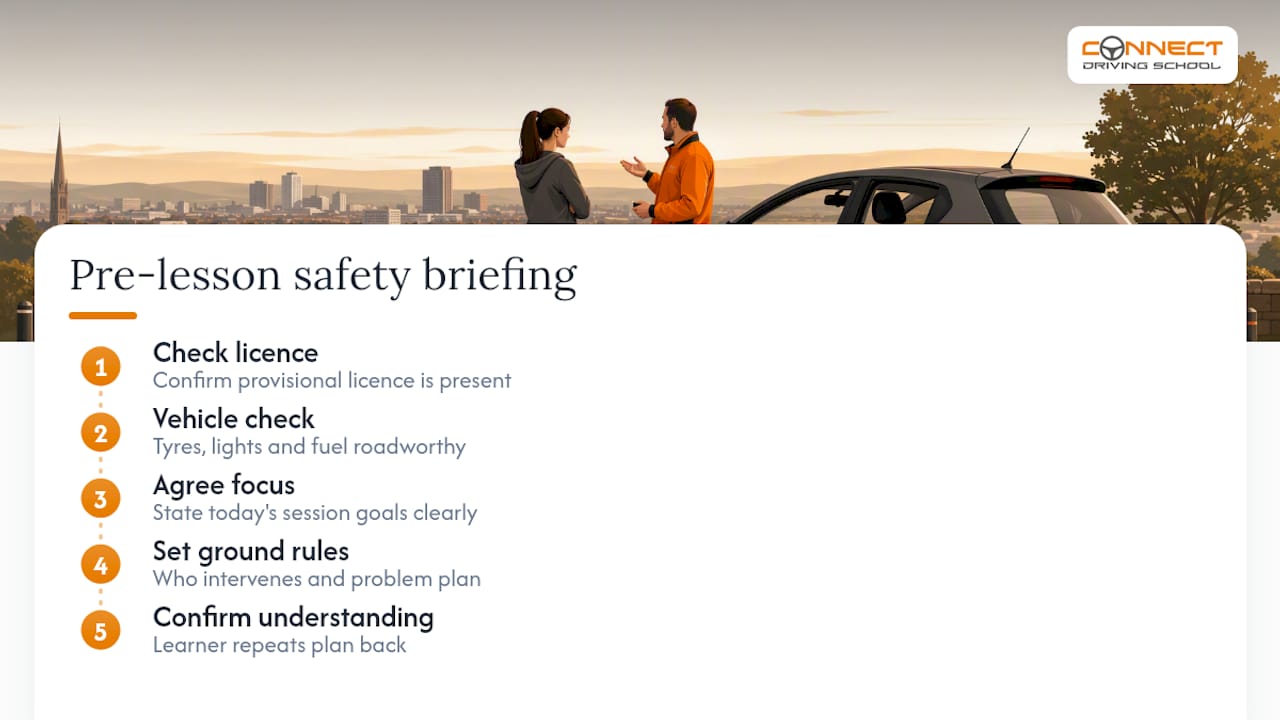
State the ground rules clearly. Who takes over if something goes wrong? What’s the plan if the learner stalls at a junction with traffic building behind? Agreeing this before you’re moving means nobody’s improvising an answer mid-manoeuvre.
Weather and route matter too. A wet, dark evening isn’t the moment to introduce a first parallel park in an unfamiliar street. Match the briefing to conditions: if visibility is poor, say so, and adjust the plan to something the learner can manage safely rather than pushing through regardless.
End the briefing by confirming the learner understands the plan and feels ready. A learner who nods along without really listening is the same learner who freezes at the first junction. Ask them to repeat back what today’s focus is; if they can’t, slow down and go through it again.
Pro Tip: Keep a laminated card in the car listing your standard pre-lesson checklist. It takes the guesswork out of briefings when you’re tired or running late, and it’s one less thing to forget.
Common hazards during lessons and how to handle them
Certain hazards come up in almost every lesson, and dealing with them calmly is a teachable skill in its own right.
Sudden pedestrian or cyclist movement near junctions and parked cars catches new drivers off guard because they’re often focused on vehicles, not people. Practise scanning pavements and cycle lanes deliberately, not just checking for cars.
Traffic building up behind at a junction makes learners panic and rush a manoeuvre they’d otherwise get right. Talk through this in the briefing: a stalled or hesitant learner causing a queue is not an emergency, and rushing to clear it usually creates a bigger problem than the wait itself.
Roundabouts with poor lane discipline from other drivers are one of the most common sources of learner anxiety. Rather than avoiding busier roundabouts entirely, introduce them gradually, starting with quieter ones and narrating your own observation process out loud before asking the learner to do the same.
Sun glare and poor visibility catch out learners who haven’t yet built the habit of adjusting sun visors or slowing earlier in low light. Flag this early and make visor and speed adjustment part of the routine, not an afterthought.
Parked cars narrowing the road force priority decisions that many learners find genuinely difficult to read. Practise on a street with this exact layout repeatedly until judging priority becomes automatic rather than a stressful guess each time.
The instructor or supervisor’s job in all of these cases is the same: stay calm audibly, not just internally. A learner who hears panic in your voice learns to associate the hazard with fear rather than a manageable decision.
What to do in an emergency or unexpected situation
Every supervisor and instructor needs a clear, rehearsed response for when something goes properly wrong, not a vague sense that they’ll “handle it”.
If you need to intervene physically, the dual controls (in a professional lesson) or the handbrake and a calm verbal instruction (in private practice) are your main tools. Grabbing the steering wheel should be a last resort, since it can startle the learner into an overcorrection that’s worse than the original problem.
For a stall in traffic, the instruction is simple and should be given the same way every time: handbrake on, into neutral, restart calmly. Rehearsing this exact sequence in a quiet car park before it happens for real in traffic means the learner has muscle memory rather than panic when it counts.
If another vehicle behaves unpredictably (undertaking, sudden braking, running a red light) the priority is distance, not blame. Teach learners to widen the gap and slow down rather than reacting to the other driver’s mistake with a mistake of their own.
Breakdowns or mechanical warnings mid-lesson need a straightforward drill: pull over safely as soon as possible, hazards on, and stop the lesson until the vehicle’s checked. Never talk a learner through continuing to drive on a warning light you haven’t identified.
After any unexpected incident, however minor, talk it through properly during the review stage rather than glossing over it. A near-miss that gets discussed becomes a lesson learned; one that gets brushed past tends to repeat.
Adapting the plan to different learners and learning styles
No two learners progress at the same pace, and a rigid lesson plan applied identically to everyone is one of the more common reasons progress stalls.
Some learners are visual: they benefit from watching you demonstrate a manoeuvre first, or from you sketching a junction layout before attempting it. Others learn by talking it through, narrating each step out loud as they do it, and some need repeated physical practice before verbal explanation means anything at all. Notice which one you’re teaching within the first couple of sessions.
Anxious learners often need shorter, more frequent sessions rather than one long lesson that lets nerves build. Confident learners who are overestimating their own skill sometimes need the opposite: a slightly harder task earlier than they’d choose themselves, to correct overconfidence before it becomes a habit.
Age and prior experience matter too. A teenager fresh to driving altogether needs far more repetition on basic control than an adult who already drives automatics abroad and is converting to manual UK roads. Adjust the starter drills block accordingly rather than assuming everyone needs the same warm-up.
The DVSA’s own emphasis on client-centred learning exists precisely because a script that works for one pupil can actively slow another down. Watch how a learner responds in the first ten minutes of a session, and be willing to abandon the plan entirely if it’s clearly not landing.
Why structured, measurable lessons actually work
Vague goals like “get more confident” rarely translate into real progress. What moves a learner forward is a specific target for that session and honest reflection afterwards on whether it was met.
The learners who progress fastest aren’t always the most naturally gifted behind the wheel. They’re the ones whose supervisors and instructors keep the plan flexible enough to bend around a bad day, while keeping the record consistent enough that nothing gets forgotten between sessions.
Pro Tip: Rotate where you practise manoeuvres. The same reverse bay park attempted in three different car parks builds genuine skill; the same one attempted fifty times in one car park builds a memorised routine that falls apart the moment the layout changes.
— Mudassar
Book lessons with Connect Driving School
If you’d rather hand the structure and the safety checks to someone else entirely, Connect Driving School runs this exact DVSA-aligned approach as a professional service, with instructor time built around your progress record rather than a fixed script.
The First Driving Lesson starts learners off from a set hourly rate, with DVSA-approved instructors setting a baseline against the 27 skills from day one. If you’re working to a deadline, the Intensive Driving Course compresses a similar structured plan into a concentrated block, while Motorway Driving covers the one area private supervisors legally can’t touch. Already passed but want to sharpen motorway confidence or general road skills? Refresher Driving Lessons and Pass Plus both build on the same competence tracking.
Private practice works well as reinforcement between paid lessons, but it can’t replace professional instruction for motorway work, standards-check-level feedback, or a genuinely objective mock test. If you’re ready to book, check current prices and availability or explore automatic driving lessons and manual driving lessons to find the right fit.
Sources
FAQ
What are the 12 driving lessons some courses refer to?
There’s no official DVSA rule requiring exactly 12 lessons. Course lengths vary by provider and by how quickly a learner progresses against the 27 skills; some courses are packaged around a set number of hours purely for pricing convenience, not a syllabus requirement.
How much should a one-hour driving lesson cost?
Prices vary by region and instructor experience. Connect Driving School’s First Driving Lesson starts from £37.50 per hour, with Refresher Driving Lessons priced the same.
What are the seven steps of a lesson plan?
Common structures cover briefing, warm-up drills, core practice, manoeuvres, higher-speed or independent driving, review, and setting the next goal, roughly matching the six-stage template in this article split slightly differently. There’s no single DVSA-mandated seven-step format; the National standard instead calls for plans adapted to the pupil’s needs rather than a fixed sequence.
What are the 27 skills for driving?
They cover four units: preparing the vehicle, controlling it, following The Highway Code, and driving safely and efficiently, as set out in the DVSA syllabus. Progress on each is tracked using five competence levels from Introduced to Reflection.
Can I supervise a learner without paying for lessons?
Yes, provided you’re at least 21, have held a full licence for three years, and the car is insured for learner drivers. You cannot accept payment for supervising and motorway driving remains off limits in private practice.
Related Posts
Comments (0)