
Step by step parallel parking for UK learners that maps DVSA examiner criteria to mirror cues, focused drills, and instructor lessons.
Pass Your Barnet Test: Mudassar’s 3 Drills and 5 Roads to Practise
Barnet uses several test routes that change regularly, and the DVSA does not publish an official list. Memorising turns is a wasted effort. Instead, practise independent driving with a sat-nav, nail your reversing manoeuvre, and get comfortable on the named local roads examiners return to again and again, before you book your slot at Barnet Driving Test Centre.
TL;DR:
- Practising independent driving with a sat-nav is more effective than memorising turns, as routes are deliberately rotated and unpredictable.
- Key areas like Barnet Hill, Great North Road, and roundabouts near Fiveways Corner are frequently tested, requiring specific familiarity and decision-making skills.
- Preparing on actual roads with an instructor and full mock tests enhances adaptability, especially since routes and conditions can change unexpectedly due to roadworks.
- During the test, candidates should respond calmly to diversions or roadworks, follow instructions clearly, and focus on safety rather than matching a predetermined route.
- Barnet-specific practice, including expert-led lessons and focused route familiarity, offers a significant advantage over generic test prep methods.
Table of Contents
- Barnet test routes: overview and what examiners typically include
- Key roads and Barnet hotspots learners should know
- How to practise Barnet routes effectively
- What to expect on test day at Barnet
- Instructor perspective: Mudassar’s top Barnet route tips
- What happens if roadworks or a diversion crop up during your test
- Why Barnet-specific practice beats generic test prep
- Book Barnet-focused test preparation with Connect Driving School
- Official guidance and helpful resources
- Sources
- FAQ
Barnet test routes: overview and what examiners typically include
The DVSA rotates test routes deliberately, and Barnet is no exception. Examiners avoid running the same route too often on the same roads, partly to stop candidates memorising a sequence of turns rather than actually learning to drive, and partly because DVSA policy requires routes to be reviewed and varied to avoid repeated disturbance to residents. When roadworks appear or traffic patterns shift, routes get updated to match.
Tests at Barnet typically last around 40 minutes and cover a mix of residential streets, main roads, and where possible, faster sections. Every test includes:
- An independent driving section, usually following sat-nav directions
- One reversing manoeuvre, chosen by the examiner on the day
- A possible emergency stop, though this isn’t included every time
DVSA has also flagged a 2025 trial to increase time spent on higher-speed roads and extend the independent driving portion on some tests, which could mean more exposure to A-road style driving during your Barnet test if your route falls under that trial. None of this changes your prep strategy much. It just means the range of road types you might meet has widened slightly, so don’t assume you’ll only see quiet side streets.
Key roads and Barnet hotspots learners should know
Certain stretches of road come up on Barnet routes far more often than others, and knowing what each one demands changes how confident you feel behind the wheel.
- Barnet Hill — a steep, busy descent into the town centre with parked cars narrowing the lane. Keep your speed controlled on the way down and check mirrors early before any lane change.
- Great North Road — a faster, multi-lane stretch used for general driving and sometimes independent driving. Get your lane positioning sorted well before junctions; late decisions here cost marks.
- Barnet Gate Lane — a narrower, more rural-feeling road with tighter bends. Watch your road position and be ready for oncoming traffic on blind corners.
- High Barnet — the high street area near The Spires shopping centre, dense with pedestrians, buses, and frequent 20 mph zones. Prioritise anticipation over hitting the exact speed limit.
- Stirling Corner and Fiveways Corner — multi-lane roundabouts and yellow-box junctions that catch out even confident drivers. Pick your lane early and never enter a yellow box unless your exit is clear.
Pro Tip: At multi-lane roundabouts like Stirling Corner, say your intended lane out loud to yourself as you approach. It forces an early decision instead of a last-second swerve.
How to practise Barnet routes effectively
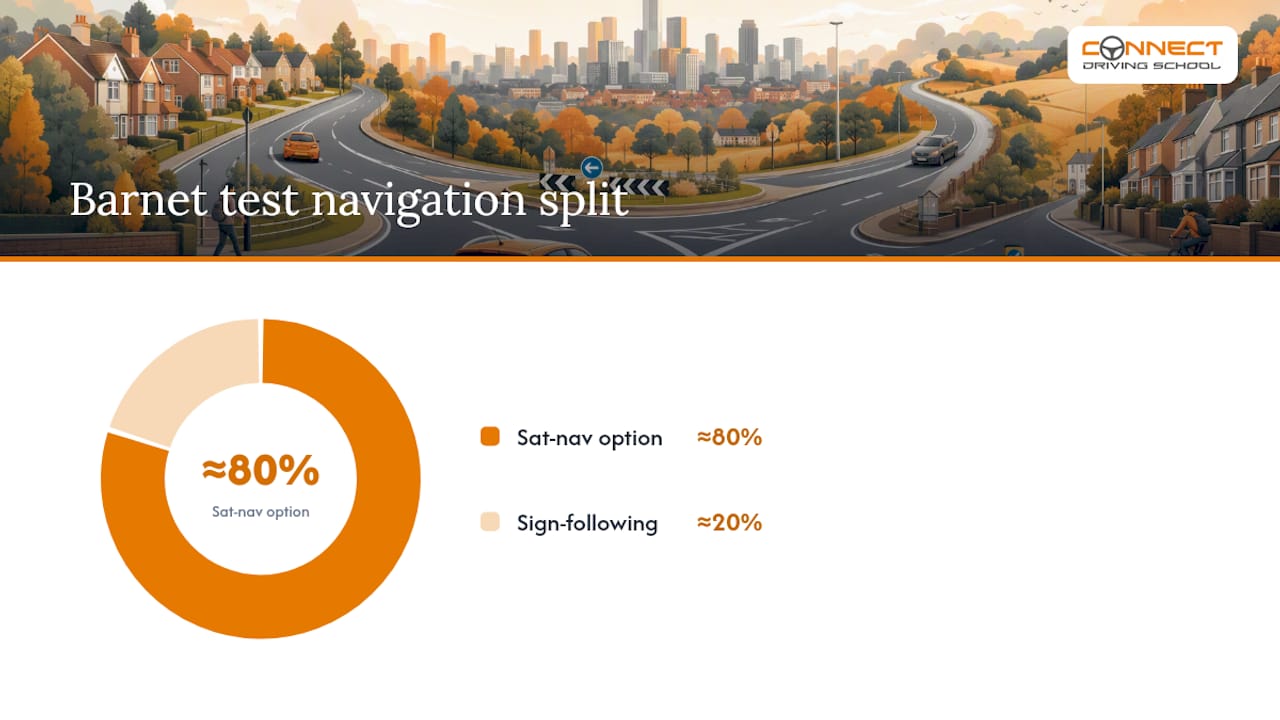
Most Barnet candidates will spend part of their test following a sat-nav rather than road signs. The examiner supplies and sets up the sat-nav themselves, so you can’t bring your own or rely on a device you’ve memorised routes on. Around four in five candidates now get the sat-nav option rather than sign-following, based on how DVSA rolled out this change, so practising both skills matters, but sat-nav confidence matters more.
A few practice methods work well together rather than alone:
- On-road lessons with an instructor — real-time feedback on lane choice, observation, and speed, adapted to whatever route you actually drive that day.
- Instructor-led mock tests — a full run-through under timed, test-like pressure, including the reversing manoeuvre and independent driving section.
- Route-practice apps — useful for familiarising yourself with the general shape of Barnet’s road network, though these are third-party recreations rather than official DVSA routes, and no download gives you the actual test route in advance.
Apps can be a helpful warm-up, but leaning on them too heavily creates a trap: you start driving from memory instead of reading the road in front of you, which is exactly the habit examiners are trained to spot. Combining app familiarisation with instructor-led sessions consistently produces steadier, more adaptable drivers than either method alone.
A solid practice session should run through four stages: a short warm-up drive to settle nerves, a dedicated independent driving block using a sat-nav, focused reversing manoeuvre practice, and finally a full mock test run under genuine time pressure. The Safety Behind the Wheel Foundation’s first-year driving guide covers independent driving fundamentals worth revisiting if sat-nav navigation still feels shaky.
What to expect on test day at Barnet
Barnet Driving Test Centre sits in EN4, and it’s worth building in extra time to get there, whether you’re driving in with your instructor or arriving by public transport. Parking nearby can fill up quickly, especially at peak school-run and commuter times, so leave a buffer rather than cutting it fine.
The test itself follows a fixed sequence:
- An eyesight check
- Then a look at your documents (provisional licence and theory test pass certificate details)
- Some vehicle safety questions before you set off
- General driving covering a mix of the roads discussed above
- The independent driving section, usually sat-nav led
- One reversing manoeuvre
- Possibly an emergency stop
- The whole test runs to roughly 40 minutes in total
If you’re unsure of an instruction mid-test, you can ask the examiner to repeat or clarify it. That’s completely normal and won’t cost you marks. What will count against you is arguing or second-guessing a fault after it’s happened. Ask, adjust, move on.
Instructor perspective: Mudassar’s top Barnet route tips
Three drills consistently separate confident passes from near-misses on Barnet routes: lane discipline through multi-lane roundabouts like Stirling Corner, reading pedestrian movement early on the High Barnet stretch near The Spires, and treating every yellow-box junction as a stop-and-check rather than a gap to squeeze through.
At Connect Driving School, a Barnet mock test session runs the full sequence: a warm-up loop through residential streets, twenty minutes of independent driving with a sat-nav, dedicated reversing manoeuvre repetition, and a timed run mimicking the real 40-minute test.
Pro Tip: If you fault on a roundabout during practice, stop and reset from 100 metres back rather than continuing. Rebuilding the decision from the same distance every time trains the habit, not just the recovery.
[Instructor bio and specific case examples to be added.]
What happens if roadworks or a diversion crop up during your test
Roadworks and diversions are one reason DVSA reviews and updates Barnet routes so often, and if you meet one during your actual test, the examiner adapts on the spot. You won’t be penalised simply because the planned route changed unexpectedly; what matters is how you respond to the road in front of you.
If a diversion appears, follow the signage exactly as you normally would, indicate clearly, and keep your observations sharp, since temporary layouts often narrow lanes or remove markings you’d usually rely on. Roadworks near Great North Road or Barnet Hill can appear with little warning given how frequently those stretches see maintenance work. If you’re following sat-nav directions and a closure forces a different path, the sat-nav will recalculate, and the examiner allows for that. Marks come from how safely you handle the changed environment, not from whether the route matched what you’d expected.
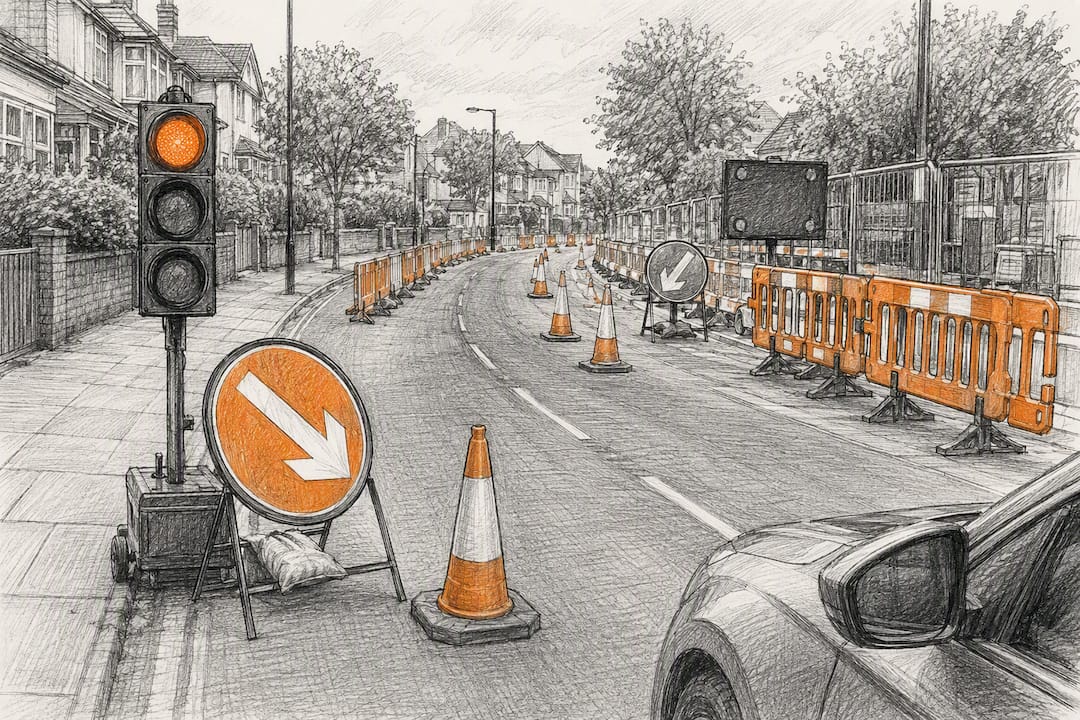
The same principle applies to temporary traffic lights, contraflows, or a lane suddenly closed for utility work. Slow down, increase your following distance if visibility drops, and don’t feel rushed into a decision because the layout looks unfamiliar. Examiners see roadworks constantly and factor unpredictability into how they assess your driving. Panicking is the real risk, not the diversion itself. Treat it like any other hazard: observe, decide, act, and keep talking yourself through it if that helps you stay steady.
Why Barnet-specific practice beats generic test prep
The conventional advice for any driving test tends to be broad: get plenty of hours in, stay calm, know your manoeuvres. None of that is wrong, but it undersells how much local knowledge matters for a centre like Barnet, where a handful of specific junctions do most of the damage to pass rates.
Generic prep treats a driving test as a uniform national experience. It isn’t. A learner who’s driven Stirling Corner’s multi-lane roundabout a dozen times under supervision has a genuine advantage over one who’s only read about roundabout theory, because the fault usually isn’t understanding the rule, it’s the split-second lane decision under pressure. That’s a rehearsed skill, not a memorised fact.
What I’d prioritise first, if time is short: spend disproportionate practice time on the two or three roads that come up most often rather than spreading hours evenly across the whole area. Barnet Hill, the Great North Road stretch, and the roundabouts near Fiveways Corner deserve more repetition than a quiet side street you might never encounter on test day.
— Mudassar
Book Barnet-focused test preparation with Connect Driving School
Connect Driving School is the practical alternative to generic online route guides for learners preparing at Barnet, because instead of a static list of turns, you get an instructor who drives you through the actual roundabouts, high streets, and reversing spots the test uses, and adjusts the session to whatever’s giving you trouble.
If you’re close to test-ready and just need a final polish, Connect Driving School offers test-prep lessons that include a focused run through Barnet’s trickiest junctions and a full mock test under time pressure. If you’re starting further back, the Intensive Driving Course from £1,200 compresses weeks of practice into a concentrated block, and Pass Plus from £270 is worth considering once you’ve passed, to build confidence on faster roads like the Great North Road. Automatic and manual tuition are both available depending on which test you’re booked for. Head to the Connect Driving School prices page to check availability and book your next Barnet-focused lesson.
Official guidance and helpful resources
For the rules examiners actually follow rather than secondhand summaries, go to the source. DVSA’s mock test guidance explains sat-nav policy directly, while the residential route nuisance policy explains why routes shift over time. For independent driving fundamentals beyond Barnet specifically, the Safety Behind the Wheel Foundation’s first-year guide is a solid supplementary read.
Sources
- Gov
- DVSA bulletin — trial to increase time on higher‑speed roads
- Barnet (London) test centre — DrivingData UK
FAQ
Is Barnet an easy test centre to pass at?
Difficulty depends more on preparation quality than the centre itself. Barnet’s routes include genuinely testing sections, like multi-lane roundabouts and busy high-street stretches, so targeted practice on those specific hotspots matters more than general driving hours alone.
What are the driving test routes at Barnet driving test centre?
DVSA doesn’t publish official routes for Barnet or any test centre, and examiners choose and can change routes to prevent memorisation. Common roads that come up include Barnet Hill, the Great North Road, Barnet Gate Lane, and the High Barnet area near The Spires.
What is the easiest driving test route in London?
No London test centre publishes routes ranked by difficulty, and DVSA’s variation policy means “easiest” isn’t a fixed concept anywhere. The better question is which skills need the most work, since a route that suits one learner (quieter roads, fewer roundabouts) might expose weaknesses in another.
Can you download driving test routes?
You can download third-party apps that recreate likely Barnet routes for practice, but these are unofficial simulations, not DVSA-published routes. They’re useful for general familiarisation, though instructor-led sessions catch the real-time decision-making that an app can’t replicate.
Does Connect Driving School offer Barnet-specific test preparation?
Yes. Connect Driving School runs test-prep lessons and full mock tests covering Barnet’s known hotspots, including Stirling Corner and the High Barnet stretch, with current prices listed on the Connect Driving School pricing page.
Related Posts

Comments (0)