
Practical UK toolkit to manage driving lesson anxiety: box breathing, an "I need a moment" script, how to pick an ADI, and when to tell the DVLA.
£34–£45 an hour in London: plan lessons around 14.7 week DVSA waits
Expect to pay around £34 to £45 an hour for manual lessons in London and a bit more for automatic, with prices generally higher in central boroughs and near busy test centres. A 10-lesson pack usually offers some per-hour discount, and a 30-hour intensive course costs considerably less per hour than paying lesson by lesson. Some driving schools publish package pricing on their own sites, which makes it worth a look if you want to compare numbers without ringing round five schools first.
TL;DR:
- Most learners should budget around £800 to £1,200 for 20 to 30 lessons, including test fees, to cover test preparation and retest risks.
- Lesson durations can significantly affect hourly costs, with 45-minute lessons often costing more per hour than full hour sessions, so always check the per-hour rate.
- Booking intensive courses or packages usually offers better value, with discounts for weekday bookings and bulk purchases, compared to pay-as-you-go lessons.
- Early test booking and avoiding long gaps in practice are crucial to prevent additional costs from retakes and extra lessons due to skills fading.
- Confirming instructor approval, test centre experience, and clear cancellation policies before booking can prevent unexpected expenses and scheduling issues.
Table of Contents
- Why do driving lessons cost so much in London?
- Which driving schools in London offer the best value?
- How do you choose the right driving school in London?
- How do lesson packages and intensive courses cut costs?
- How do DVSA waiting times affect your total cost?
- What does Connect Driving School actually offer?
- What happens if you cancel or miss a lesson?
- How do you pay for driving lessons in London?
- What London learners get wrong about lesson costs
- Booking with Connect Driving School: what happens next
- Sources
- FAQ
Why do driving lessons cost so much in London?
London prices sit well above the national average, and it isn’t just because instructors can charge more here. PassRates’ 2026 guide puts London manual lessons at roughly £35 to £45 an hour, against a much lower national baseline, and pins the gap on operating costs rather than pure margin. An instructor stuck in stop-start traffic on the South Circular burns more fuel and loses more billable time between pupils than one working in a market town. Add London’s higher insurance premiums and the congestion charge if lessons run through central zones, and the hourly rate has to absorb all of it.
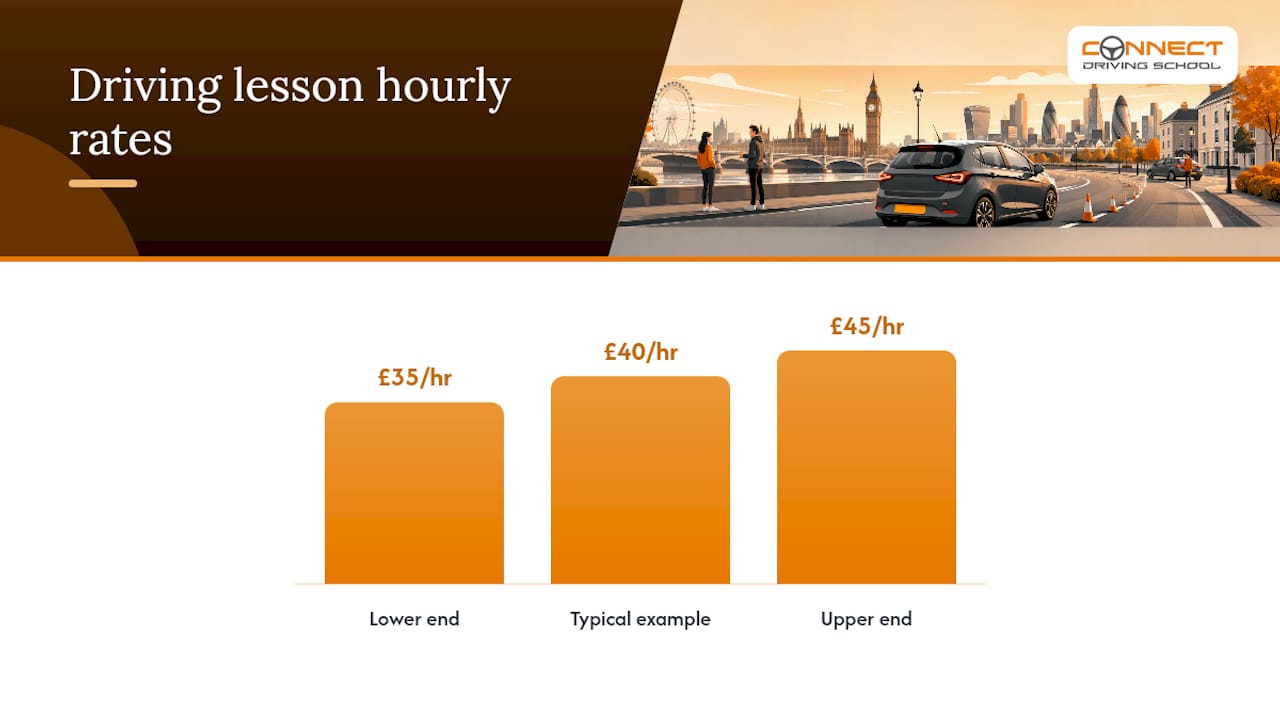
Lesson length matters more than most learners realise when comparing quotes. A “£30 lesson” advertised for 45 minutes actually costs more per hour than a £38 lesson booked for a full 60 minutes. Always ask for the per-hour rate, not the per-lesson price, before you compare two schools.
Timing changes the bill too:
- Weekday daytime slots are usually the cheapest, since instructors have more availability to fill.
- Evenings and weekends often carry a premium of a few pounds an hour.
- Last-minute single bookings almost always cost more than lessons booked as part of a course.
**Here’s the maths that matters for budgeting: for example, at about £40 an hour, 20 lessons cost roughly £800, 30 lessons about £1,200, and adding the practical and theory test fees brings the total to a realistic beginner-to-test budget without retest risk.
Which driving schools in London offer the best value?
One driving school leads this list because it publishes clear package pricing on its own site, something several London providers still make you ring up to find out. The table below draws on Google-verified ratings and each school’s own published information.
DriveThruL and 1Driving.co.uk are two of the few local schools that put actual figures on their websites, which is why they carry hourly prices in the table above. Most competitors keep pricing behind a phone call or a contact form, so treat the blank cells as a reminder to ask directly rather than a gap in the school’s quality.
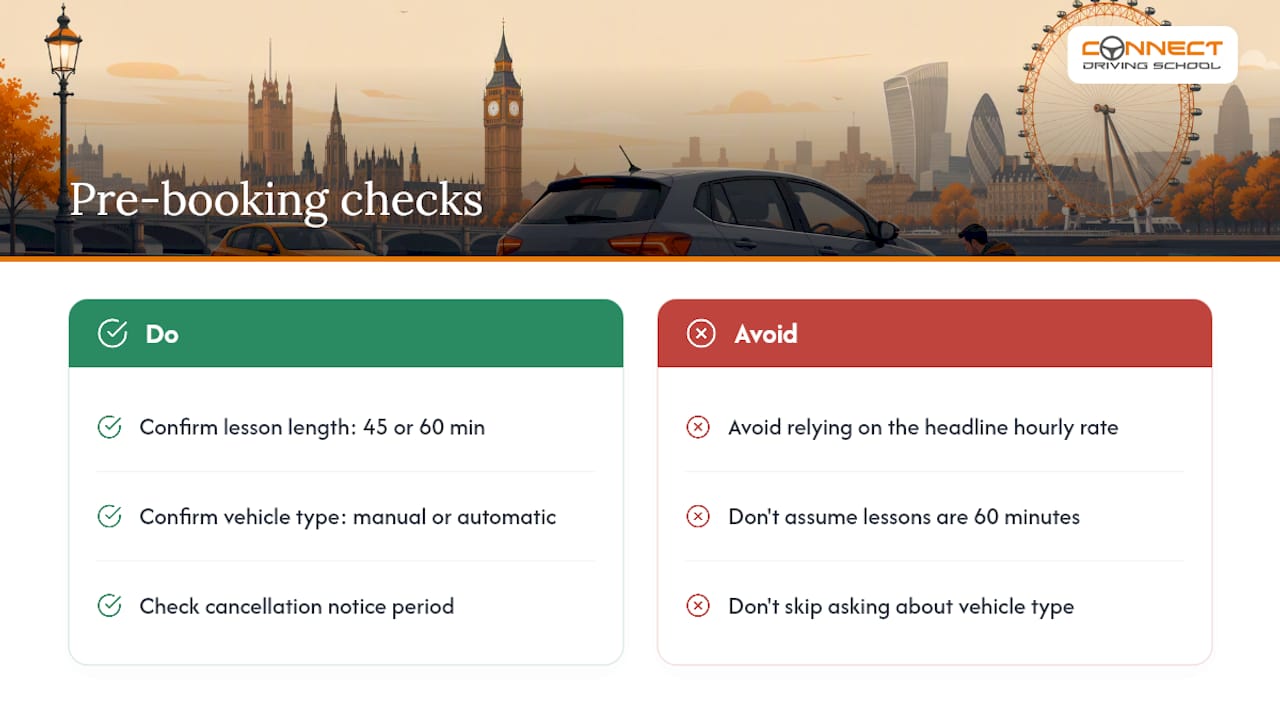
Before booking with any of these, confirm three things on your first call: the exact lesson length (45 or 60 minutes), whether the vehicle is manual or automatic, and the cancellation notice period. Those three details change the real cost more than the headline hourly rate does.
How do you choose the right driving school in London?
Ratings tell you almost nothing about fit. A five-star school with 800 reviews might still be wrong for a nervous learner who needs a slower pace, or for someone booked into a test centre the instructor rarely covers. Work through this instead:
- Confirm DVSA/ADI approval. Every instructor should hold a valid ADI badge; ask for the badge number if it isn’t listed on the website.
- Check pricing is visible or easily quoted. Schools that publish rates, like Connect Driving School, save you the awkward “how much is it really” phone call.
- Ask about local test-centre experience. An instructor who regularly teaches around your test centre knows its quirks, from tight roundabouts to notorious junctions.
- Clarify lesson length and vehicle type upfront, so quotes compare fairly.
- Ask directly: “What’s your current availability? Do you offer mock tests? What’s your recent pass rate, and what’s your cancellation policy?”
Red flags include instructors who won’t confirm a badge number, vague answers about cancellation charges, or pass-rate claims with no detail behind them.
Pro Tip: Book your final few lessons to land in the same week as your test, not weeks before it. Skills fade fast, and a gap between your last lesson and test day is one of the most common, avoidable reasons for failing.
How do lesson packages and intensive courses cut costs?
Buying in bulk almost always beats paying lesson by lesson. A 10-lesson pack commonly shaves several pounds off the per-hour rate compared with single bookings, and weekday block bookings tend to offer the sharpest discount.
- 10-lesson packs: typically the best entry point for steady per-hour savings.
- Intensive courses: compress 20 to 40 hours into one or two weeks, useful if you need a licence fast or learn better through repetition rather than long gaps between lessons.
- Pass Plus: a short post-test course, commonly priced from £255, aimed at motorway and higher-speed confidence.
- Motorway lessons: often sold separately for learners nearing their test, since motorways aren’t part of the practical test itself.
Intensive courses work best when you can commit fully for the week. If life gets in the way midway through, book a top-up lesson before the test to rebuild muscle memory rather than walking in cold.
How do DVSA waiting times affect your total cost?
Waiting times add a real, often underestimated cost to learning in London. The DrivePro tracker records a London median wait of roughly 14.7 weeks, with slot-availability running as high as 23.5 weeks, meaning you may need to search almost six months ahead to find a test slot in some areas. The AA reports some national easing, but London still lags behind many other regions.
Failing your test adds another layer of cost. With a national pass rate in the late 40s percent, budgeting for at least one retest is realistic. A failed test means another £62 fee plus, typically, two to four extra lessons to fix whatever went wrong, easily £100 to £200 on top of your original plan.
- Book your test slot as early as possible, then work backwards to schedule lessons.
- Avoid a long idle gap between your last lesson and test day.
- Ask your instructor for a mock test in your final one or two sessions.
What does Connect Driving School actually offer?
Some driving schools offer a full journey for London learners, including first lessons, intensive courses, Pass Plus, and dedicated motorway sessions, typically taught by DVSA-approved instructors in both manual and automatic vehicles. Some of these providers set out clear pricing rather than leaving you to guess:
- Pricing for first lessons, intensive courses, Pass Plus, and motorway lessons varies by school; check directly with the provider for current rates.
Combined with DVSA-approved instructors and published pricing, it gives London learners a rare thing in this market: a number you can check before you ever pick up the phone.
What happens if you cancel or miss a lesson?
Cancellation terms vary more between London driving schools than almost any other cost factor, and they catch out more learners than bad instructors do. Most schools require between 24 and 48 hours’ notice to cancel or reschedule without charge; miss that window and you’ll typically still be billed the full lesson price, since the instructor has usually turned down other pupils for that slot.
Some schools charge a flat cancellation fee rather than the full lesson cost, others simply forfeit the slot from a pre-paid package. Intensive courses tend to have stricter terms again, since the whole week is often blocked out in advance; cancelling partway through can mean losing several hours of pre-paid tuition rather than a single lesson.
Ask about the cancellation policy before you pay for a package, not after. Specifically:
- How much notice is required to cancel or reschedule without charge?
- Is the cancellation fee a flat rate or the full lesson price?
- What happens to unused hours in a block booking or intensive course if you need to pause?
- Does bad weather or instructor illness count differently to a personal cancellation?
Weather-related cancellations, instructor illness, and vehicle breakdowns are usually handled outside standard cancellation terms, but confirm this rather than assuming. A school with a clear, written cancellation policy, ideally visible before you book, is generally a better sign than one that only explains its terms after you’ve already paid.
How do you pay for driving lessons in London?
Most London driving schools accept card payments and bank transfers as standard, with cash becoming less common as instructors move to app-based booking systems. Debit and credit card payments are typically processed either through the instructor directly or via a booking platform tied to the school.
Package and intensive course payments are usually taken upfront or in a deposit-plus-balance structure, since schools need to block out instructor time in advance. Some schools offer instalment options for larger intensive courses, splitting a £1,000-plus course into two or three payments rather than one lump sum; ask specifically if this matters for your budget, as it isn’t always advertised upfront.
There’s no widespread government financing scheme for standard driving lessons, but younger learners and their families sometimes spread costs by combining a smaller weekly-lesson budget with a shorter intensive top-up nearer test day, rather than paying for one long course in full. If a parent or guardian is covering costs, ask whether the school will invoice separately or require the named account holder to be the one paying, since this varies between providers and can cause payment delays if not clarified early.
What London learners get wrong about lesson costs
Most cost guides treat London driving lessons as a single number to hunt down, cheapest hourly rate wins. That’s the wrong frame. The bigger cost risk isn’t the rate per hour, it’s the combination of a long DVSA wait and a failed test, which can add hundreds of pounds that no amount of haggling over £2 an hour will offset.
The conventional advice, “shop around for the cheapest instructor”, ignores that London’s slot-availability waits can stretch past five months in some areas. A learner who books cheap lessons but starts too late, or leaves a gap before their test, often ends up paying more overall through refresher lessons and repeat fees than someone who paid slightly more for a school with clear scheduling and mock-test support.
Prioritise this order: confirm your test date window first, then work backwards to a lesson schedule, then compare hourly rates between schools that fit that timeline. Price matters, but it’s the third question, not the first.
— Mudassar
Booking with Connect Driving School: what happens next
Some driving schools provide lesson pricing you can check before you commit, rather than receiving a quote only after a phone call. Their instructors may be DVSA-approved and have working knowledge of test routes in certain London areas.
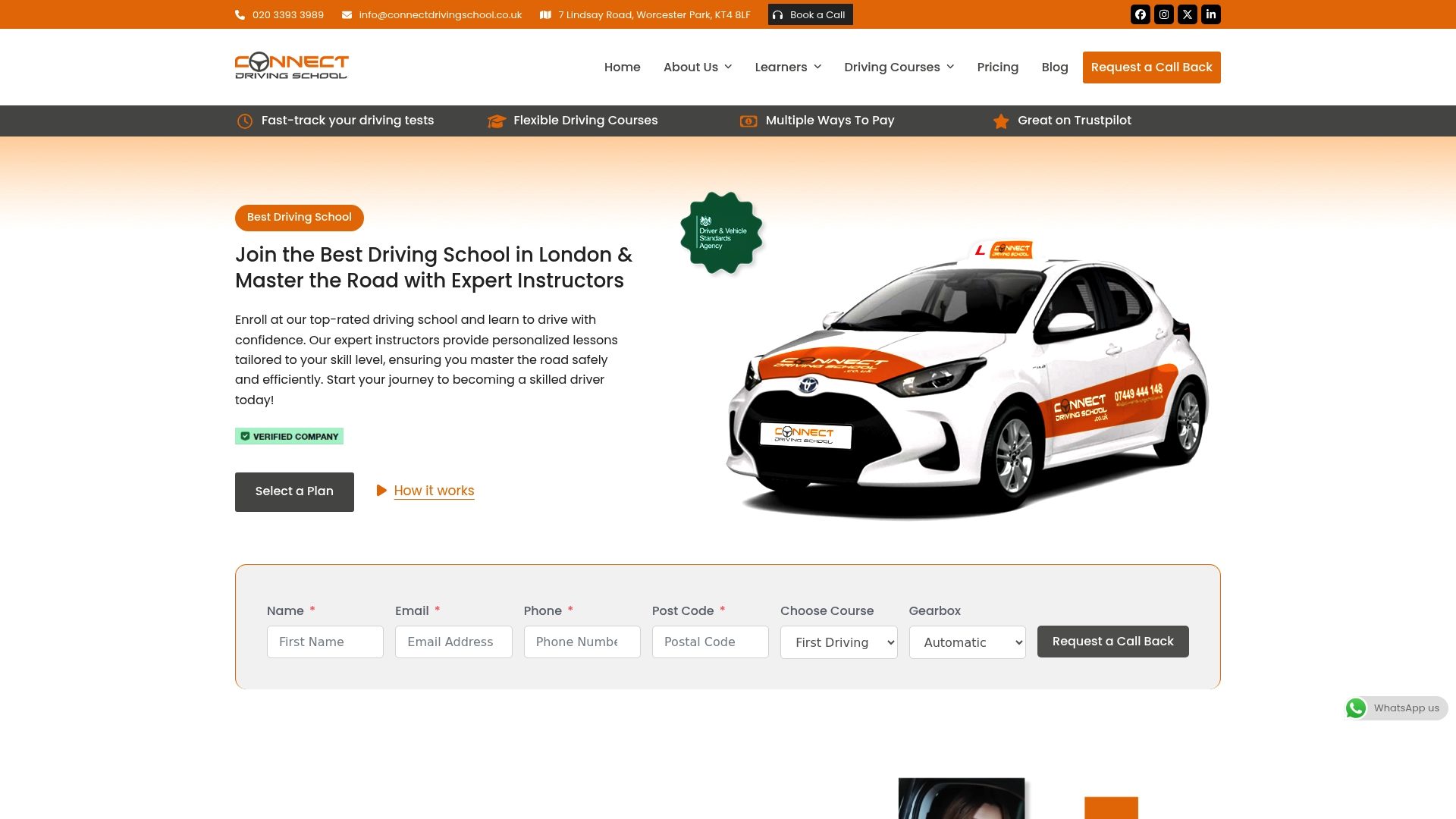
Booking is simple: pick your first lesson or a package on the Connect Driving School booking page, choose manual or automatic, and confirm your preferred days. For your first lesson, bring your provisional licence and glasses or contact lenses if you need them for driving, that’s genuinely all you need. If you already know your test centre, mention it when booking so your instructor can build route familiarity into early lessons rather than leaving it until the final few sessions.
Sources
- DrivePro driving test waiting times tracker
- AA newsroom — driving test waiting times
- PassRates — driving lessons cost UK 2026
FAQ
How much is 20 driving lessons in the UK?
At London’s typical rate of £34 to £45 an hour, 20 lessons cost roughly £800 to £900; national averages outside London tend to be lower, but exact figures vary.
How do you claim 40 hours of free driving lessons?
There’s no general 40-hours-free scheme for UK learners; some local authorities and youth programmes have offered limited free-lesson schemes in the past, so check with your local council or school rather than assuming national eligibility.
Is 20 lessons enough to pass?
It depends entirely on prior experience and how often you practise between lessons; many learners need closer to 30 to 40 hours of tuition plus private practice, and building in a buffer of a few extra lessons before your test reduces the risk of a costly retest.
How much is 12 driving lessons?
Twelve lessons at London’s typical £34 to £45 hourly rate usually cost several hundred pounds, though block-booking discounts from schools such as Connect Driving School can reduce that amount.
Related Posts

Comments (0)