
Expect £34–£45 an hour in London. Learn how to budget, schedule around long DVSA waits, and choose schools that publish clear package pricing.
8 mock Isleworth test routes to run before Fleming Way test day
Isleworth (Fleming Way) tests follow the standard DVSA format, mixing residential streets, busy junctions and faster A-roads rather than one fixed route. Practise varied mock tests covering these road types instead of memorising a single path, since DVSA no longer publishes exact routes. Book targeted practice sessions on the local roads described below and you will walk in with far less uncertainty.
TL;DR:
- Practise a variety of routes that include residential streets, junctions, and faster roads, since DVSA no longer publishes exact test routes.
- Focus on improving observation, lane discipline, and pedestrian crossing positioning, especially at busy junctions and roundabouts.
- Incorporate 20 to 35-minute independent driving segments in mock tests, following sat-nav instructions and reacting to road signs.
- Build confidence by running through different routes at different times of day to simulate real traffic variations and avoid pattern memorization.
- Arrive early with all documents, avoid over-rehearsing a single route, and conduct last-minute mock tests two days before the exam for better stress management.
Table of Contents
- Isleworth (Fleming Way) test centre: quick facts and what to expect on test day
- Sample Isleworth (Fleming Way) routes: mock routes you can use
- Designing mock tests for Isleworth: a lesson plan that actually builds skill
- Common hazards and examiner focus on Isleworth routes
- Independent driving and sat-nav rules at Isleworth
- Local tips and a pre-test checklist for Fleming Way
- Instructor perspective: what we see most often with Isleworth candidates
- How Connect Driving School can help with Isleworth test preparation
- Sources
- FAQ
Isleworth (Fleming Way) test centre: quick facts and what to expect on test day
The test centre sits on Fleming Way in Isleworth, TW7, and bookings run through the standard DVSA driving test booking service. Learners travelling from driving school coverage areas across south and southwest London can usually reach it by car or a short train and bus combination, so build in extra time if you are arriving from further out.
On the day, the test runs to a familiar structure:
- An eyesight check and two vehicle safety questions (“show me, tell me”) before you set off.
- General driving covering a broad mix of road types local to Fleming Way.
- Around 20 to 35 minutes of independent driving, with the examiner handling any sat-nav setup.
- One or two manoeuvres, and possibly an emergency stop.
The whole test takes roughly 40 minutes. Isleworth’s pass rate sits at or slightly above the national average in recent centre reporting, which tells you something useful: this is not a notoriously brutal centre stacked against learners, nor an easy ride. It behaves like a fairly typical London test centre, so generic overconfidence is as risky as excessive nerves.
Sample Isleworth (Fleming Way) routes: mock routes you can use
DVSA stopped publishing official test routes some years ago specifically to stop learners memorising turns instead of learning to drive, so treat everything below as a practice framework built from public route patterns and local road knowledge, not a guaranteed exam route. The value is in the road mix, not the exact sequence.
-
Fleming Way to Twickenham Road loop. Leave the centre, join London Road, then head towards Twickenham Road. This route mixes moderate traffic with several pedestrian-heavy stretches near shops, good for testing observation habits. Roughly 15 to 18 minutes, with a right turn at a busy junction that tests gap judgement.
-
Isleworth to Syon Lane. Head south towards Syon Lane, crossing residential roads before reaching a stretch with more consistent 30mph traffic flow. Useful for practising steady speed control after a series of give-way junctions. Around 12 minutes.
-
South Street and the one-way sections. Isleworth has narrow one-way stretches near the town centre that catch learners out on positioning. Run this short loop, under 10 minutes, purely to build confidence with tight road width and parked cars on both sides.
-
Twickenham Road towards the A310. This route takes you from slower residential roads onto a faster arterial stretch, a good proxy for the independent driving section since it forces route decisions at speed. Budget 18 to 20 minutes.
-
Church Street and the roundabout approach. Includes a multi-lane roundabout with lane discipline pressure. Practise mirror checks well before the roundabout, not on approach. Around 12 minutes.
-
Worton Road industrial loop. Quieter roads with wide junctions, ideal for practising manoeuvres like bay parking or a controlled stop, since there is space and lower traffic pressure. Around 10 minutes plus manoeuvre time.
-
London Road towards Brentford. A longer stretch with heavier traffic and bus stops, useful for bus lane awareness and cyclist interaction. Around 15 minutes.
-
Mixed loop combining two of the above. Once a learner is comfortable with each segment individually, string two together to simulate the full 40-minute structure, including a manoeuvre midway.
Pro Tip: Rerun each route at a different time of day. Isleworth traffic patterns shift noticeably between a quiet mid-morning slot and the school-run congestion around 3.30pm, and an examiner won’t schedule around your comfort zone, so neither should your practice.
Designing mock tests for Isleworth: a lesson plan that actually builds skill
A mock test only earns its name if it mirrors the real structure, not just the roads. Set each session up properly and the routes above become genuine exam preparation rather than a scenic drive.
- Open with the basics. Run an eyesight check and one “show me, tell me” question before moving off, exactly as DVSA examiners do.
- Run a genuine independent driving block. DVSA’s own mock-test guidance recommends around 30 minutes total, and suggests mixing urban roads, dual carriageways and multi-lane roundabouts within that time.
- Build in manoeuvre opportunities deliberately. Plan a straight stretch for pulling up on the right and reversing, a bay for parking practice, and a quiet street for parallel parking, rather than hoping one appears.
- Set the sat-nav up properly, then let go of it mentally. Practise following spoken directions without over-relying on the screen, since examiners expect drivers to react to road signs too.
- Vary start points and directions each session. Begin from a different spot on Fleming Way or reverse the direction of a familiar loop. This stops pattern memorisation and forces real decision-making, which is what actually transfers to test day.
- Debrief immediately. Note every hesitation, missed mirror check or late signal while it is fresh, not after the drive back.
Common hazards and examiner focus on Isleworth routes
Local test-centre summaries point to a recurring pattern around Fleming Way: busy junctions, frequent pedestrian crossings, and the shift from narrow residential streets to faster arterial roads catch learners off guard more than any single tricky manoeuvre.
Expect examiners to pay close attention to:
- Deliberate, visible mirror and blind-spot checks, particularly before lane changes near multi-lane roundabouts.
- Thorough observation at T-junctions, where a rolling glance rather than a proper check is a common minor fault.
- Positioning and timing around pedestrian crossings, especially near shops on South Street and London Road.
- Correct behaviour around bus lanes and cyclists, both common on the busier stretches towards Brentford.
Examiners generally care more about seeing deliberate observation than achieving perfect lane placement. A drill worth running with an instructor: approach three or four junctions in a row and narrate your mirror checks out loud. It sounds unnatural, but it trains the habit examiners are actually marking.
Independent driving and sat-nav rules at Isleworth
The independent driving section runs for 20 to 35 minutes, and the examiner sets up the sat-nav for you, so you never need to fumble with a postcode mid-test. Following directions correctly matters, but so does reading road signs, since either method can be used.
- Practise following spoken sat-nav instructions on unfamiliar Isleworth streets, not just your usual routes.
- Get comfortable reacting to road signs alone occasionally, in case the sat-nav briefly loses signal near Fleming Way’s built-up sections.
- Know that a wrong turn is not an automatic fail. Examiners simply direct you back on track, so your mock tests should include deliberately taking a wrong turn now and then to practise staying calm.
Local tips and a pre-test checklist for Fleming Way
Arrive around 10 minutes early, not much more, and check parking availability near Fleming Way in advance since spaces can be tight during school run times. Bring your provisional licence and test confirmation, and double-check your instructor’s car is booked for the slot.
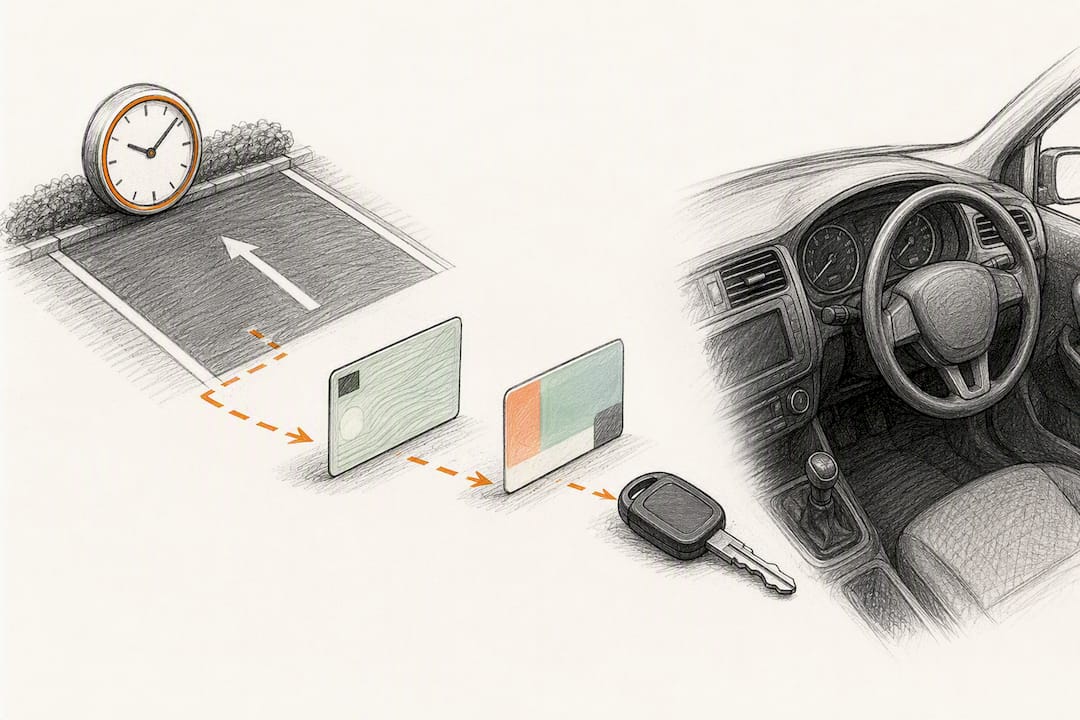
Avoid the trap of over-rehearsing one favourite loop until it feels safe. Local routes are reviewed periodically and can shift after roadworks or resident complaints, so variety matters more than familiarity with a single path.
Pro Tip: Run your last mock test two days before, not the morning of. A same-day mock often raises anxiety rather than settling it.
- Confirm test time and centre address the night before.
- Check documents: provisional licence, test confirmation email.
- Arrive with the car fuelled and mirrors adjusted before you even reach Fleming Way.
- Do a short 10-minute warm-up drive beforehand if your instructor’s schedule allows it.
Instructor perspective: what we see most often with Isleworth candidates
The learners who pass first time on Fleming Way routes are rarely the ones who drove the same loop twenty times. They are the ones who handled an unexpected diversion calmly, because their mock tests were varied enough to force real decisions. Targeted local practice, not repetition, builds that adaptability.
— Mudassar
How Connect Driving School can help with Isleworth test preparation
This driving school provides an alternative to guessing your way through test prep with generic routes pulled from an app. Their DVSA-approved instructors run local mock tests built around Fleming Way’s actual road mix, so your last few lessons focus on the junctions, crossings and roundabouts that trip learners up here specifically, not a script.
Sessions are built as tailored pre-test packages, and manual and automatic tuition are both available depending on which licence you’re working towards. If you’re within days of your test date, a last-minute mock lesson focused purely on Isleworth’s hazard points can sharpen the habits examiners are actually marking. You can check availability and book a lesson or pre-test package through Connect Driving School.
FAQ
What are the driving test routes in Isleworth?
DVSA no longer publishes official routes for any centre, including Fleming Way, so Isleworth routes are best treated as a mix of residential streets, busy junctions and faster roads like the A310, practised through varied mock tests rather than a single memorised path.
Is Isleworth a good place for driving tests?
Isleworth (Fleming Way) is a fairly representative London test centre, with a pass rate reported at or slightly above the national average, meaning it is neither notably easier nor harder than typical local alternatives.
What is the pass rate for the Isleworth driving test centre?
Recent centre-level reporting places Isleworth’s pass rate close to or just above the national average, making it a reasonably typical benchmark rather than an outlier.
How do I check driving test routes?
You cannot check official routes directly since DVSA stopped publishing them, but you can build realistic practice by driving the varied road types around your test centre and running full mock tests that follow DVSA’s own mock-test structure.
Related Posts
Comments (0)