
Shortlist of London short notice driving test car hire options, DVSA vehicle requirements, and a practical booking checklist to avoid test day refusal.

Avoid Losing £62–£75: UK Checklist & Instructor Tips for Using a Car
Yes, you can use your own car or a hire car for your UK driving test, provided it meets DVSA rules on tax, MOT, insurance and roadworthiness. The most common reasons for an on-the-spot cancellation are dashboard warning lights, insurance that does not explicitly cover a driving test, and vehicles the examiner is not permitted to use.
TL;DR:
- Cars used for testing must be taxed, insured for a test, and have a valid MOT if over three years old, with no dashboard warning lights.
- Hire cars require written permission from the provider, proper insurance covering test use, and functional dual controls to be eligible for the test.
- Driver aids like parking sensors and cruise control are usually allowed, but self-parking or autopilot features and satnavs are not permitted during the test.
- Passing in an automatic license restricts the driver to automatic vehicles, while a manual pass grants the license for both manual and automatic cars.
- Conducting last-minute safety checks on warning lights, tyres, and documents the night before can prevent test cancellation and save costs.
Table of Contents
- DVSA rules for using your own car for the practical driving test
- Hire cars, dual controls and insurance: can you use a rental or instructor hire car?
- Vehicle features you can and cannot use during the test
- Manual vs automatic: what changes (if anything) for your test and licence
- Day-of-test checklist: a practical pre-test vehicle and hire checklist
- Practical tips from Connect Driving School (instructor perspective)
- Author’s perspective: prioritise readiness over last-minute practice
- FAQ
- Sources
DVSA rules for using your own car for the practical driving test
Before you book your test car, check it against the official requirements. According to Gov, the vehicle must be roadworthy, taxed, insured specifically for a driving test, and fitted with the right equipment. A car that is merely “driveable” is not automatically test-ready.
The core checks are straightforward but easy to overlook:
- The car must be taxed and, if it is over three years old, hold a valid MOT certificate.
- Insurance must cover the person taking the test, not just the registered keeper or instructor.
- The vehicle needs an extra interior mirror for the examiner, a working passenger seatbelt, and a head restraint that is not a slip-on type.
- L-plates must be displayed clearly on the front and back.
- The car must be able to reach 62 mph, have a speedometer in mph, four wheels, and fall within the maximum authorised mass limits for a standard car test.
Dashboard warning lights are a frequent, avoidable cause of cancellation. Examiners will refuse to test in a car showing an airbag, ABS or engine management light, even if the fault seems minor or intermittent, so checking insurance and warning lights before arrival is worth doing the night before, not on the drive over.
If your car has an outstanding manufacturer safety recall, bring stamped proof from the dealer or manufacturer, or a screenshot of a recall check showing no action is pending. Without this, the examiner can cancel the test on the spot. The DVSA also maintains a list of specific models that cannot be used because they restrict the examiner’s all-round vision, so it is worth confirming your exact model is not excluded before test day.
Hire cars, dual controls and insurance: can you use a rental or instructor hire car?
Most candidates sit their test in their instructor’s car, since the DVSA does not supply vehicles for any part of the test. That is the simplest route for most learners, but hire cars and rentals are allowed too, within limits.
Many hire companies explicitly forbid their vehicles being used for a driving test, so a standard rental agreement is not automatically test-ready. If you plan to hire a car, follow these steps:
- Contact the hire company directly and get written confirmation that the vehicle may be used for a driving test.
- Check the hire agreement and the insurance policy both state, in writing, that test use is permitted, not just general driving.
- Confirm whether dual controls are fitted and working, since many instructor-hire cars include them and some test centres expect to see them on an instructor’s vehicle.
- Bring the written permission and insurance documents with you in case the examiner or test centre staff ask to see them.
Dual controls give an instructor a secondary brake and clutch, used during lessons rather than the test itself, but their presence is one of the quickest ways an examiner recognises a legitimate instructor vehicle. As DVSA examiner guidance notes, even a dual-controlled hire car still needs explicit permission and the correct insurance before it counts as eligible.
Pro Tip: If you are at all unsure about a hire car’s paperwork, book your test in your instructor’s car instead. It removes the insurance guesswork entirely.
Vehicle features you can and cannot use during the test
Modern cars come loaded with driver aids, and not all of them are fair game on test day. Knowing which ones to leave on and which to switch off avoids confusion mid-route.
- Parking sensors, cruise control and hill-start assist are generally fine to use as normal, since they do not take over the core driving task.
- Self-parking systems and manufacturer autopilot features, such as Tesla’s Autopilot, cannot be used because the test assesses your own control of the car.
- Your own satnav is not permitted for test navigation. The examiner provides route guidance using their own equipment.
- Heavily tinted windows can cause problems if they restrict the examiner’s view of your observations, and certain models are refused outright because they limit all-round vision, as set out on the GOV.UK own-car eligibility page.
When in doubt about a specific feature, ask your test centre in advance rather than finding out on the day.
Manual vs automatic: what changes (if anything) for your test and licence
The test itself does not change based on gearbox. The manoeuvres, the hazard perception, the “show me, tell me” questions and the pass standard are identical whether you sit in a manual or an automatic.
What changes is your licence afterwards. Pass in an automatic and your licence is restricted to automatic vehicles only. Pass in a manual and you are licensed to drive both manual and automatic cars, which gives you more flexibility later.
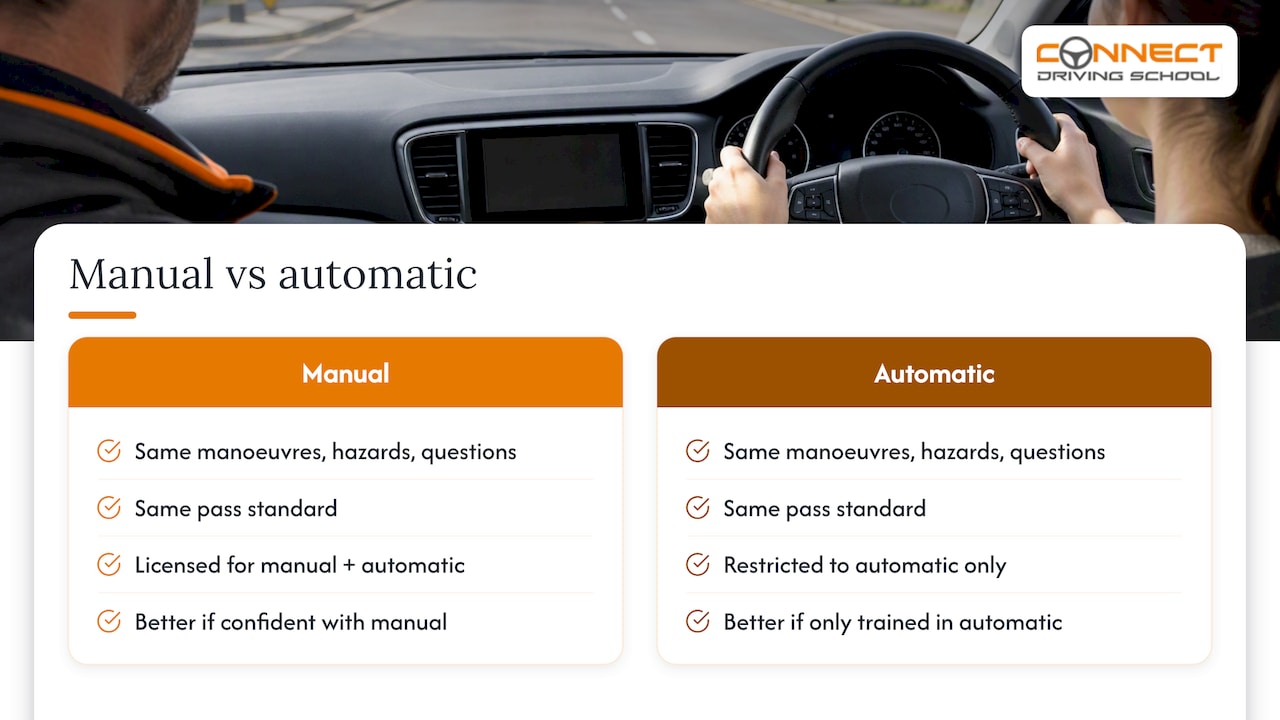
Choosing which to use often comes down to confidence and access. If you have only ever practised in an automatic, sitting the test in a manual you are not comfortable with adds unnecessary risk. Many learners choose based on whichever car their instructor supplies, since consistency with the vehicle you trained in matters more than the gearbox type itself. Our manual driving lessons and automatic courses are built around whichever licence outcome suits you.
Day-of-test checklist: a practical pre-test vehicle and hire checklist
A few minutes of checking before you leave the house can save the entire test fee. Costs are not trivial: a car test is £62 on weekdays and £75 on evenings, weekends and bank holidays, and that fee is lost if the car does not meet the rules.
- Confirm tax and MOT status online the night before.
- Check insurance documents name the test and the driver, and print or save a copy.
- Switch the ignition on and look for any dashboard warning lights.
- Check tyre pressure and tread, fuel level, and that all lights and indicators work.
- Clean the windscreen and mirrors so visibility is not an issue.
- If using a hire car, bring written permission for test use and proof the insurance covers it.
If a fault appears at the last minute, tell the test centre straight away rather than hoping it goes unnoticed. If the examiner refuses the car, ask what evidence would resolve the issue and whether the test can be rearranged without losing the fee.
Pro Tip: Run through the checklist the evening before, not the morning of, so there is time to fix a problem rather than panic about it.
Practical tips from Connect Driving School (instructor perspective)
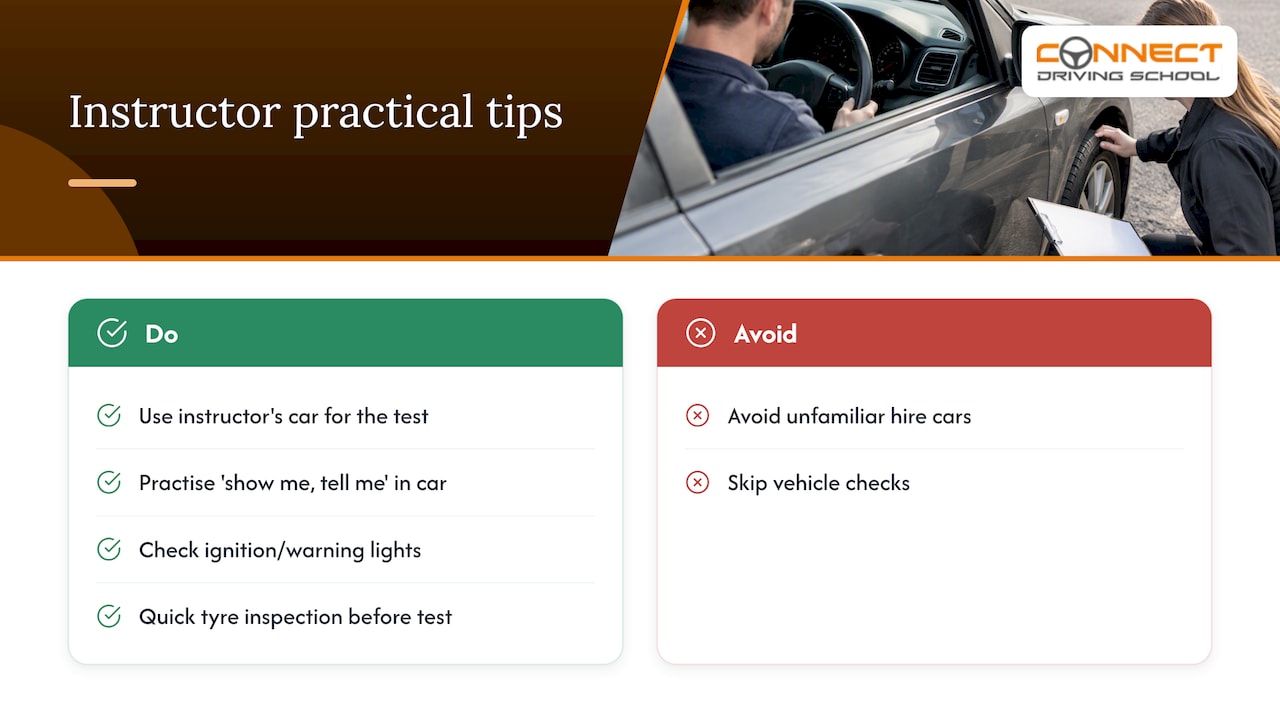
Most of our students take their test in one of our instructors’ cars, which sidesteps hire paperwork and insurance gaps entirely. We build vehicle familiarity into lessons from the start, including automatic driving lessons, manual driving lessons, intensive courses and Pass Plus, so the car on test day feels like the car you trained in.
It is recommended to practise the “show me, tell me” questions in the actual test car, not just in theory, since examiners ask two of these and a wrong answer can cost a fault. Before any test, we run through ignition checks for warning lights and a quick tyre inspection with the student, the same steps that catch most avoidable cancellations before they happen.
Author’s perspective: prioritise readiness over last-minute practice
Given the choice, it is often better for a learner to use an instructor’s car rather than a hire car with uncertain paperwork, especially if you are moving to the UK from the US and navigating unfamiliar vehicle and licensing rules. The insurance risk alone is not worth it when a cancelled test still costs the full fee.
Arrive early enough to run the safety checks calmly with your instructor rather than racing in at the last minute. If you take one thing from this, make it the dashboard warning light check: it is the single most avoidable reason tests get cancelled before they even start.
— Mudassar
FAQ
Can I hire a car for my driving test in the UK?
You can, but only if the hire company gives written permission for test use and the insurance explicitly covers it, since many standard rental agreements forbid this. Without that written confirmation, the examiner guidance allows the test centre to refuse the car.
How do I pass my driving test with the fewest avoidable faults?
There is no guaranteed method, but checking your car thoroughly beforehand removes the most common preventable failure points, such as warning lights or missing insurance cover for the test. Practising “show me, tell me” answers in your actual test car also helps you avoid faults during the vehicle safety questions.
What are the new driving test booking rules?
Since 2026, learners must book and manage their own car driving tests directly rather than through a third party, and they are limited to two changes, moving a test only to one of the three nearest centres. These updated booking rules affect how much flexibility you have if your car or circumstances change close to test day.
Does Connect Driving School provide the car for the test?
Most of our students use one of our instructors’ cars for their test, which avoids hire paperwork and insurance checks altogether. Our course packages include test preparation built around the vehicle you will actually sit the test in.
Can I drive a Twizy without a licence?
No, a Renault Twizy is a light quadricycle that still requires a valid driving licence to drive on public roads, just like any other motor vehicle. Licence category requirements depend on the specific model and its power output, so check the vehicle’s classification before assuming it is licence-exempt.
Related Posts
Comments (0)