
UK DVSA backed practice plan to lift your hazard perception score. Learn when to click, how scoring works, and how to aim for 44/75.
Avoid 4 test faults: Mini roundabout rules for UK learners
At a mini roundabout, give way to traffic approaching from your immediate right, and keep to the left of the central white circle as you pass round it. The only common exception is when a long vehicle cannot physically complete the turn without crossing the marking. Avoid U-turns. These rules sit in the Highway Code and in DVSA’s own test standards.
TL;DR:
- Drivers approaching from the right have the priority at mini roundabouts, and the central white circle must be passed on the right unless a long vehicle cannot do so without crossing the markings.
- Signaling should be timed carefully: signal right for a right turn, signal left after passing the previous exit, and avoid early or late signals to prevent confusing other drivers.
- Large vehicles and long vehicles are permitted to drive over the central marking when necessary, but U-turns are discouraged due to limited visibility and tight turns.
- Proper approach, position, and observation are critical, with common faults including cutting across the central mark, missing traffic from the right, or signaling improperly, which can lead to test failure.
- Practicing slow, deliberate approaches and rehearsing signals with a driving instructor helps ingraining habits that reduce errors during the test.
Table of Contents
- What the Highway Code requires at mini roundabouts
- How to approach and position yourself for each exit
- Signalling at mini roundabouts: timing and common mistakes
- Special cases: large vehicles, U-turns and double mini roundabouts
- Mini roundabouts on the driving test: faults that matter
- Instructor tips: turning the rules into reliable habits
- Why learners find mini roundabouts harder than they expect
- Practise mini roundabouts with Connect Driving School
- FAQ
- Sources
What the Highway Code requires at mini roundabouts
Mini roundabouts are governed by the same basic logic as full-sized ones, just compressed into a smaller space and a shorter decision window. The Highway Code sets out the approach clearly: treat a mini roundabout like a normal roundabout, choose your lane early, check your mirrors, adjust your speed, and give way to traffic already on the roundabout or approaching from your right.
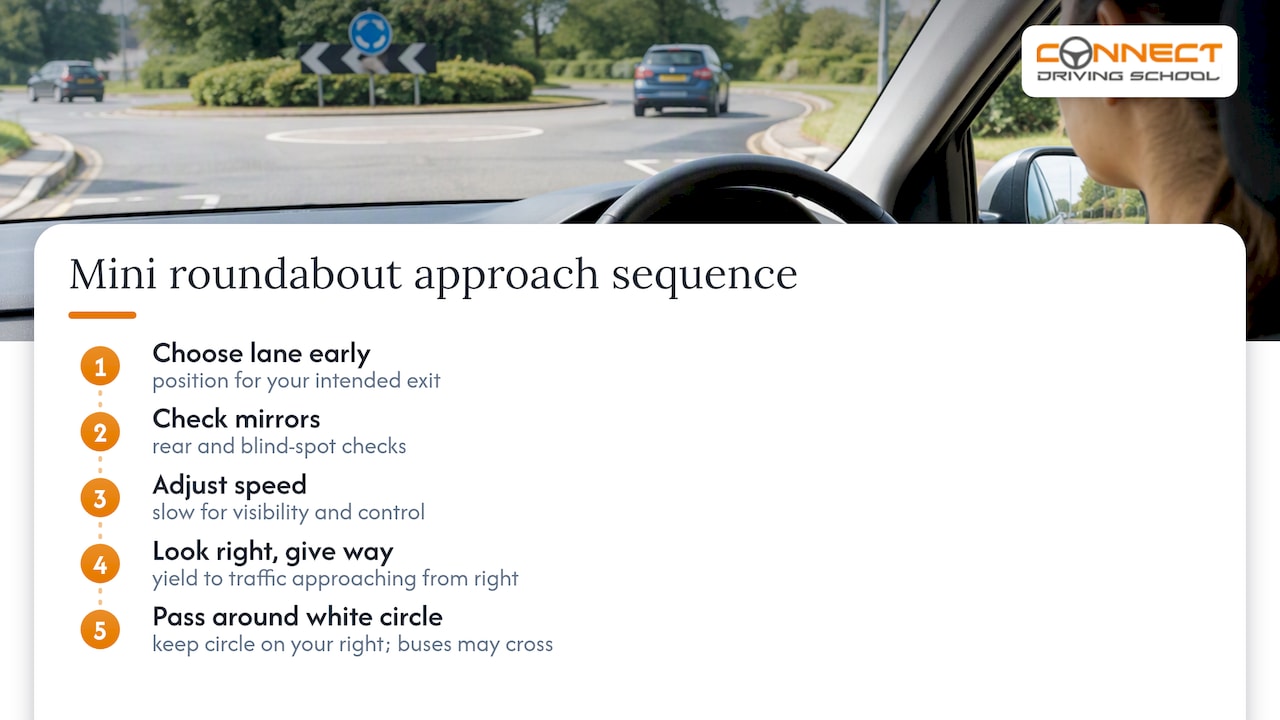
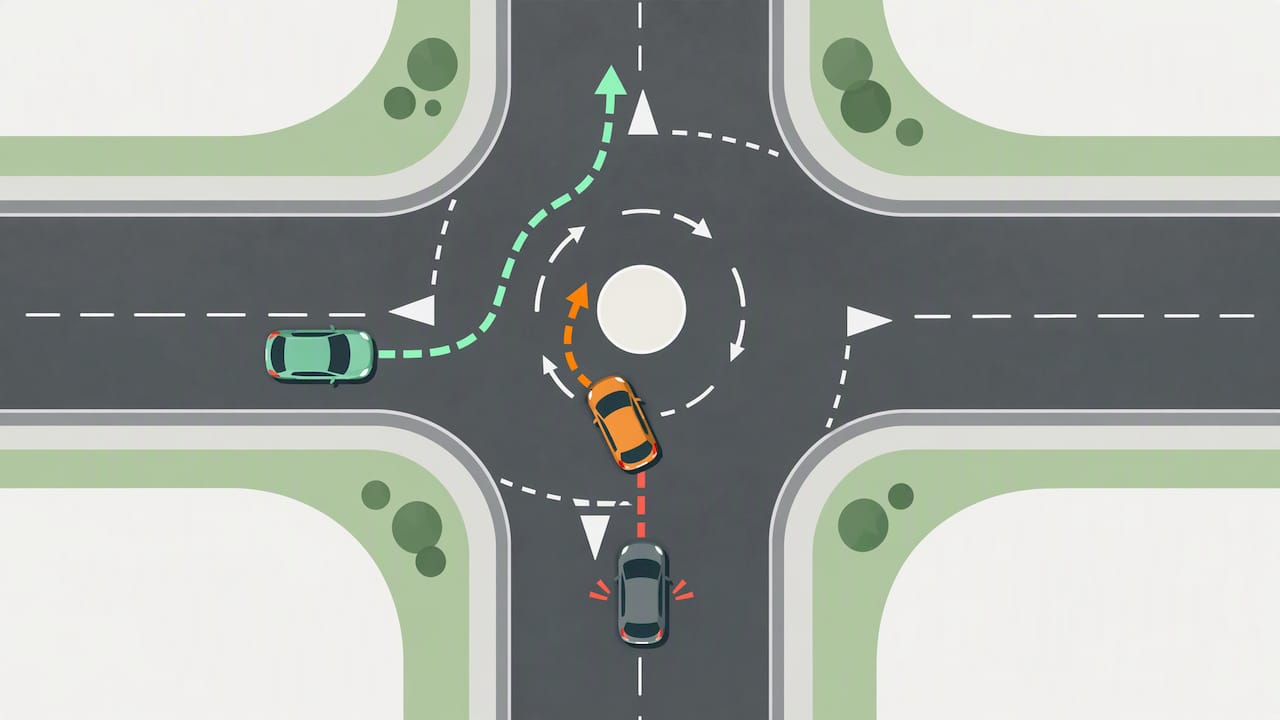
The central white circle is the part that trips learners up. You must pass around it, keeping it on your right, rather than driving straight over the top. The Highway Code allows one exception: when the size of your vehicle or the layout of the junction makes it impossible to get round without crossing the marking, you may drive over it carefully. This is a practical allowance for buses, lorries and other long vehicles, not a general permission for cars to cut the corner when traffic is light.
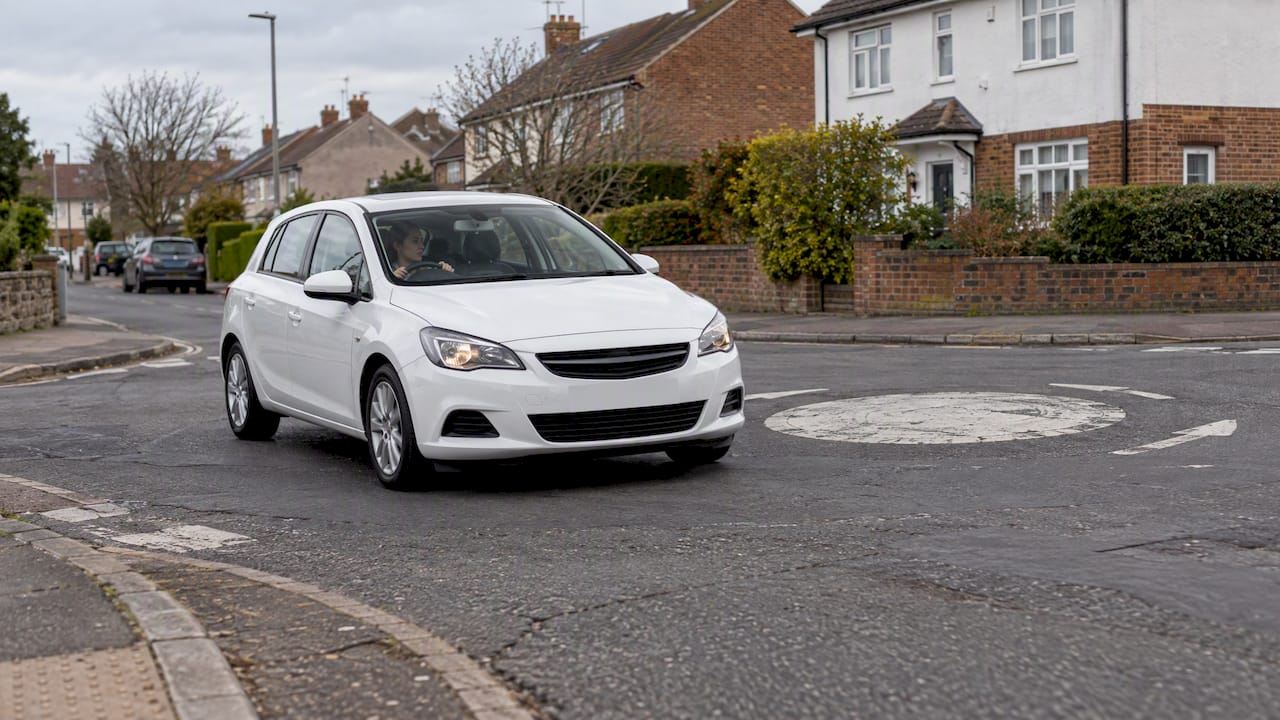
The Code is also direct about turning back on yourself: it advises against making U-turns at mini roundabouts at all. This isn’t framed as a blanket criminal offence in every case, but it’s discouraged because the tight geometry and short sightlines make a full turn unpredictable for other drivers.
Mini roundabouts typically appear on roads with a speed limit of 30 mph or less, which is part of why they rely on give-way behaviour rather than traffic lights. The road markings guidance on GOV.UK confirms the same priority rule: give way to traffic from the right, and keep to the left of the white circle unless doing so is impracticable. Design standards covered in the DfT’s mini-roundabouts report add useful context: these junctions are meant for low-speed approaches, and repeated overrunning of the central marking, often from drivers cutting corners, degrades the paint and makes the junction harder to read for everyone else.
How to approach and position yourself for each exit
A mini roundabout rewards a routine you can run on autopilot once it’s drilled in. Work through these steps every time, in order, and the junction stops feeling rushed:
- Read the signs and road markings early, including any arrows painted on the approach lane.
- Decide which exit you need well before you reach the give-way line.
- Check your mirrors to see what’s behind and alongside you.
- Position your car correctly: generally stay central in your lane unless markings or arrows direct you into a left or right-hand lane for a specific exit.
- Ease off the accelerator and select an appropriate gear, usually second, as you approach.
- Stop at the give-way line if another vehicle has priority.
- Give way to traffic from your immediate right and to anything already circulating.
- Move off when the gap is genuinely safe, not just physically possible.
- Keep to the left of the central marking as you go round.
- Signal left once you’ve passed the exit before the one you want, then come off smoothly.
Positioning changes slightly depending on where you’re heading. For a left turn, stay in the left part of your lane and signal left on approach. Going straight ahead usually means no signal until you’re about to leave, since signalling right on approach would mislead drivers waiting to your left. For a right turn, or where the layout asks you to loop almost all the way round, signal right as you approach and hold that signal until you’ve passed the exit just before yours.
Observation matters as much as position. Look right as you approach, but keep glancing left and ahead too, since mini roundabouts are often small enough that pedestrians, cyclists and oncoming traffic are all visible within the same few seconds. A gap that looks short is often enough, provided the approaching vehicle isn’t close enough to force a sudden brake.
Signalling at mini roundabouts: timing and common mistakes
Signals at mini roundabouts work on the same logic as full-sized ones, but the short approach distance means timing errors show up fast. The rules from the Highway Code are straightforward:
- Signal right if you’re turning right or looping almost all the way round.
- Don’t signal on approach if you’re going straight ahead, since there’s nothing useful to tell other drivers yet.
- Signal left once you’ve passed the exit before yours, to show you’re about to leave.
The most common mistake is signalling too early on a right turn, which can make a driver waiting on the roundabout think you’re turning before you actually reach the junction. The second is forgetting to cancel a signal after leaving, which misleads whoever is approaching behind you. Because mini roundabouts give you only a second or two of clear road before the give-way line, rehearsing the signal at walking pace on a quiet road, with your instructor calling out the exit, builds the muscle memory that a real junction won’t give you time to think through.
Pro Tip: Say your signal out loud as you flick the indicator during practice. It forces you to notice the exact moment you’re meant to act, rather than signalling on instinct.
Special cases: large vehicles, U-turns and double mini roundabouts
Most mini roundabouts behave consistently, but a few situations call for different handling:
- Large or long vehicles are permitted to drive over the central marking when their size makes it impossible to get round otherwise. If you’re behind a lorry or bus doing this, hold back and give it room rather than trying to squeeze past.
- U-turns are discouraged by the Highway Code because of poor sightlines and tight turning circles. If you need to turn around, it’s usually safer to continue to a proper junction or use a side road instead.
- Double and multiple mini roundabouts, often found where two roads cross close together, are treated as separate junctions. Give way to the right at each one in turn rather than treating the whole arrangement as a single roundabout.
These layouts appear often enough around London that it’s worth practising them specifically rather than assuming skills from a single mini roundabout transfer automatically.
Mini roundabouts on the driving test: faults that matter
DVSA’s examiner guidance treats mini roundabouts as a standard test for position, observation, signals and control, and the same guidance lists not following road markings at mini roundabouts among common reasons candidates fail. A fault becomes serious when it creates genuine risk, such as cutting across the white circle into another driver’s path, rather than being purely technical.
The faults examiners note most often are:
- Positioning, particularly drivers cutting across the central marking when it wasn’t necessary.
- Observation, especially missing traffic from the right or failing to check for cyclists close to the kerb.
- Speed, either approaching too fast to stop at the give-way line or crawling through so slowly that it confuses other drivers.
- Signals, either missing them entirely or leaving them on after the exit.
A short checklist before every mock test run helps: confirm your position matches your intended exit, check mirrors twice on approach, give way properly, time your signal to the exit before yours, and control your speed smoothly rather than braking late.
Instructor tips: turning the rules into reliable habits
Instructors use a few specific drills to make mini roundabout habits automatic. Slow-approach practice, where you crawl towards the junction at walking pace while narrating what you see, builds the observation habit before speed gets added back in. Mirror-signal-manoeuvre rehearsals, repeated on quiet residential junctions, fix the sequencing problem that causes most late signals.
Instructors also watch for two physical habits: steering too early, which pulls the car towards the centre marking, and braking too late, which forces a rushed decision at the give-way line. Planning the exit two road markings before the junction, rather than at the last second, removes most of that pressure.
Why learners find mini roundabouts harder than they expect
Most learners underestimate mini roundabouts because they look simple on paper. In practice, the small space compresses every decision, give way, position, signal, into a couple of seconds. Slowing right down on the approach buys back that time, and it’s the single change that helps most during supervised practice.
— Mudassar
Practise mini roundabouts with Connect Driving School
Mini roundabouts punish rushed decisions, and the fastest way to fix that is structured practice with someone watching your position, timing and observation in real time. Instructors build sessions around the junctions that cause the most test faults, mini roundabouts included.

- A first driving lesson is a practical way to get an honest read on where your roundabout habits need work.
- Refresher lessons suit drivers who want to tighten up positioning and signalling before a longer drive.
- An intensive course can concentrate junction practice, including mini roundabouts, into a shorter run-up to your test.
Whether you need automatic lessons or manual lessons, check current prices and book a session through Connect Driving School to get mini roundabouts sorted before test day.
FAQ
Who has the right of way on a mini roundabout?
Traffic approaching from your immediate right has priority, and you must give way to it and to vehicles already circulating. This rule comes directly from the Highway Code and applies at every mini roundabout unless signs or markings state otherwise.
Can you do a full turn at a mini roundabout?
The Highway Code advises against U-turns at mini roundabouts because the tight layout and short sightlines make them unpredictable for other drivers. If you need to turn around, it’s usually safer to continue to a junction designed for that purpose.
Is it illegal to make a U-turn at a mini roundabout?
A U-turn at a mini roundabout isn’t framed as an outright criminal ban in every case, but the Highway Code discourages it for safety reasons, and doing so unsafely could still lead to a driving offence. It’s best treated as a manoeuvre to avoid rather than one to rely on.
Could you fail your test for not signalling at a mini roundabout?
Yes, missing or poorly timed signals are listed among common reasons candidates fail, according to DVSA’s examiner guidance. Signalling left too early, too late, or forgetting to cancel it can all count against you, depending on how it affects other road users.
Sources
Related Posts


Comments (0)