
A UK test‑ready manual hill‑start method that prevents rollback and stalling. Step‑by‑step DVSA checks plus instructor drills to build confident clutch...
Avoid a £70 PCN: Box junction rules and instructor tips for UK drivers
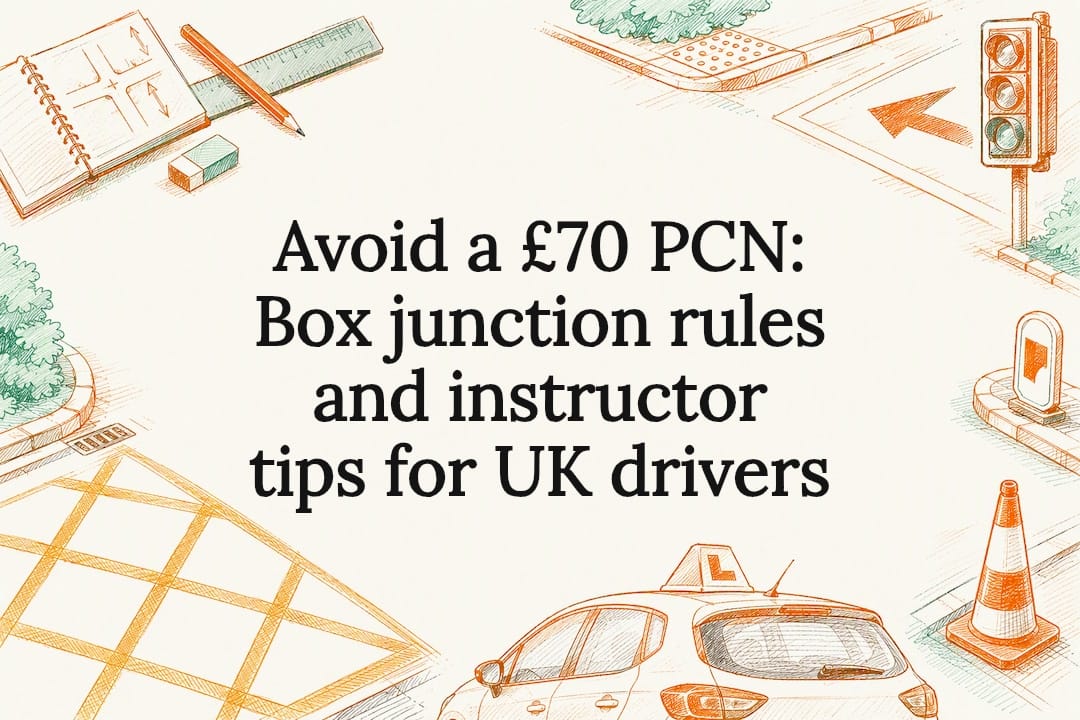
You must not enter a yellow box junction unless your exit road or lane is clear, though you may wait inside the box if you are turning right and are only prevented from completing that turn by oncoming traffic. Ignore this and you risk a Penalty Charge Notice, since councils across England now enforce box junctions with automatic number plate recognition cameras.
TL;DR:
- Cameras are now widely used to automatically enforce box junctions, with initial warning periods often preceding penalties.
- You can only wait inside a box junction if your exit is clear or if you are turning right and blocked solely by oncoming traffic or a waiting right-turning vehicle.
- Penalty charges for blocking a box junction vary by council but commonly start at £70, with early payments often halving this amount.
- Evidence like dashcam footage and photos should be collected promptly if you believe a PCN was issued unfairly, especially before specific enforcement deadline lapses.
- Never assume the queue will clear behind the vehicle in front; always wait until your exit is fully visible and accessible before entering a box junction.
Table of Contents
- What the law and Highway Code say about box junctions
- Exceptions and special cases you need to understand
- How councils enforce box junctions and what it costs you
- How to appeal a yellow box junction PCN
- Practical driving tips to avoid box junction fines
- Instructor perspective: how lessons build junction judgement
- Book lessons to sharpen your junction judgement
- Where to check the official rules and local guidance
- Sources
- FAQ
What the law and Highway Code say about box junctions
The rule comes straight from the Highway Code, rule 174, which sets out that drivers must not enter a box junction until their exit road or lane is clear. The only built-in exception is for a driver turning right who is stopped only by oncoming traffic or by another vehicle also waiting to turn right.
The legal basis for the yellow criss-cross markings themselves sits in the Traffic Signs Regulations and General Directions 2016, known as TSRGD. This legislation defines what a box junction is and where a council is permitted to mark one.
Box junctions typically appear where:
- A junction has a history of blocking, particularly at busy crossroads or T-junctions.
- Traffic needs to keep flowing at signalled roundabouts, so the box sits across the roundabout exit.
- The road is a narrow two-way route where a stationary vehicle would block oncoming traffic entirely.
- Emergency service premises need a guaranteed clear exit at any time of day.
At signalled roundabouts, the same principle applies even though the layout looks different from a standard crossroads box.
Exceptions and special cases you need to understand
The right-turn exception is the one drivers rely on most, but it has strict limits. It only protects you if you are stopped from completing your turn by oncoming traffic or another vehicle waiting to turn right, not by general congestion ahead of you.
- Right turns: you may enter and wait in the box if turning right, provided oncoming traffic or a rival right-turner is the only thing blocking your path.
- Service and emergency vehicles: TSRGD 2016 allows for markings outside emergency service premises specifically so vehicles can exit without delay, and enforcement reflects that priority.
- Signalled roundabouts: a box junction placed across a roundabout exit works on the same logic as any other, so you must not enter unless your exit is clear, exception aside.
- Changing signals: if the lights change while you are lawfully waiting under the right-turn exception, you are not in contravention simply because the phase has moved on.
None of these exceptions cover following the vehicle in front into the box on the assumption that the queue will clear.
How councils enforce box junctions and what it costs you
Most London boroughs and a growing number of councils elsewhere use ANPR cameras to catch box junction contraventions automatically, rather than relying on traffic wardens on the ground. When a council introduces camera enforcement at a new location, it will often run an initial warning period before switching to full penalties.
- Cameras capture the vehicle’s position and check whether any part of it stopped inside the markings while the exit was not clear.
- Newcastle City Council ran a warning period when it introduced ANPR enforcement, issuing letters before switching to penalties.
- Escalation follows if a PCN is left unpaid, moving from the discounted rate to the full charge and then to further recovery action.
Newcastle City Council states its standard PCN for blocking a box junction is £70, reduced to £35 if paid early, though it notes that other authorities may vary this. Councils may vary procedures, so the figure on your own PCN is the one that applies to you, not a national standard. Always check the notice itself for the exact payment window and any local escalation timeline, since these details differ between authorities.
How to appeal a yellow box junction PCN
If you believe a PCN was issued unfairly, you have a formal route to challenge it rather than simply paying up. Start by gathering evidence before memories or footage disappear.
- Check the statutory grounds first: the Traffic Penalty Tribunal lists limited grounds for cancellation, including that the contravention did not occur, the vehicle was taken without your consent, the penalty exceeded the correct amount, there was a procedural error, or the underlying traffic order was invalid.
- Consider whether a “compelling reason” applies: this is an exceptional ground, used sparingly, for situations outside the standard categories.
- Collect your evidence: dashcam footage, your own photographs of the junction and markings, witness details and any correspondence with the issuing authority all help build your case, and TfL’s own guidance recommends the same approach.
- Submit a formal representation to the issuing authority within the timeframe stated on your PCN, setting out your grounds clearly and attaching your evidence.
- Escalate to tribunal if your representation is rejected and you still disagree, using the independent adjudication route.
Pro Tip: Photograph or screenshot dashcam footage showing your vehicle’s final position the same day, since even a small part of the vehicle inside the markings can count as a contravention.
Practical driving tips to avoid box junction fines
Most contraventions happen because a driver follows the car in front rather than judging the junction independently. Your exit lane being clear for the vehicle ahead does not mean it will still be clear once you reach it.
- Never enter a box junction just because the vehicle in front has moved into it.
- When turning right, hold back before the box if you cannot see your exit is clear, then use the right-turn exception only when oncoming traffic is the sole obstacle.
- Watch for faded or unusual box markings at older junctions and gyratory systems, where the layout can be harder to read at speed.
- Treat signalled roundabouts with the same caution as a standard crossroads box, since the marking does the same job.
Pro Tip: If you are unsure whether your exit will stay clear, it is always safer to wait behind the stop line than to guess and end up straddling the box.
Instructor perspective: how lessons build junction judgement

In lessons, I get learners to narrate what they see before they move, checking the exit lane, not just the light. Drilling that habit on quiet roads first means it holds up under pressure at busy junctions later.
At Connect Driving School, every instructor is DVSA-approved, and students consistently report becoming test-ready with pass rates the school states at over 92%. That grounding in structured, patient teaching is what turns box junction rules from theory into a habit that survives real traffic.
— Mudassar
Book lessons to sharpen your junction judgement
Reading the rules is one thing. Judging a live junction at speed, with traffic building behind you, is another skill entirely, and it is exactly what structured lessons are built to teach.

A first lesson lets an instructor see how you currently read a junction and correct habits before they become fixed. Pass Plus builds further on that judgement for drivers who already hold a licence but want sharper decision-making in complex traffic, while refresher lessons help returning drivers who feel rusty around box junctions and busy signalled roundabouts.
- Check current prices for lessons and courses, including Pass Plus and refresher options.
- Browse automatic driving lessons if you prefer automatic tuition.
- Compare manual driving lessons for standard gearbox training.
There is no pressure to commit beyond a single first lesson if you simply want an assessment of your junction handling.
Where to check the official rules and local guidance
For the definitive wording, go to the Highway Code and TSRGD 2016.
- TfL’s guidance on yellow box junctions covers London-specific enforcement and purpose.
- Your council’s own enforcement notice will confirm local camera use and warning periods.
- The Traffic Penalty Tribunal sets out the grounds of appeal for moving traffic PCNs.
- Always check the PCN you actually received for authority-specific payment and appeal instructions.
Sources
- The Highway Code: using the road (159 to 203)
- Traffic Signs Regulations and General Directions 2016 — Schedule 9, paragraph 11 (box junctions)
- Traffic enforcement reminder for drivers | Newcastle City
- Yellow box junctions – Transport for London
FAQ
What are the new rules on box junctions?
The core rule has not changed: under Highway Code rule 174, you must not enter a box junction unless your exit is clear, aside from the right-turn exception. What has changed in recent years is enforcement, with more councils introducing ANPR camera monitoring and initial warning periods, as Newcastle City Council has done.
Will I get fined for stopping in a box junction?
Stopping in a box junction when your exit was not clear, outside the right-turn exception, can result in a Penalty Charge Notice from your local council. Newcastle’s PCN for this contravention is £70, reduced to £35 if paid within the early payment window, though your own notice may show a different figure depending on the issuing authority.
What rules apply to a junction box?
The same rule applies to every yellow box junction: do not enter unless your exit road or lane is clear, as set out in Highway Code rule 174. The legal placement and design of the markings themselves comes from TSRGD 2016.
Can you turn right at a box junction in the UK?
Yes, you may enter a box junction and wait to turn right if you are prevented from completing the turn only by oncoming traffic or another vehicle also waiting to turn right. This exception does not cover general traffic congestion blocking your exit, so it only protects a genuine right-turn hold-up.
Related Posts
Comments (0)