
Practical UK test guide to bay parking with instructor tested mirror reference points, a 10 rep practice plan, and the GOV.UK rules learners must follow.
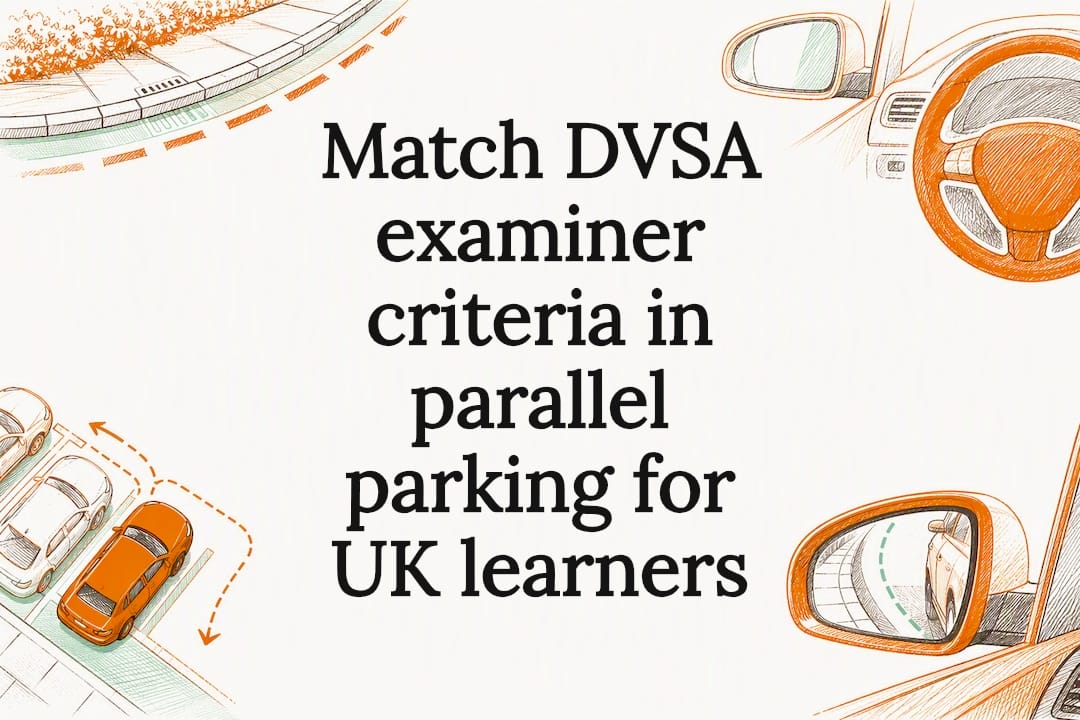
Match DVSA examiner criteria in parallel parking for UK learners
Yes, you may be asked to reverse-park on your UK driving test, and the simplest way to pass it is to prioritise slow, controlled steering over speed. The examiner marks your control and observation first, position second. Aim to finish roughly parallel to the kerb and within about two car lengths of the vehicle in front.
TL;DR:
- Stopping and waiting for visual cues before steering transitions is essential to prevent mounting the kerb and improve accuracy.
- Effective observation includes mirror checks, shoulder checks, and blind spot confirmation before and during reversing, not just glance-over checks.
- Rushing steering or turning too sharply causes common faults like clipping the kerb, which can be corrected with slow, deliberate movements and reference points.
- Practicing reversing into various-sized gaps and focusing on muscle memory builds confidence and reduces test nerves more reliably than repeating the same scenario repeatedly.
- Structured lessons tailored to individual weaknesses help refine control, observation, and timing faster than practicing without expert guidance.
Table of Contents
- Parallel parking guide: the step-by-step technique
- How do you keep observation sharp while reversing?
- What is the examiner actually marking?
- Common faults and how to fix them quickly
- Practice drills that actually build the skill
- Pre-test checklist before you start the manoeuvre
- Parallel parking on a hill, in a tight gap, or in heavy traffic
- Troubleshooting common problems during parallel parking
- Building confidence and easing test-day nerves
- Instructor view: building confidence and handling test variability
- Ready to put this into practice with a qualified instructor?
- Sources
- FAQ
Parallel parking guide: the step-by-step technique
Forget trying to remember a perfect diagram. Parallel parking is a sequence of small, repeatable decisions, and once you’ve drilled the sequence a few dozen times, your hands will know it before your brain catches up.
Start by choosing a suitably sized gap, ensuring it is large enough to comfortably park your vehicle, though your test space will usually be generous. Signal if it helps other road users, check your mirrors, and pull up alongside the car in front so your vehicle sits roughly level with it, about half a metre to a metre away.
Here’s the sequence RAC Drive recommends, and it’s the same one instructors across London teach in lessons:
- Get level and check your reference point. Line up so your rear window or door mirror sits roughly alongside the back of the car you’re parking behind.
- Select reverse, check all-round, then begin moving slowly. As soon as you’re rolling backwards, start turning the wheel towards the kerb, usually one full turn, but this varies by car.
- Watch for your angle cue. When the front of your own car begins to clear the back of the car in front, in your nearside mirror you’ll see the kerb starting to come into view at an angle.
- Straighten the wheel once you’re at roughly 45 degrees to the kerb, and continue reversing in a straighter line.
- Counter-steer with full lock away from the kerb when your rear window reference shows you’re getting close and level with the car behind. This swings the front of the car in.
- Straighten up fully once you’re parallel, check your position in both mirrors, and stop.
Throughout, your nearside mirror does the heavy lifting for judging distance from the kerb, your rear view mirror watches for approaching traffic, and shoulder checks cover the blind spots a mirror can’t reach. Finish by selecting neutral, applying the handbrake, and confirming with a final look that you’re close to the kerb and not sticking out into the road.
Pro Tip: Don’t count turns of the wheel and hope for the best. Wait for the visual cue, the point where the kerb or the car behind lines up in your reference mirror, before you move to the next steering phase. Rushing this is the single biggest cause of mounting the kerb.
How do you keep observation sharp while reversing?
Examiners are trained to look for “all-round effective observation”, which is a formal way of saying you need to prove you’re checking everywhere, not just glancing once and hoping. Before you even select reverse, run through your mirrors, check your blind spots over both shoulders, and decide whether it’s actually safe to start.
Once you’re moving, a check before every steering input matters more than one long look at the start.
- Check your nearside mirror constantly for kerb distance once you’re turning in.
- Check your rear view mirror and rear window for traffic approaching from behind.
- Glance over your shoulder before pulling away from the kerb and again before any repositioning.
- If a pedestrian or vehicle approaches while you’re mid-manoeuvre, stop, let them pass, then continue.
- Reversing cameras and parking sensors can support you, but the examiner wants to see your eyes and head moving, so use them as a backup, not a replacement for checks.
What is the examiner actually marking?
Control and observation carry the real weight in this manoeuvre, and Gov confirms position is the secondary consideration. A finish that’s parallel to the kerb and, on the road, within roughly two car lengths of the vehicle ahead, meets the standard.
If you misjudge the angle and need to pull forward and try again, that’s usually logged as a minor driver fault rather than an automatic fail, provided you do it safely and with proper observation, according to Driving Test Success. What tips it into a serious fault is doing that adjustment carelessly, without checking your mirrors first.
One thing worth knowing before test day: GOV.UK examiner guidance confirms this manoeuvre might be set on the open road or into a marked bay at the test centre, and examiners assess observation to the same standard either way.
Common faults and how to fix them quickly
Most test faults on this manoeuvre trace back to four habits, and every one of them is fixable with practice rather than talent.
- Rushing the steering transitions. Wait for your reference point (the kerb angle in your mirror, the alignment with the car behind) before you counter-steer, rather than guessing on a turn count.
- Weak or invisible observation. Make your shoulder checks big enough that an examiner sitting beside you can actually see your head turn.
- Clipping or mounting the kerb. This almost always means you turned too early or too sharply. Small, slow wheel movements beat one big turn every time.
- Excessive repositioning. One clean pull forward and re-attempt is fine. Three attempts suggests you need more practice at reading your reference points, not more attempts on test day.
Pro Tip: If you keep clipping the kerb at the same point in the manoeuvre, that’s not bad luck, it’s a pattern. Ask your instructor to isolate that exact phase and repeat it in short bursts until the correction becomes automatic.
Practice drills that actually build the skill
Reversing into the same gap on the same street ten times teaches you that street, not the skill. GOV.UK’s own advice after a parking-related fault is to practise reversing into different sized spaces and adjusting position once you’re in.
- Set up cones or use parked cars to create a tight gap, a generous gap, and an average gap, then run the full sequence in each.
- Rehearse the mirror and shoulder check routine on its own, without even moving the car, until it’s second nature.
- Once the basics feel steady, move practice from a quiet residential street to a busier road to build tolerance for the pressure of passing traffic.
- Break lessons into short, focused reps rather than one long session. A few minutes on steering timing, then a few on observation, tends to stick better than an unfocused hour.
Pre-test checklist before you start the manoeuvre
Before you commit to reversing, run through this sequence every single time, on test day and in practice:
- Confirm mirrors are checked and blind spots covered, and signal if appropriate.
- Make sure the gap is genuinely safe to attempt, not just legally available.
- Confirm the handbrake is off (if you’re moving) and you’re in reverse gear.
- Keep your foot control smooth, feathering the clutch or brake rather than jerking.
- If you’re unsure about anything the examiner has said, ask them to repeat it rather than guessing.
Parallel parking on a hill, in a tight gap, or in heavy traffic
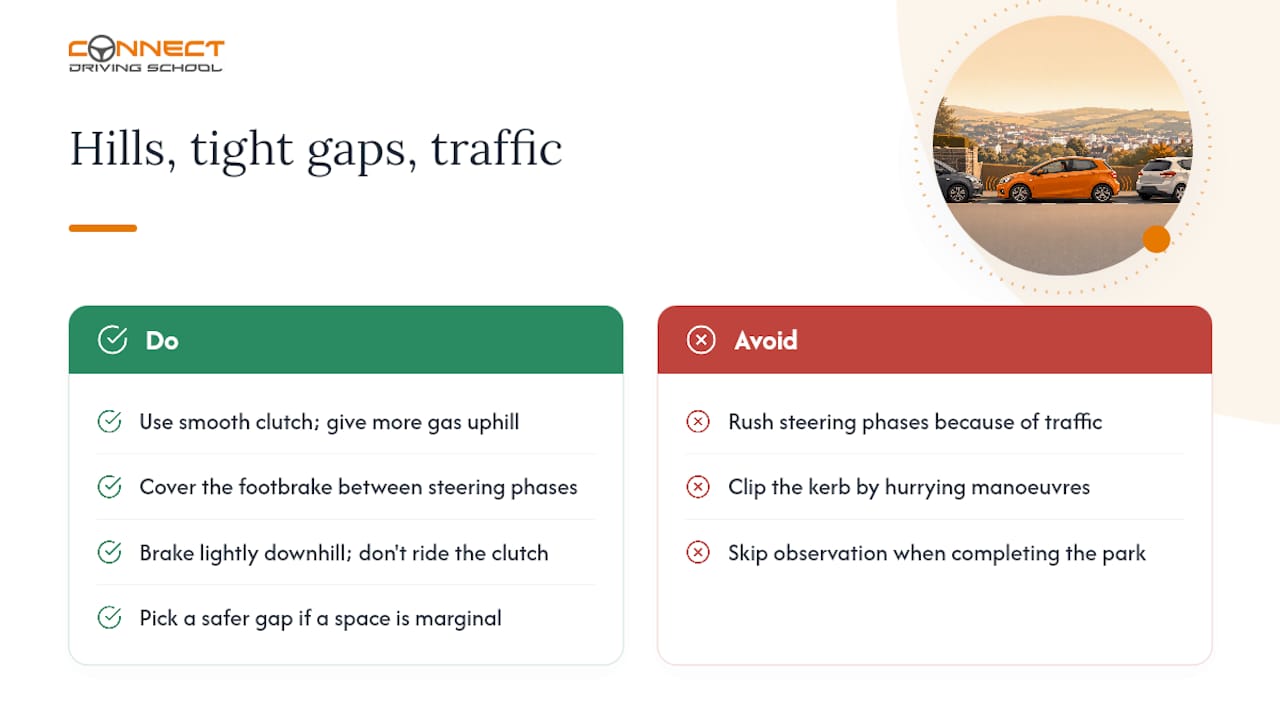
Hills change your clutch control more than your steering. On an uphill parallel park, you’ll need slightly more gas and less clutch bite to stop the car rolling back mid manoeuvre, so keep your foot control smooth and be ready to cover the footbrake between steering phases. On a downhill approach, gravity does some of the work reversing, so ease off and control your speed with light, repeated brake touches rather than riding the clutch.
Tight gaps reward patience over ambition. If a space looks genuinely marginal, it’s entirely acceptable to select a different one, on test day the examiner won’t penalise you for choosing a safer gap over a technically-legal but cramped one. If you commit to a tight space, expect to need a pull forward and reset at some point, and that’s fine as long as you check your mirrors before moving.
Heavy traffic adds pressure but doesn’t change your technique, it changes your patience threshold. If cars are queuing behind you, resist the urge to rush the steering phases faster than you’ve practised. A following driver waiting ten extra seconds is a non issue; a rushed manoeuvre that clips the kerb is a fault on your record. If traffic genuinely can’t pass and is backing up, it’s reasonable to complete the manoeuvre promptly and cleanly rather than pausing for lengthy checks, but don’t skip observation altogether.
Troubleshooting common problems during parallel parking
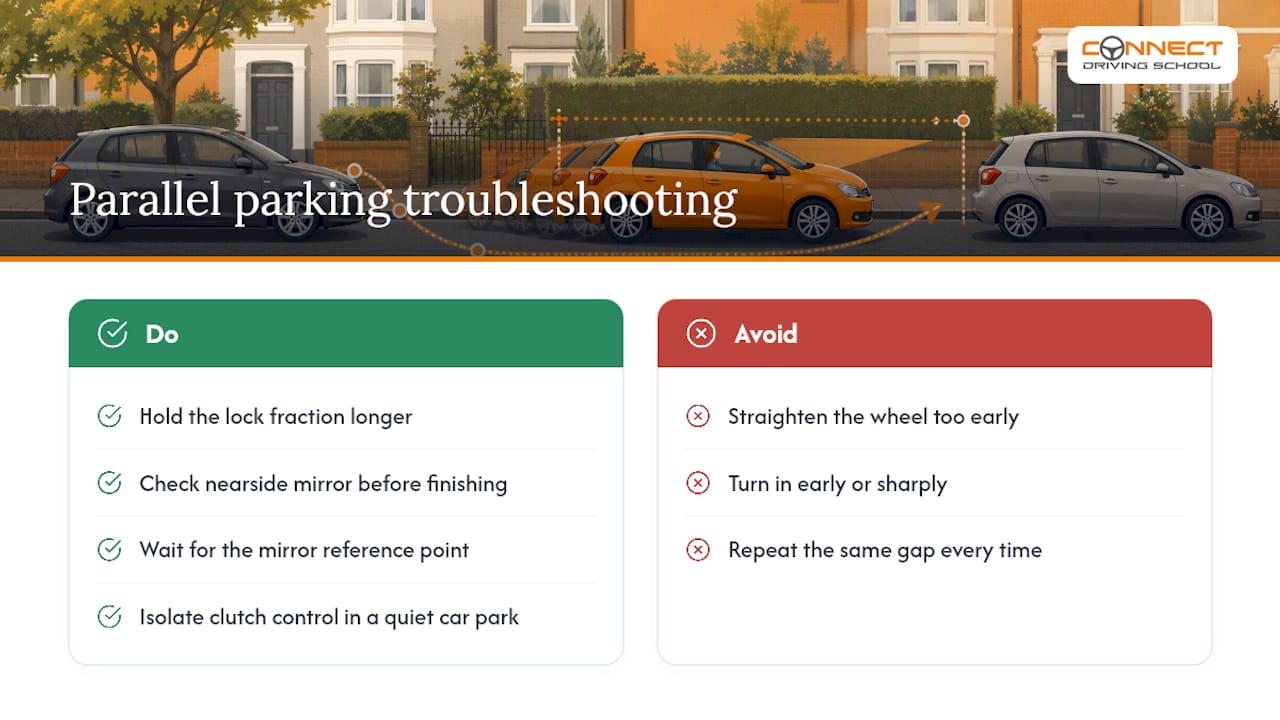
If you keep ending up too far from the kerb, the fix is almost always in your final steering phase, you’re straightening the wheel too early, before the car has fully rotated parallel. Hold the lock a fraction longer and check your nearside mirror before calling it done.
If you’re mounting the kerb repeatedly, you’re turning in too early or too sharply on the first steering phase. Wait for your reference point, the moment the back of the car in front appears in your mirror at the right angle, rather than starting the turn as soon as you begin reversing.
If you stall or roll during the manoeuvre, that’s a clutch control issue rather than a steering one, and it’s worth isolating in a quiet car park before you attempt the full sequence again. And if you find yourself needing three or four attempts every single time, don’t just repeat the same gap. Vary the space size in practice, as GOV.UK suggests, because relying on one memorised gap size is often the real problem in disguise.
Building confidence and easing test-day nerves
Confidence in this manoeuvre comes from repetition of the same small decisions, not from luck or natural talent. Once your reference points, the mirror alignment, the angle cue, the counter-steer moment, become automatic, the manoeuvre stops feeling like a memory test and starts feeling like muscle memory.
Practise in a quiet space first so you’re not managing traffic and technique simultaneously. As the steps become familiar, add real-world pressure gradually: a busier road, a smaller gap, an instructor timing you. That staged exposure is far more useful than one nerve-wracking attempt on an unfamiliar street the day before your test.
It also helps to remember that examiners expect some imperfection. A controlled pull forward and reset, done with proper mirror checks, reads as competence, not failure.
Instructor view: building confidence and handling test variability
Examiners might set this on the road or in a bay, and treating that as a coin flip misses the point. Whichever setting comes up, the marking criteria don’t change, so drilling a small set of reference points until they’re automatic matters more than guessing the format. In lessons, weak spots like clutch timing on hills, late steering transitions, or thin observation habits usually respond fastest to short, isolated practice rather than repeating the whole manoeuvre end to end.
— Mudassar
Ready to put this into practice with a qualified instructor?
Reading the steps is one thing. Getting the timing right with your own hands on your own wheel is another, and that gap is exactly what structured lessons close. Qualified instructors build parallel parking practice around your actual weak points, whether that’s steering timing, clutch control on hills, or observation habits, rather than running you through a generic script.

Lessons can focus specifically on the drills covered above, cone work for varied gap sizes, isolated mirror-and-shoulder rehearsal, or full manoeuvre reps on progressively busier roads, either as standalone top-up sessions or built into a full test preparation course. If parallel parking is the one manoeuvre standing between you and test-ready, book a lesson with Connect Driving School and get it sorted with proper feedback, not guesswork.
Sources
FAQ
Do you always have to parallel park on the UK driving test?
Not every test includes it, but reverse parking, either on the road or into a bay, is one of the manoeuvres examiners can choose from. GOV.UK’s guidance confirms examiners have flexibility in how they set it, so preparing for both formats is worthwhile.
How close to the kerb do you need to finish?
You should finish roughly parallel to the kerb, and on an on-road reverse park, within about two car lengths of the vehicle in front. Being slightly further out is not automatically a fail if your control and observation were solid throughout.
Is it okay to pull forward and try again during the manoeuvre?
Yes, a safe, well-observed adjustment is typically recorded as a minor driver fault rather than an immediate fail, according to Driving Test Success. What matters is checking your mirrors and blind spots before you move, not the fact that you needed a second attempt.
What’s the biggest reason learners fail this manoeuvre?
Rushing the steering transitions before waiting for a proper visual reference point is the most common cause, according to RAC Drive. Weak or invisible mirror and shoulder checks are the second most frequent issue examiners flag.
How can I practise parallel parking before my test?
Set up cones or use safely spaced parked cars to create gaps of different sizes, then run the full sequence slowly and repeatedly in each one. Structured lessons with a DVSA-approved instructor, such as those offered through Connect Driving School, can isolate your specific weak point and correct it faster than unsupervised practice alone.
Related Posts
Comments (0)