
Run eight instructor tested mock routes and an exam style Fleming Way plan to rehearse independent driving, junctions and manoeuvres.
One Stall Won’t Fail You: DVSA Rules and Drills to Stop Stalling a Car
Stalling a car happens when the engine stops because there isn’t enough power getting through, usually from releasing the clutch too fast or picking the wrong gear. It’s one of the most common learner mistakes and almost never causes damage. If it happens, keep calm: apply the handbrake, put the car in neutral, and restart the engine before moving off again.
TL;DR:
- Most stalls occur when releasing the clutch too quickly without enough engine revs, especially when pulling away in high gears or on hills.
- Consistent practice of finding and holding the biting point with proper revs helps reduce stalls faster than random driving.
- If a stall happens, calmly apply the handbrake, check neutral, restart, and resume from the same routine, avoiding rushed reboots.
- Automatic cars rarely stall unless there is a mechanical issue like fuel or sensor faults, which require professional inspection.
- A single stall during a driving test is a minor fault, but repeated or unsafe stalls can escalate to serious faults and threaten a pass.
Table of Contents
- What causes stalling a car in the first place?
- How do you stop stalling for good?
- What should you do if you stall a car?
- Can an automatic car stall too?
- Does stalling affect your driving test?
- When does stalling point to a mechanical problem?
- What do learners get wrong about stalling?
- Do different cars stall differently?
- What instructors do differently to fix stalling fast
- Stop stalling with a few targeted lessons
- Sources
- FAQ
What causes stalling a car in the first place?
Most stalls come down to one thing: the clutch and the engine revs aren’t working together. Release the clutch too quickly before the engine has enough power behind it, and the wheels demand more than the engine can give. The engine gives up. That’s the mechanic of nearly every learner stall.
A handful of specific habits cause it most often:
- Releasing the clutch too fast and skipping past the biting point altogether
- Selecting too high a gear for your speed, especially pulling away in second or third
- Not giving the engine enough revs before releasing the clutch fully
- Coasting to a stop without pressing the clutch down, so the engine labours against the wheels
- Poor seat position or thick-soled shoes preventing full, controlled clutch travel
Getting the biting point right is really about revs. On flat ground, most cars need somewhere between 1,500 and 2,000 RPM to pull away smoothly, rising to 1,800 to 2,500 RPM on a hill start where gravity is working against you.
Not every stall is down to technique, though. If the car cuts out at idle with no clutch involved, at traffic lights, or repeatedly despite decent clutch control, that points towards a mechanical issue rather than a driving one. Fuel delivery problems, ignition faults, a failing sensor, or a weak battery can all cause an engine to die unexpectedly, and no amount of practice will fix those.
How do you stop stalling for good?
Prevention is a routine, not a one-off trick. Build the same sequence every single time you move off, and the stalls start disappearing within a few sessions.
- Get set up before you move: seat close enough that your knee has a slight bend at full clutch depression, mirrors checked, handbrake on.
- Find the biting point: press the clutch fully, select first gear, and slowly raise the clutch until you feel the car’s nose dip slightly or the revs drop a touch. That’s the bite.
- Hold it there for a second or two rather than letting the clutch keep rising. This is the part most learners rush.
- Add gas gently, aiming for roughly 1,500 to 2,000 RPM on flat roads, then bring the clutch up the rest of the way as you feel the car start to pull.
- On hills, add more revs first, closer to 1,800 to 2,500 RPM, and release the handbrake only once you feel the car wanting to move forward, not before.
Structured, repeated practice beats one long session. Instructors who use short, focused drills, like holding the bite point for two seconds and repeating it dozens of times in a quiet car park, tend to see stalls drop off faster than learners who just do lap after lap of a test route hoping it clicks.
Hill starts deserve separate practice time using the handbrake method described above. Many newer cars come with hill-hold assist, which holds the brakes for a couple of seconds after you release the footbrake, and it’s worth asking your instructor to show you exactly how yours behaves.
Pro Tip: Set a habit cue for stopping, not just starting. Press the clutch down before the car drops below around 10mph when slowing to a stop, so the engine never has to fight the wheels as you brake.
What should you do if you stall a car?
The order you do things in matters more than speed. Panicking and rushing the restart is what causes the second stall.
- Apply the handbrake immediately and press the footbrake if you’re still moving even slightly.
- Put on your hazard lights if you’re in a position that could confuse or block other drivers, such as a junction.
- Press the clutch fully and check the gearstick is in neutral.
- Turn the key or press the start button to restart the engine.
- Select first gear, find the biting point again, and move off using the same routine you practised.
A few situational notes make this easier in the moment:
- On a hill, keep the handbrake on until you’ve found the bite and feel the car ready to hold itself, then release it as you would normally.
- At a busy junction, prioritise clearing the road safely over speed. A calm ten seconds beats a rushed, wobbly restart.
- If you stall twice in a row, that’s a signal to stop rushing rather than push through. Pull over somewhere quiet if you can and reset your breathing before trying again.
Staying composed genuinely changes the outcome here. The biggest factor in avoiding a second stall is psychological rather than mechanical: drivers who pause and reset almost always recover more smoothly than those who snatch at the controls.
Can an automatic car stall too?
Rarely, and that’s by design. Automatic gearboxes and modern engine control units manage power delivery for you, so there’s no clutch to mistime and no biting point to hunt for. Most automatic drivers will never stall a car in normal driving.
When an automatic does stall, it’s almost always a sign of something mechanical rather than a driving mistake:
- Fuel delivery problems or a failing fuel pump
- Faulty sensors feeding bad information to the engine control unit
- Torque converter issues affecting how power transfers to the wheels
- A weak or failing battery struggling to keep systems running
If this happens, the response is the same as any stall: hazards on if needed, restart the engine, and get moving again. But if it happens more than once, watch the dashboard warning lights closely and book the car in with a garage. A recurring stall in an automatic almost never fixes itself.
Does stalling affect your driving test?
A single, well-handled stall on your test is not automatically a fail. The DVSA classes it as a driving fault, which is the minor category, and you’re allowed up to 15 of these across the whole test and still pass. It’s only the serious and dangerous fault categories that end the test.
What turns a stall into something worse is context. A stall becomes a serious or dangerous fault when it blocks a junction, forces another driver to brake sharply or take evasive action, or keeps happening in a way that shows the examiner you’ve lost control of the car rather than made one mistake.
Examiners are watching how you recover just as much as whether you stalled at all. A composed restart, mirror check, and smooth move off tells them far more than the stall itself does. Panicking, stalling again immediately, or pulling away without checking your surroundings is what tends to escalate things.
When does stalling point to a mechanical problem?
If you’re using good technique and still stalling regularly, especially at idle or with a warning light on, that’s your car telling you something rather than a training gap.
Run a few quick checks before booking a garage visit: confirm you have enough fuel, check the battery isn’t struggling to start the car in the first place, glance at the dashboard for any lit warning symbols, and double check your seat and footwear aren’t restricting full clutch travel.
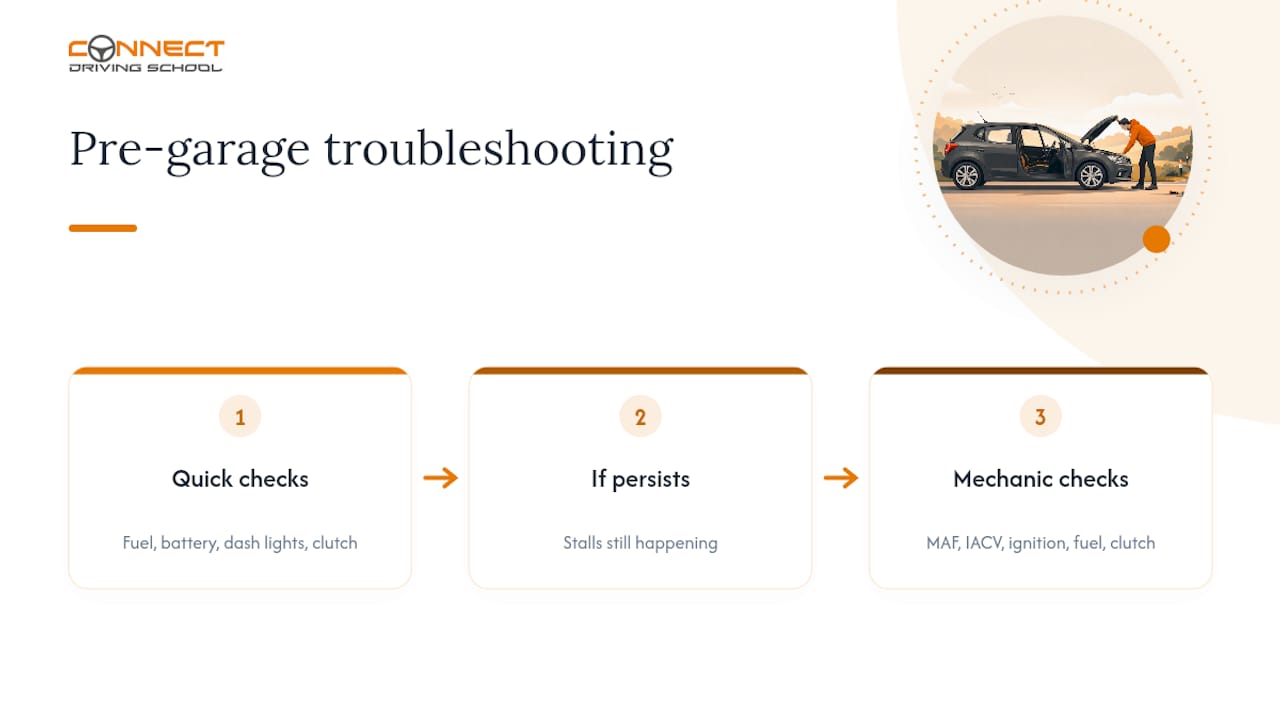
If those all check out and the stalling continues, ask the mechanic to look at the air intake or MAF sensor, the idle air control valve, spark plugs and ignition coils, the fuel filter or pump, and the clutch itself if it’s a manual. Frequent stalling does add wear to the clutch, starter motor and battery over time, so a persistent pattern is worth sorting rather than living with.
What do learners get wrong about stalling?
The biggest misconception is that stalling means you’re a bad driver. It doesn’t. Every experienced driver stalled repeatedly while learning, and most manual drivers have stalled at least once well into their driving life, usually at an awkward junction or an unfamiliar hill.
Another common myth is that stalling damages the car. Occasional stalls put no meaningful strain on anything. It’s only frequent, repeated stalling over weeks or months that adds measurable wear to the clutch, starter motor and battery, and even then it’s rarely expensive to address.
Some learners also believe a stall automatically fails the driving test, which puts unnecessary pressure on every lesson. As covered above, a single controlled stall in a safe situation is a minor fault, not a fail.
There’s also a belief that more revs always prevents stalling. That’s only half true. Too many revs without matching clutch control causes a jerky, snatchy start or even a small wheel spin, which unsettles newer drivers just as much as a stall does. The skill isn’t revs alone, it’s revs and clutch moving together at the right pace.
Finally, some learners think idling at junctions or in traffic wastes less fuel than restarting after a stall, so they avoid switching the engine off out of habit. In the UK, there’s no blanket law against idling a stationary engine on a public road, though some local councils do have specific rules against unnecessary idling, particularly near schools.
— Mudassar
Do different cars stall differently?
Engine size, gearing, and clutch weight all change how forgiving a car feels when you’re learning. Smaller petrol engines, common on entry-level hatchbacks used by driving schools, tend to be more forgiving of low revs because they’re lighter and need less torque to get moving. Diesel engines, by contrast, often have more low-down torque and can pull away at lower revs than petrol equivalents, but the clutch bite point can feel narrower and harder to locate precisely.
Cars with a heavier clutch, often older or larger vehicles, need a firmer, more deliberate release to find the bite, whereas lighter city cars are usually more sensitive and stall with even a slightly clumsy clutch action. Turbocharged engines can behave unpredictably at very low revs since power delivery isn’t always linear, which occasionally catches learners out on hill starts specifically.
None of this means one type of car is inherently harder to learn in overall. It means the exact revs and clutch feel you get used to in one car won’t transfer perfectly to another. If you’re switching between a lesson car and a family car for practice, expect a short adjustment period each time rather than assuming your technique has slipped.
What instructors do differently to fix stalling fast
Good instructors don’t just tell you to “find the biting point,” they break it into small, repeatable drills: holding the bite for two seconds with the handbrake on, then releasing it, then doing it again. That repetition builds the muscle memory that a single long lesson never quite manages.
If stalling is your specific sticking point, targeted sessions focused purely on bite-point control and hill starts, rather than a full mixed lesson, tend to fix it fastest. Ask your instructor to build a short session around just that before your next full lesson.
Stop stalling with a few targeted lessons
Professional instructors can help you get past the stalling stage faster than working it out alone in an unaccompanied car, by watching your clutch and rev timing and correcting it in real time rather than leaving you to guess what went wrong.

For current lesson pricing and options, please see the driving school’s website. A couple of sessions focused purely on biting point control and hill starts, alongside standard manual or automatic tuition, is often enough to break the habit for good. If you’re preparing for your test in Wandsworth, Merton, Kingston, Sutton, Croydon, or across London more widely, book a driving lesson with Connectdrivingschool and get a stalling-specific session scheduled with a qualified instructor.
Sources
- Car stalling: Why it happens and how to avoid it
- Stalling your car: a guide to stalling a car and how to recover
FAQ
Is it illegal to idle your engine in the UK?
There’s no nationwide law banning idling a stationary engine on a public road, though some local councils enforce rules against unnecessary idling, particularly near schools and residential areas.
What do you do if you stall a car?
Apply the handbrake, put the car in neutral, restart the engine, then find the biting point again in first gear before moving off, using hazard lights if you’re in a position that could obstruct traffic.
Does stalling a car damage anything?
Occasional stalls cause no meaningful damage, but frequent, repeated stalling adds extra wear to the clutch, starter motor and battery over time.
Do you fail your driving test if you stall?
A single stall handled calmly and safely is usually recorded as a minor driving fault, not a fail; it only becomes serious if it blocks a junction, endangers other road users, or keeps happening.
Related Posts
Comments (0)