
Compare the best theory test apps for UK learners, see how official DVSA questions and four in one practice fit together, and follow Mudassar’s study plan...
Exactly What to Say for DVSA Show Me, Tell Me Questions in UK Tests
There are 21 possible vehicle safety questions on the DVSA’s official list, 14 ‘tell me’ and 7 ‘show me’, and your examiner will ask you one of each during the practical test. The ‘tell me’ question comes first, before you move off; the ‘show me’ question comes later, while you’re driving, and only when the examiner judges it safe. Get one wrong and you pick up a single minor driving fault, not an automatic fail.
TL;DR:
- Most mistakes in ‘show me’ questions result from nerves or rushing, not lack of technical knowledge, and can be minimized with practice.
- Confirming the location of each control by feel and practicing responses aloud helps build confidence and reduces hesitation during the test.
- Key ‘show me’ actions include operating windscreen washers, switching lights, and hazard lights, which should be demonstrated smoothly without distracted driving.
- ‘Tell me’ questions cover checking essential systems like tyre condition, brakes, and fluid levels, with answers accepted from the vehicle handbook or door sticker if specific numbers vary.
- Roughly 14 key safety questions must be memorized and practiced daily, focusing on brief, clear responses to avoid overcomplicating answers during the test.
Table of Contents
- What are the 7 ‘show me’ questions?
- What are the 14 ‘tell me’ questions and their answers?
- How examiners mark these questions
- Building a practice routine that actually sticks
- An instructor’s view on where learners actually lose marks
- Book focused ‘show me, tell me’ practice in London
- Where to check the official list
- Sources
What are the 7 ‘show me’ questions?
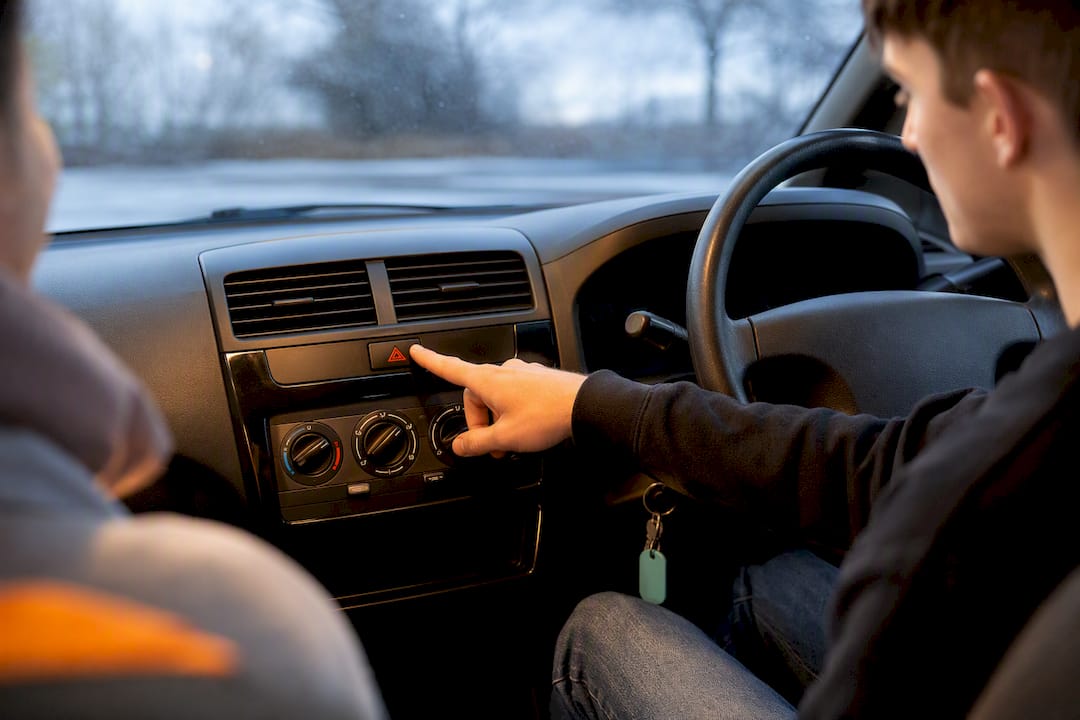
These are the questions the examiner asks once you’re already moving, so you need to know how to carry out each action without taking your attention off the road for more than a second or two. The examiner will only ask when it’s genuinely safe to do so, so don’t reach for a switch until you’re prompted.
- Show me how you’d wash and clean the windscreen using the windscreen wipers and washer. Operate the control while driving; a quick squirt and a wipe cycle is all that’s needed.
- Show me how you’d demist the front windscreen. Switch on the relevant heater and fan controls, adjusting the airflow direction if your car allows it.
- Show me how you’d set the demister controls to demist the rear window. Point out or operate the heated rear window switch and airflow settings.
- Show me how you’d switch on your rear fog light(s) and explain when you’d use them. Turn on the fog light switch and mention the legal visibility trigger, roughly 100 metres.
- Show me how you’d switch your headlight from dipped to main beam and back again. Flick the stalk or switch and confirm the dashboard indicator light changes.
- Show me how you’d switch on the hazard warning lights and then switch them off again. Press the hazard button, then press it again to cancel.
- Show me how you’d operate the horn. A brief, controlled press, checking it’s safe and appropriate to do so first.
Pro Tip: Practise finding each control by feel, not by sight, before your test. Glancing down at a switch for two seconds while moving is exactly the kind of thing that unsettles a nervous learner, and instructors will tell you the smoothest candidates never take their eyes off the road to do this.
What are the 14 ‘tell me’ questions and their answers?
These come at the very start of the test, usually just after you’ve got in the car and before you set off, so the engine may not even be running yet. The official DVSA list sets out exactly what’s expected, and examiner guidance clarifies what counts as an acceptable answer.
- Open the bonnet and tell me how you’d check the engine oil level. Locate the dipstick, wipe it clean, reinsert fully, then withdraw and check the level sits between the minimum and maximum marks.
- Tell me how you’d check the coolant level. Check the level against the markings on the coolant reservoir, only ever doing this when the engine is cold.
- Tell me how you’d check the brake fluid level. Identify the brake fluid reservoir and confirm the fluid sits between the minimum and maximum lines.
- Tell me how you’d check that the headlights and tail lights are working. Switch on the ignition and lights, then walk round the car to visually check each one, or ask someone to confirm from outside.
- Tell me how you’d check the parking brake for excessive wear. Apply the parking brake and check it holds firmly without travelling too far up its ratchet.
- Tell me how you’d check the direction indicators are working. Turn on the ignition, operate the indicator stalk, and check the lights flash correctly front and back.
- Tell me how you’d check the brakes are working before starting a journey. Move off and gently apply the footbrake, checking the car doesn’t pull to one side and the pedal doesn’t feel spongy.
- Tell me how you’d know if there was a problem with your anti-lock braking system. Check that a warning light appears when the ignition is switched on and then goes out, confirming the system has passed its self-check.
Tyre condition comes up more than once, and it’s the one area where getting the detail right genuinely matters beyond the test.
The legal minimum tyre tread depth across the UK is 1.6mm, measured around the central three-quarters of the tyre’s width and around its entire circumference.
- Tell me how you’d check the tyres for sufficient tread depth and general condition. Check for cuts, bulges, and even wear, and confirm tread meets the 1.6mm legal minimum.
- Tell me how you’d check the tyres are correctly inflated. Check the pressures against your vehicle’s manufacturer guidance, usually printed inside the driver’s door sill or in the handbook, using a reliable gauge when the tyres are cold.
- Tell me how you’d check the power-assisted steering is working correctly. If the steering feels unusually heavy, or a warning light stays on after the engine starts, that suggests a fault.
- Tell me how you’d use the horn. Explain that it should only be used to alert other road users of your presence, never aggressively or while stationary in traffic.
- Tell me what the vehicle’s brake fluid warning light means, if it comes on. It signals low brake fluid or a fault in the hydraulic braking system, and should be checked immediately.
- Tell me how you’d check the exhaust system is secure and doesn’t have any obvious defects. Listen for unusual noises and check underneath for loose or hanging sections, or excessive vibration.
Where a check depends on the manufacturer’s specific guidance, such as tyre pressures, examiners accept “I’d check the handbook or door sill sticker” as a complete answer. You don’t need to memorise numbers that vary between cars.
How examiners mark these questions
A wrong answer to a ‘tell me’ or ‘show me’ question earns one driving fault, recorded as a minor. It only becomes a serious problem if you rack up 16 or more minor faults across the whole test, at which point you’d fail regardless of the safety questions. The exception is a dangerous action during a ‘show me’ demonstration, such as swerving while fiddling with a switch, which can end the test immediately.
Most mistakes have nothing to do with mechanical knowledge and everything to do with nerves or overthinking:
- Overcomplicating a simple answer instead of giving the short, practical version examiners expect
- Forgetting to switch the ignition or lights on before demonstrating something like the horn or indicators
- Reaching for a ‘show me’ control before the examiner confirms it’s safe to do so
- Attempting a manoeuvre or switch operation mid junction or roundabout instead of waiting for a straight, quiet stretch
Before your test, run through three things: your ‘tell me’ phrasing out loud, the exact location of every ‘show me’ control, and the reminder to only act on a ‘show me’ request once your examiner has said it’s safe.
Building a practice routine that actually sticks
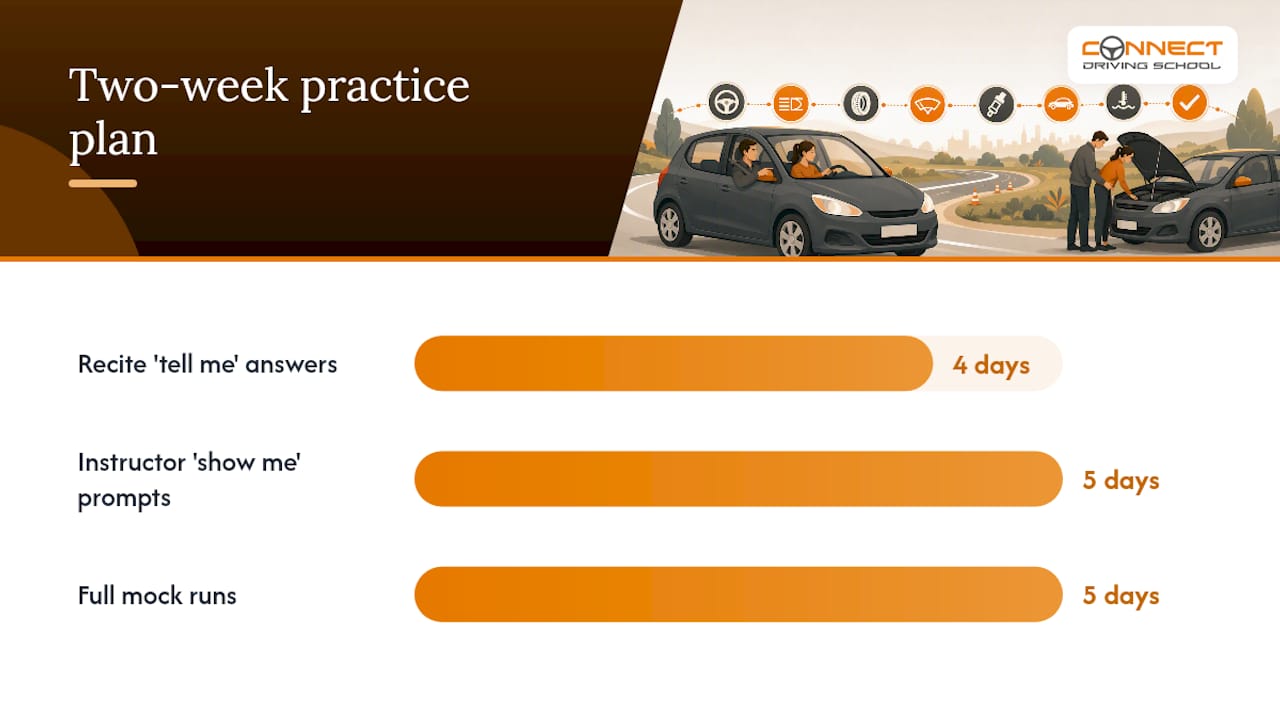
Two weeks is plenty of time to make these answers automatic rather than something you’re guessing at on test day. Spend ten minutes a day reciting the ‘tell me’ answers out loud, ideally in the car with the bonnet actually open in front of you, because saying the words while looking at the real dipstick or reservoir cements the answer far better than reading a list on your phone.
- Days 1 to 4: recite all 14 ‘tell me’ answers from memory, checking each against the official wording
- Days 5 to 9: ask your instructor to prompt random ‘show me’ actions during a normal lesson, at safe moments, so the response becomes instinctive
- Days 10 to 14: run a full mock start, tell me question, drive off, show me question, exactly as it happens on test day
Ask your DVSA-approved instructor to throw questions at you out of order, since examiners don’t ask them in the sequence you’ve memorised, and a shuffled question can throw candidates who’ve only practised the list top to bottom.
Pro Tip: Rehearse a short opening phrase for each ‘tell me’ answer, something like “I’d check the brakes by…”, and repeat it three times before moving to the next question. That small verbal habit gives your brain a running start under pressure, rather than freezing on the first word.
An instructor’s view on where learners actually lose marks
In my experience training learners across London, the two questions that trip people up most are the power steering fault check and the ABS warning light, both because candidates try to over explain a system they don’t fully understand. The fix is always the same: give the short, correct answer and stop talking. Driving schools often build these questions into mock tests so nerves are already spent before the real one.
— Mudassar
Book focused ‘show me, tell me’ practice in London
Learners can benefit from rehearsing these exact questions with a DVSA-approved instructor rather than just reading a list the night before. Test-preparation sessions often include a full mock test, live ‘show me’ practice at safe moments on real roads, and honest, examiner-style feedback on answers and hesitation points.
Whether you need a single top-up lesson before test day or a block of sessions to build confidence from scratch, lessons run flexibly around your schedule and experience level. If you’re within a fortnight of your test and want to walk in knowing every answer cold, book a lesson with Connect Driving School and get your show me, tell me answers test-ready.
Where to check the official list
- DVSA’s official ‘show me, tell me’ question list, updated periodically on GOV.UK
- Examiner marking guidance for exact wording and acceptable answers
Sources
Related Posts

Comments (0)