
Compare the best theory test apps for UK learners, see how official DVSA questions and four in one practice fit together, and follow Mudassar’s study plan...
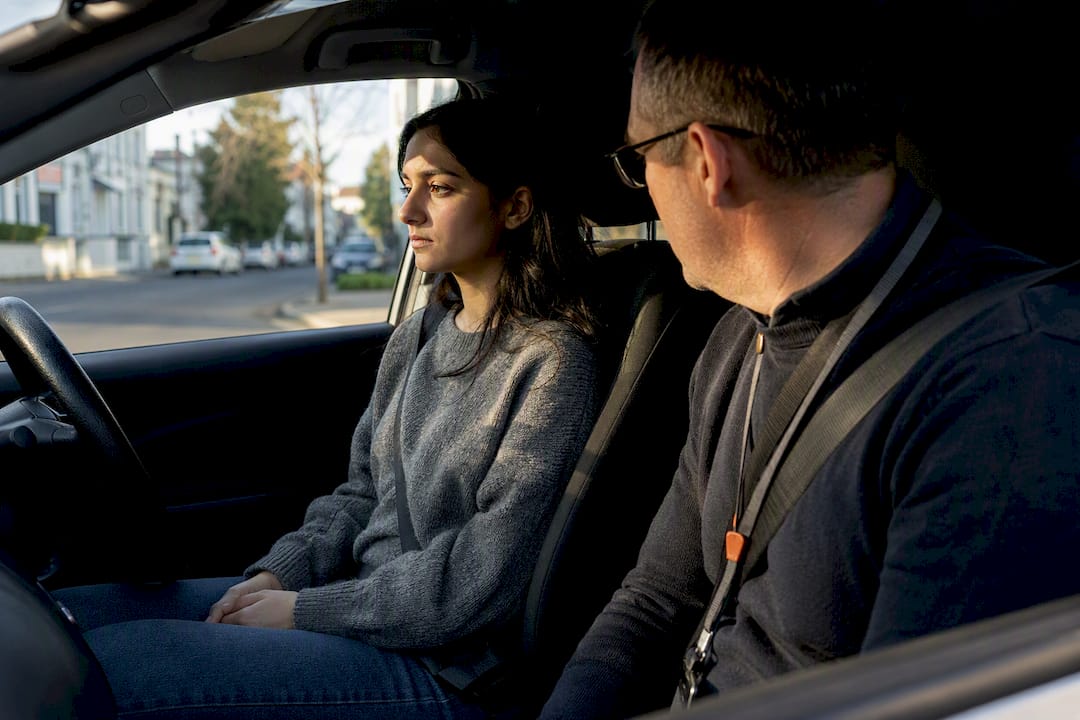
Avoid a £1,000 Fine: ADHD Driving Lessons and DVLA Steps (UK)
Having ADHD does not automatically stop you learning to drive in the UK. There are clear legal rules around disclosure, and practical steps that make lessons work far better for an ADHD brain. Check the Gov, talk to your clinician about medication timing before lessons, and start looking for an instructor who genuinely understands neurodivergent learners rather than one who simply tolerates them.
TL;DR:
- Reporting ADHD to the DVLA is mandatory if medication or symptoms impact driving safety, and failure can lead to fines up to £1,000.
- Booking lessons when medication is at peak effect improves driving accuracy, and predictable routines can reduce cognitive load for neurodivergent learners.
- Finding an instructor with experience in teaching neurodivergent learners and asking targeted questions helps ensure appropriate, adaptable instruction.
- Using visual cues, structured breaks, and practicing the same routes multiple times enhance hazard perception and confidence in ADHD learners.
- Short, familiar solo drives combined with clear communication about anxiety or low mood issues support ongoing progress and emotional well-being.
Table of Contents
- Do I need to tell the DVLA about my ADHD?
- Preparing for lessons: medication, routine and what to bring
- How do I find an instructor who understands ADHD?
- In-lesson techniques that actually help
- Booking your test and requesting reasonable adjustments
- First solo drives, insurance and staying confident
- How Connect Driving School matches these recommendations
- Anxiety, depression and driving lessons: what to plan for
- Why the standard driving-lesson advice misses ADHD learners
- Book ADHD-aware driving lessons with Connect Driving School
- Sources
Do I need to tell the DVLA about my ADHD?
Yes, if your ADHD or your medication affects your ability to drive safely, you must tell the DVLA. This applies whether you hold a provisional licence and are just starting lessons, or you already hold a full licence and were diagnosed later in life. Failing to report when required carries a fine of up to £1,000, and if you’re involved in a collision where non-disclosure comes to light, it can complicate insurance and any legal proceedings.
The DVLA’s own medical fitness guidance sets out a two-stage process once you notify them: an initial review, followed by medical enquiries if they need more detail from your GP or specialist. Most people with well-managed ADHD go through this without issue.
Practical steps to start:
- Use the online ADHD and driving form on GOV.UK to notify DVLA directly.
- Ask your GP or psychiatrist for a short letter confirming your diagnosis and treatment if DVLA requests supporting evidence.
- Keep a copy of anything you submit and the date you sent it.
- If you’re unsure whether your case needs reporting, NHS guidance on ADHD is a sensible starting point before you call DVLA directly.
Preparing for lessons: medication, routine and what to bring
Getting the timing right matters more than most learners realise. Stimulant medication, taken as prescribed, is linked to fewer driving errors, so booking lessons when your medication is at peak effect gives you a real advantage over squeezing a lesson in during a low period or straight after a rushed lunch.
- Time it to your medication. Book lessons for when your dose is active, not wearing off, and avoid slots where you’ll be hungry or exhausted.
- Keep the routine consistent. Same instructor, similar time of day, and repeated routes early on. Predictability lowers the mental load of learning something new every single lesson.
- Prepare a short briefing note. Two or three lines on what helped or hindered last time, handed to your instructor before you set off.
- Bring any clinician guidance. If your GP or specialist has given advice on driving and medication, share it with your instructor.
- Use your phone for a running list. Jot down the one or two things to practise next time, straight after the lesson while it’s fresh.
Pro Tip: Ask your instructor to text you the plan for next lesson the night before. Knowing exactly what’s coming removes a layer of anticipatory anxiety that otherwise eats into your concentration before you’ve even started the car.
How do I find an instructor who understands ADHD?
Not every instructor adapts well, and a rushed, one-size-fits-all teaching style is the fastest way to undo a good lesson. Before booking, ask a few direct questions.
- “Have you taught neurodivergent learners before, and can you give an example of how you adapted?”
- “Are you DVSA-approved, and how long have you been teaching?”
- “What happens if I need more processing time on a manoeuvre than most learners?”
- “How do you handle a lesson where I’m clearly having an off day?”
Red flags include instructors who talk over you, stick rigidly to a script regardless of how you’re doing, or seem irritated by repeated questions. Look locally for instructors and schools that explicitly mention neurodivergent or SEN experience, and don’t be afraid to book a single trial lesson before committing to a block. Specialist SEN and tutoring resources, such as the ADHD support archives at Trinity Education, can also help you understand what “good adaptation” looks like in a learning context before you sit in the car.
In-lesson techniques that actually help
This is where the theory meets the road, and it’s where most of the real progress happens. British Psychological Society guidance on teaching neurodivergent learners to drive recommends breaking tasks into smaller steps and building in processing time, and that maps directly onto how a good instructor should run a lesson.
- One instruction at a time. “Mirror, signal, then wait” beats “mirror, signal, manoeuvre, and watch that cyclist” as a single stacked command.
- Coaching questions over commands. “What do you notice about that junction?” builds judgement that survives after the test; “turn left here” doesn’t.
- Visual cues. Coloured stickers on the dashboard or mirrors, or a small cue card on the dash, cut down on how much you have to hold in working memory at once.
- Structured breaks. A short pause after a roundabout or a tricky parallel park lets your brain reset before the next task.
- Repeated-route practice. Driving the same loop two or three times before introducing a new route builds hazard perception without overloading you with novelty and navigation at the same time.
Progress with ADHD rarely moves in a straight line. Some weeks you’ll nail roundabouts and struggle with mirrors; other weeks it flips. That’s normal, not a sign you’re behind.
Pro Tip: If a manoeuvre goes wrong, ask your instructor for a five-second pause before they jump in with a correction. That brief gap often lets you catch and fix the mistake yourself, which builds confidence far faster than being told what you did wrong every time.
Booking your test and requesting reasonable adjustments
When you book your practical driving test online or by phone, there’s a section to declare additional needs. Use it. Examiners can genuinely change how they run the independent driving section once they know.
- Diagrams instead of, or alongside, spoken directions.
- Shorter direction sequences, sometimes limited to two instructions at a time rather than a longer chain.
- Written place names if you find spoken instructions harder to hold onto under pressure.
The DSA’s guidance on reasonable adjustments confirms examiners can adapt the roughly ten-minute independent driving section to your preferred method, whether that’s road signs, verbal directions, or a diagram. Practise all three in lessons before test day, then tell your instructor which one actually reduces your stress rather than assuming.
First solo drives, insurance and staying confident
Your first drives alone should be short, familiar, and timed for quiet roads, not rush hour on an unfamiliar dual carriageway.
- Start with a five-minute loop you’ve driven dozens of times with your instructor.
- Build up distance and complexity gradually over weeks, not days.
- Check your insurance policy’s wording on medical disclosure, and call your insurer directly if anything is ambiguous.
- Keep a copy of any clinician letters or DVLA correspondence in case you ever need to reference them.
- If confidence dips, a Pass Plus course or a handful of motorway refresher lessons can rebuild it faster than avoiding driving altogether.
How Connect Driving School matches these recommendations
Connect Driving School’s model lines up closely with what this guide recommends for ADHD learners. Every instructor is DVSA-approved, and lessons across London are built around the individual learner rather than a fixed script, which matters enormously when pacing needs to flex week to week.
- DVSA-approved instructors who are used to adjusting pace rather than pushing a standard curriculum regardless of how a lesson is going.
- Structured briefings and consistent routines, mirroring the routine-based approach that reduces cognitive load for neurodivergent learners.
- Pass rates cited above 92%, alongside strong Trustpilot feedback from learners of varying ages and experience levels.
- Low-tech aids built into teaching, from visual cues to broken-down manoeuvre steps, rather than assuming every learner absorbs instructions the same way.
Learners considering lessons should still ask their assigned instructor directly about specific ADHD teaching experience, since individual instructor style varies even within a well-run school.
Anxiety, depression and driving lessons: what to plan for
ADHD rarely travels alone. Anxiety and low mood are common alongside it, and both can make an already demanding task, learning to drive, feel heavier some weeks than others.
Anxiety tends to show up as tension around specific manoeuvres: roundabouts, motorway joins, parallel parking near an audience. It can trigger a fight-or-flight response that makes you freeze on a decision you’d normally make instantly. Depression, meanwhile, often shows up as low motivation to book the next lesson at all, or a flat, distracted state that makes it harder to hold instructions in mind.
The fix isn’t pretending these feelings away. Tell your instructor when something specific is causing you dread, not just that you’re “having a bad day.” A good instructor will slow down, revisit an easier version of the manoeuvre first, and rebuild from there rather than pushing through. If low mood is making it hard to stay consistent with lessons, shorter, more frequent sessions often work better than long ones spaced weeks apart, since momentum matters more than duration when motivation is the barrier.
If anxiety or depression is significantly affecting your daily functioning, that’s worth raising with your GP alongside your ADHD management, not instead of it. The NHS pages on ADHD are a reasonable starting point for understanding where the overlap between these conditions sits and when it’s worth asking for extra support before your next lesson.
Why the standard driving-lesson advice misses ADHD learners
Most generic driving advice assumes a learner who can absorb instructions in the order they’re given, retain them for the next thirty seconds, and recover instantly from a mistake. That’s not how an ADHD brain typically works, and pretending otherwise is why so many ADHD learners quit lessons feeling like the problem is them rather than the teaching method.
The conventional advice, “just practise more,” undersells how much pacing and structure matter compared with sheer hours behind the wheel. Two learners can log the same forty hours and have wildly different outcomes depending on whether their instructor broke tasks into manageable steps or simply repeated the same instructions louder and slower.
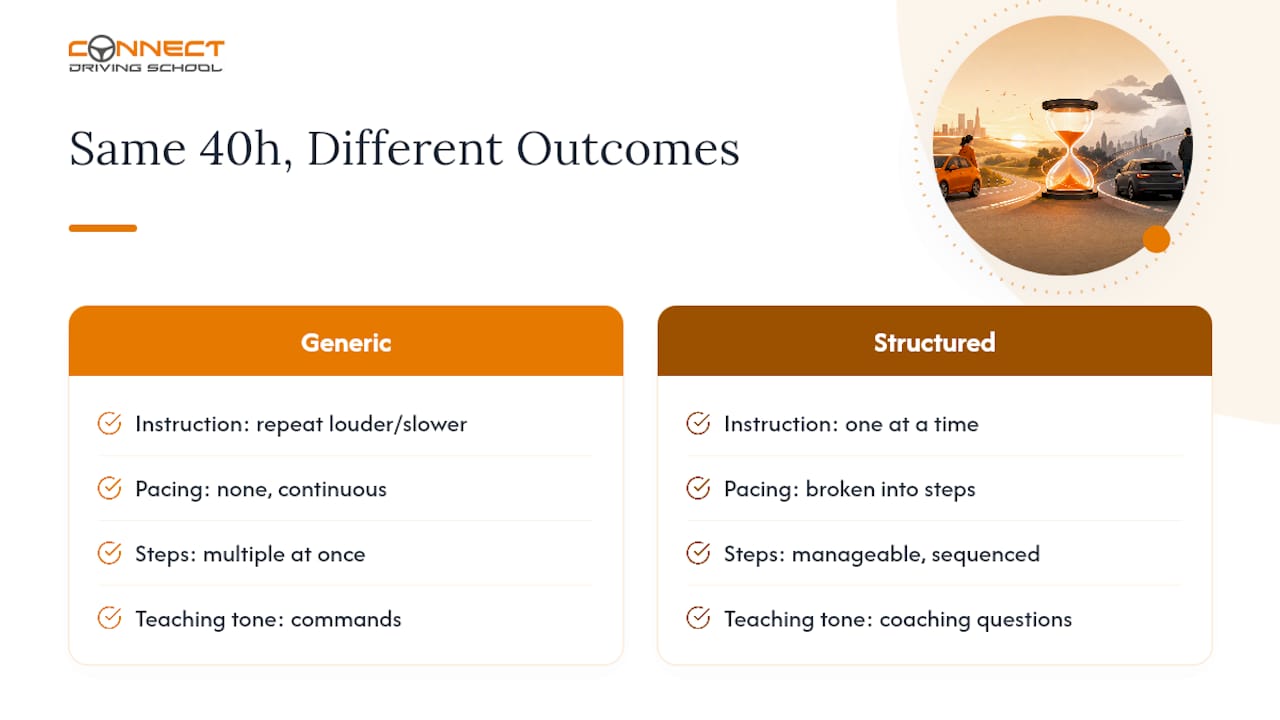
What the evidence actually supports is unglamorous but effective: consistent routines, one instruction at a time, and an instructor willing to ask coaching questions instead of barking commands. None of that requires expensive equipment or specialist gadgets, just an instructor who treats variability in performance as normal rather than a discipline problem.
If you take one thing from this guide, prioritise the instructor relationship over everything else. The right person, patient, willing to adapt, comfortable with an off day, will do more for your progress than any single tip on this page.
— Mudassar
Book ADHD-aware driving lessons with Connect Driving School
Connect Driving School is the practical next step if this guide has made you want lessons built around how you actually learn, rather than a generic course you’re expected to fit into. Lessons run across London with DVSA-approved instructors, pricing starts from £14.99 per hour, and the teaching style already leans on the routines, structured briefings and patient pacing covered throughout this guide.
Booking is straightforward: get in touch through the Connect Driving School booking page online, or call to talk through your specific needs before your first lesson. Mention anything relevant, medication timing, preferred instruction style, previous lesson experiences, so your instructor can plan the first session around you rather than a standard first-lesson template. From there, you can book as a one-off trial or commit to a course, whichever suits how you like to test the water.
This article is general information, not a substitute for advice from a qualified doctor. Consult a qualified healthcare professional about your own circumstances before acting on anything here.
Sources
Related Posts


Comments (0)