
Compare the best theory test apps for UK learners, see how official DVSA questions and four in one practice fit together, and follow Mudassar’s study plan...
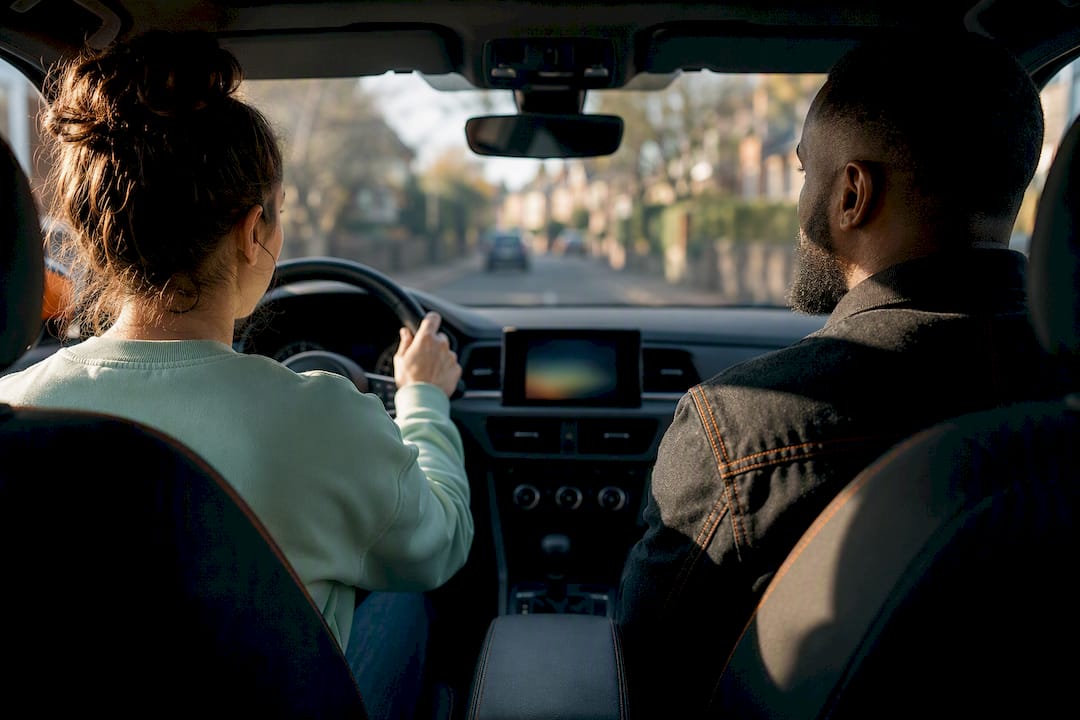
40 minute mock driving test checklist for learners and instructors
A mock driving test is a full rehearsal of the practical exam, run to the same sequence, timing and DVSA marking sheet as the real thing. An examiner-style 40-minute mock, scored honestly and followed by a debrief, is the best available predictor of whether you’ll pass. Most learners benefit from a small number of mocks, with the last one sat close to test day.
TL;DR:
- Taking two to three examiner-style mock tests, spaced over several weeks, provides a clear diagnostic and builds confidence under test conditions.
- Mock tests must include a full realistic drive from a test center, with a focus on independent driving and fault logging without instructor interference.
- Repeating faults in categories like junction observation or mirror checks indicates habits requiring targeted practice, not just occasional errors.
- Prioritize fixing serious faults and patterning minor faults, especially if they reoccur close to test day, or consider rescheduling if faults persist.
- After each mock, focus on practicing the most common failure points, such as head turns for junctions or mirror sequences, to improve performance and reduce test risk.
Table of Contents
- What is a mock driving test and why does it help?
- What should a proper mock include? (exact structure and timing)
- How to run an effective examiner-style mock
- How many mock tests should you take, and when?
- How to read your mock results and decide whether to move your test
- What to practise after a mock (the faults that fail most learners)
- How to book a credible mock with your instructor
- How Connect Driving School uses mocks to lift pass rates
- Book a mock test that actually tells you something
- Sources
What is a mock driving test and why does it help?
A mock driving test reproduces the practical exam from start to finish: same route style, same instructions, same pressure. Your instructor becomes an examiner for 40 minutes, no coaching, no hints, just observation and marking.
That pressure matters more than it sounds. Plenty of learners drive well on ordinary lessons but freeze the moment someone with a clipboard sits beside them. A mock exposes that gap while there’s still time to close it, and the Ready to Pass? campaign treats it as one of the strongest indicators of exam readiness precisely because it recreates that same nervous energy.
A properly run mock gives you three concrete things:
- A fault sheet marked against real DVSA categories, not a vague “you did fine”
- A clear picture of which mistakes are one-offs and which are habits
- An honest answer to the question “am I actually ready?” rather than a hopeful guess
What should a proper mock include? (exact structure and timing)
A mock that skips steps isn’t testing anything real. To mean something, it has to include every element the DVSA’s own guidance sets out for examiners, run in the same order and against the same timings.
That 20-minute independent stretch matters more than most learners realise. It makes up roughly half the real practical test, and it’s where nerves tend to unravel good driving into missed mirror checks and hesitant positioning.
Every fault gets logged as minor, serious, or dangerous. Miss the manoeuvre, skip the independent drive, or let the “mock” run 25 minutes because you’re short on time, and you’ve built a warm-up lesson, not a genuine rehearsal.
How to run an effective examiner-style mock
The instructor’s job during the drive is to say nothing beyond the scripted examiner instructions. That’s the whole discipline of it. According to guidance on running mock tests, the moment an instructor slips into “watch your speed there” mode, the simulation stops measuring anything useful.
- Start in the test-centre car park if you can manage it, at roughly the time of day your real test is booked
- Give only examiner-style instructions: “turn left when it’s safe”, “pull up on the right”
- Choose the manoeuvre at random, the same way an examiner would
- Mark every fault on the DVSA sheet as it happens, without commenting
- Hold a full debrief afterwards, working through the sheet fault by fault
Starting from the actual test centre isn’t a nice touch. The Ready to Pass? campaign points out that the opening minutes of a real test, pulling out of an unfamiliar car park under a stranger’s gaze, are among the most failure-prone of the whole exam.
Pro Tip: Ask your instructor to stay completely silent between instructions, even during a manoeuvre that’s going wrong. Watching yourself recover from a wobble without a safety net is worth more than getting it right with help.
How many mock tests should you take, and when?
Two to three mocks tends to be the sweet spot, according to instructors surveyed by Adrian Flux, and there’s a logic to spacing them properly rather than cramming them all into one week.
- First mock, a few weeks out: this one’s a diagnostic. It tells you what actually needs work, not what you assume needs work.
- Second mock, one to two weeks before test day: confirms whether the fixes have stuck under pressure, not just on a quiet Tuesday afternoon.
- Final check, if needed, in the last few days: short and focused, not a full re-run.
Resist the urge to squeeze in an intensive session the night before your test. A light, calm run-through beats a stressful last-minute mock that leaves you second-guessing everything you’ve learned.
How to read your mock results and decide whether to move your test
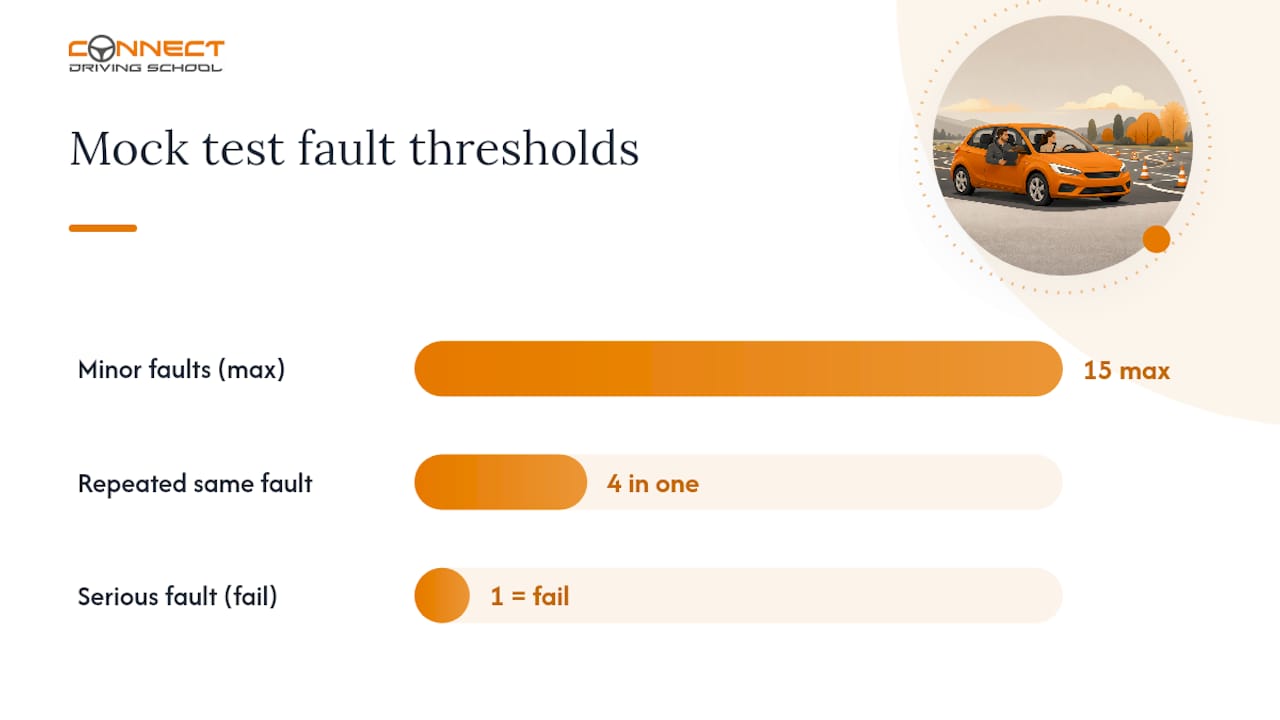
The pass threshold on the real test is up to 15 minor faults and zero serious or dangerous faults, and that’s exactly the standard to hold your mock against. One serious fault causes immediate failure on both mock and real test.
Minor faults scattered across different categories are normal and rarely worth panicking over. The pattern to watch for is repetition within one category: four mirror-check minors in a single drive isn’t bad luck, it’s a habit, and a habit that shows up repeatedly on a real test often gets marked as serious.
Instructors often recommend multiple mock tests before the real one, with the final checks close to test day to confirm readiness.
- Fix serious faults first, always, before worrying about polishing minors
- Group your minors by category and book lessons that target the worst one specifically
- If you’re still collecting serious faults close to test day, move the appointment
You can change your driving test appointment free up to a certain number of full working days before it is due, allowing flexibility if you are not ready.
What to practise after a mock (the faults that fail most learners)
Four fault categories account for the overwhelming majority of failures, and they’re the same four every time: junction observation, mirror checks, blind-spot checks when moving off, and positioning or speed for the road.
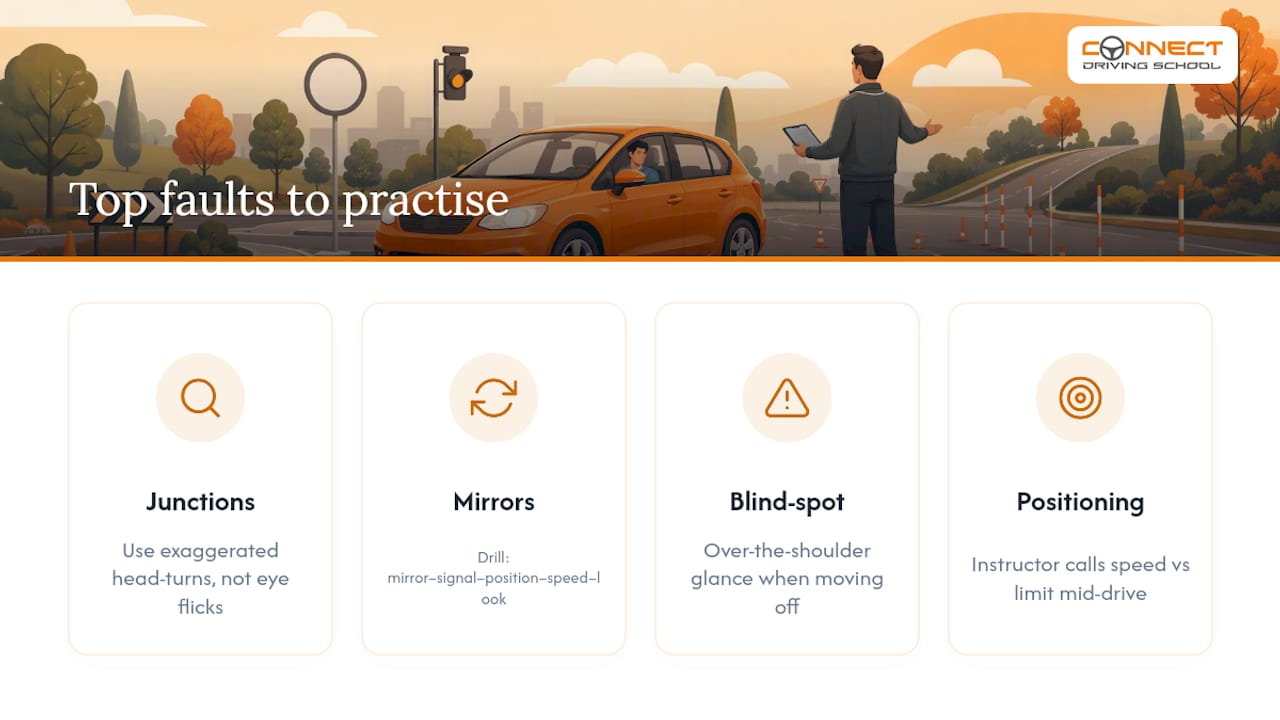
For junction observation, practise exaggerated head-turns rather than eye flicks. Examiners can’t see your eyes move, but they can see your head turn, and visible, deliberate observation is what actually gets credited.
For mirror checks, drill the full sequence out loud until it’s automatic: mirror, signal, position, speed, look. Say it under your breath if you have to, on every single manoeuvre for a week straight.
For blind-spot checks on moving off, build in a deliberate over-the-shoulder glance every time you pull away from a parked position, even when the road looks empty.
For positioning and speed, ask your instructor to call out your speed against the limit mid-drive so you build a feel for it without relying on the speedometer.
Pro Tip: On test morning, spend five minutes visualising the drive rather than cramming theory. Slow, deliberate breathing for sixty seconds before you get in the car does more for a shaky start than any last-minute revision.
How to book a credible mock with your instructor
A mock bolted onto the last twenty minutes of an ordinary lesson isn’t a mock, it’s a rushed impression of one. Book it properly and it earns its cost.
- Ask for a dedicated 90 to 120 minute session, split between the 40-minute drive and a full debrief afterwards
- Confirm the instructor will mark against the official DVSA sheet, not just give general impressions
- Request the drive start from the test centre car park and include a genuine independent driving section
- Check the instructor will stay in examiner role throughout, saving all feedback for after the engine’s off
Pricing tends to track the cost of a standard 90 to 120 minute lesson, though it varies by region and some intensive course packages fold a mock in as standard. Ask upfront what’s included before you book, so there’s no confusion about whether you’re getting a real assessment or a glorified practice drive.
How Connect Driving School uses mocks to lift pass rates
Connect Driving School’s DVSA-approved instructors run examiner-style mocks as standard in the final weeks of a course, scoring pupils against the real fault sheet rather than a rough impression.
Ask your instructor to slot a mock into your final-week plan alongside a targeted debrief. Treat the fault sheet as your revision list for the days that follow, not just a score to feel good or bad about.
— Mudassar
Book a mock test that actually tells you something
Plenty of instructors offer a “mock” that’s really just a longer lesson with a stopwatch. Connect Driving School runs it properly: a full 40-minute examiner-style drive, marked against the genuine DVSA fault sheet, followed by a debrief that turns your fault list into an actual lesson plan for the days before your test.
A session typically runs 90 to 120 minutes, covering the drive itself plus a thorough debrief, priced in line with a standard double lesson rather than a premium add-on. Every instructor is DVSA-approved and trained to stay in examiner mode for the full drive, so the result actually reflects where you stand, not where your instructor hopes you stand.
If you’re in your final fortnight before test day, this is the moment to book one. Head to Connect Driving School and arrange a mock test session with tailored follow-up lessons built around whatever your fault sheet turns up.
Sources
The Ready to Pass? campaign sets out the official readiness checklist and the rule on changing your test appointment free of charge up to 10 working days out. DVSA’s own guidance for instructors running mock tests lays out the exact structure and marking approach a valid mock should follow. For a breakdown of the most common test faults and how examiners categorise them, GOV.UK’s fault guide is the primary reference worth bookmarking before your own mock.
Related Posts

Comments (0)