
Calmly stop stalling a car as a UK learner. Read DVSA safe advice, instructors' drills for clutch control and hill starts, quick restart steps, and when...
10 Slow Reps to Nail Bay Parking: Mirror Cues and a Test Drill for UK Learners
Getting a bay park right comes down to one habit: keep checking your mirrors and blind spots all the way through the manoeuvre, and finish squarely inside the white lines. Everything else, the mirror reference points, the steering timing, the corrections, sits underneath that one rule. GOV.UK confirms bay parking is one of four manoeuvres an examiner may set on your test, and the sections below break the technique down into steps you can actually practise.
TL;DR:
- Checking mirrors and blind spots continuously during the manoeuvre is crucial, as examiners look for safe observation throughout the entire parking process.
- Practising mirror reference points individually and calibrating them to your specific vehicle significantly improves consistency in lining up within the bay lines.
- Finishing accurately within the bay lines is mandatory, with even slight overhangs counted as faults and multiple corrections suggesting poor control.
- Using sensors and reversing cameras as secondary tools is helpful, but safe visual observation and mirror checks remain the primary assessment criteria during the test.
- Structured, instructor-led practice focusing on observation timing and mirror checks leads to faster improvement and higher test success probability.
Table of Contents
- Bay parking tips: your pre‑manoeuvre safety checklist
- How to reverse bay park: step‑by‑step with mirror reference points
- Forward bay parking and reversing out safely
- Common bay parking mistakes and quick fixes
- A short practice plan and what to ask your instructor
- Highway Code rules that still apply once you’re parked
- Do parking sensors and technology aids help?
- What I’d tell a learner before their bay park attempt
- Book bay parking practice with Connect Driving School
- Sources
- FAQ
Bay parking tips: your pre‑manoeuvre safety checklist
Before you touch the steering wheel, run a proper check of what’s around you. Missing this step is one of the fastest ways to pick up a serious fault, no matter how neat your parking ends up looking.
- Do a full 360° check: both door mirrors, the interior mirror, then a shoulder check for blind spots before you move at all.
- Confirm the bay is suitable. Look at its width and depth, skip disabled bays unless you’re entitled to use them, and watch for a badly parked car spilling into the space next door.
- Signal only if it will genuinely help another road user understand what you’re doing.
- Switch off the engine and apply the handbrake once you’ve stopped, and check your mirrors before opening the door into moving traffic or pedestrians. The Highway Code’s parking rules are explicit on both points.
- Never park in a loading bay, on a clearway, or anywhere the signage or road markings prohibit it. Fines aside, it’s simply not a legal space to use.
Pro Tip: Treat the 360° check as a habit you do before every manoeuvre, not just bay parking. Instructors see far more faults from skipped observation than from wobbly steering.
How to reverse bay park: step‑by‑step with mirror reference points
Reverse bay parking rewards patience over speed. RAC’s guidance on the manoeuvre puts observation and smooth steering control ahead of everything else, and that’s the right order to think about it.
- Position yourself first. Drive past the bay and stop roughly two car lengths beyond it, or wherever your instructor has calibrated as your reference distance. This gives you enough swing room to turn in cleanly.
- Check before you move. Full mirror and blind‑spot checks, then select reverse and check again as the car starts to move.
- Watch for your reference point. A widely used cue is the third bay edge appearing in your left door mirror. This is not identical for every driver or every car, so it’s worth calibrating it on your own vehicle during lessons. When it appears, apply full lock towards the bay.
- Steer smoothly, don’t dry steer. Keep the car rolling gently rather than turning the wheel while stationary. Dry steering wears the tyres and looks jerky to an examiner.
- Watch both door mirrors as you straighten. As the car lines up between the bay markings, unwind the lock gradually and check both mirrors to judge whether you’re central.
- Correct if needed. If your angle is clearly wrong, pull forward and start the turn again rather than fighting it all the way in. One modest correction is generally fine; several in a row suggests weak control and risks tipping a minor fault into something more serious.
- Finish inside the lines. The car needs to end up within the bay markings. Crossing well outside the lines, or ending up in the neighbouring bay, is treated as a serious fault.
Pro Tip: Ask your instructor to point out your car’s specific mirror reference the first time you try this. Every vehicle sits differently, and guessing the reference point wastes far more attempts than getting it confirmed once.
Observation is marked continuously throughout, not just at the start. An examiner watching you check your mirrors three or four times during the reverse is seeing exactly what they want to see.
Forward bay parking and reversing out safely
Driving forward into a bay is generally the easier half of the exercise, but it carries a stricter finishing standard than most learners expect.
- Line up your approach. Position the car so you have a wide, unhurried turning arc into the bay, using your wing mirror as a guide for when to start turning.
- Turn at the right moment. Steer in smoothly once your reference point in the mirror lines up with the bay entrance, adjusting your speed to match how tight the turn needs to be.
- Finish precisely. This is where forward bay parking gets strict. Guides summarising DVSA standards note that finishing with even one or two wheels resting on the bay line counts as a driving fault, and ending up partly in the adjacent bay is a serious fault. Aim to finish clearly and squarely within the lines, not just “close enough.”
- Reverse out with full observation. Check both mirrors and take a shoulder check before edging backwards. Steer at roughly the point where you’re a third of the way out of the bay, then check again before joining the flow of traffic.
- Treat busy car parks differently. If pedestrians or other cars are moving nearby, pause rather than rush. Reversing out is as much an observation exercise as the bay park itself.
Common bay parking mistakes and quick fixes
Most learners lose marks on the same handful of errors, and each one has a straightforward fix once you know what to look for.
- Chasing the line. Trying to fix a bad angle with small steering wiggles usually makes things worse. Pull forward early, reset, and start the approach again.
- Skipping blind‑spot checks. A quick glance in the mirror isn’t enough. Build the shoulder check into your routine every single time, not just when you remember.
- Reversing too fast or dry steering. Keep your speed low with gentle clutch control and turn the wheel while the car is moving, not while it’s stationary.
- Finishing on the line and hoping it’s fine. It usually isn’t. If you’re not confident you’ve finished within the markings, pull out and try again. Examiners generally allow a reasonable number of corrections, and a clean second attempt beats a scruffy first one.
- Over‑focusing on perfect centring. Examiner guidance on parking suggests the real question is whether the car could reasonably be left in that position, not whether it’s dead centre to the inch.
A short practice plan and what to ask your instructor
Bay parking rewards repetition more than any other manoeuvre. GOV.UK’s test structure means you’ll face one manoeuvre from a set of four, chosen on the day, so practising only your favourite version leaves you exposed.
- Practise both reverse and forward bay parks, and try both left‑hand and right‑hand bays. The examiner picks the exercise, not you.
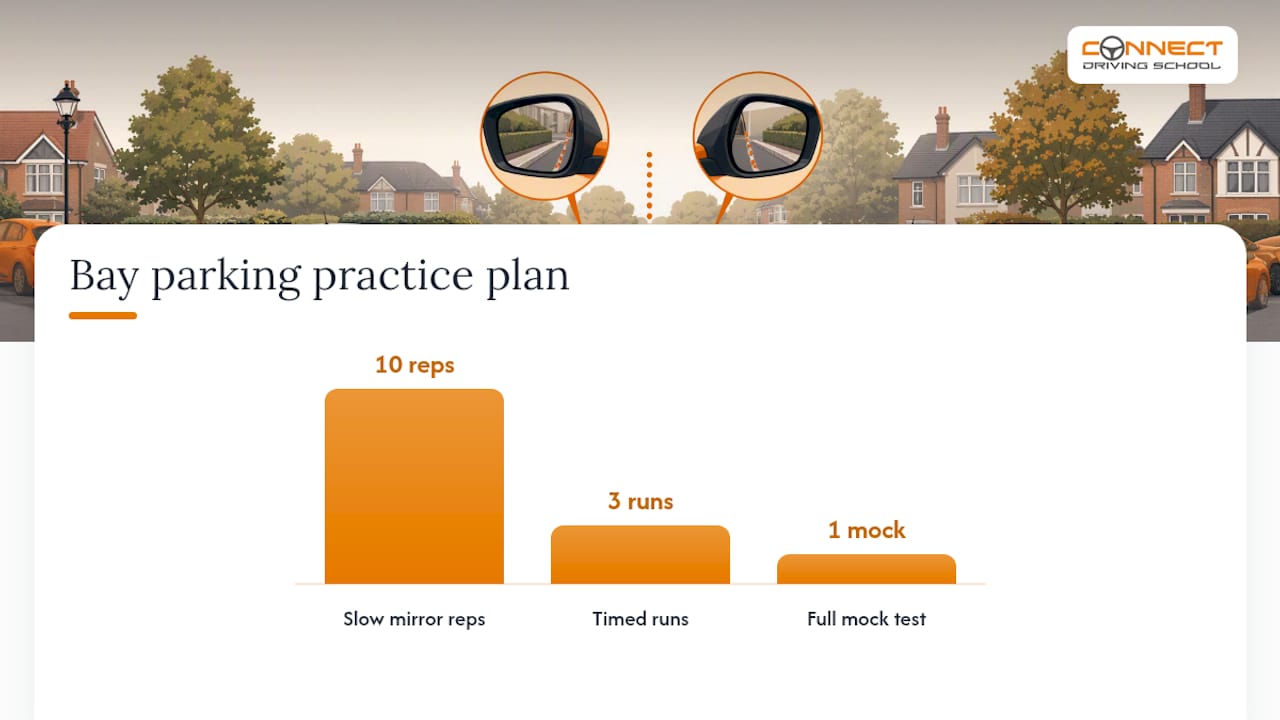
- Run 10 slow reps focused purely on your mirror reference points, without worrying about speed.
- Follow with three timed runs concentrating on where you actually finish inside the bay.
- Finish with one full mock test that mixes the bay park in with your other manoeuvres, so it doesn’t feel like an isolated drill.
Pro Tip: Ask your instructor to calibrate your mirror reference point specifically for the car you’re learning in, then time a few runs under test‑like pressure. That combination closes the gap between practice and the real thing faster than anything else.
Connectdrivingschool’s DVSA‑approved instructors work through exactly this kind of structured drill with learners across London, and the school’s pass rate sits above 92%, with strong ratings on Trustpilot from students who’ve been through the same practice routine.
Highway Code rules that still apply once you’re parked
Getting into the bay cleanly is only half the job. What you do once you’ve stopped matters too, both for your test and for everyday driving.
- Switch off the engine and apply the handbrake before you leave the car, as set out in the Highway Code.
- Check your mirrors before opening any door, particularly on the traffic side of the vehicle.
- Never use a disabled bay, loading bay, or clearway unless you’re entitled to, and be aware that misuse can carry a fine.
- Remember that examiners weigh safety and observation before precise centring, but a car left badly positioned can still count against you.
Do parking sensors and technology aids help?
Parking sensors and reversing cameras are useful backup tools, not a replacement for looking around you. On the practical test, examiners are marking your observation, not whether your car beeped at the right moment, so relying on sensors instead of mirror checks will cost you marks even if you never touch the kerb.
That said, if your car has sensors or a rear camera fitted, use them as a secondary check alongside your mirrors rather than instead of them. A sensor picking up a low bollard or a kerb your mirrors don’t show clearly can genuinely prevent a knock, especially in tight, busy car parks where visibility is limited. The same logic applies to blind‑spot warning lights on the wing mirrors: treat them as a prompt to check properly, not a substitute for the check itself.
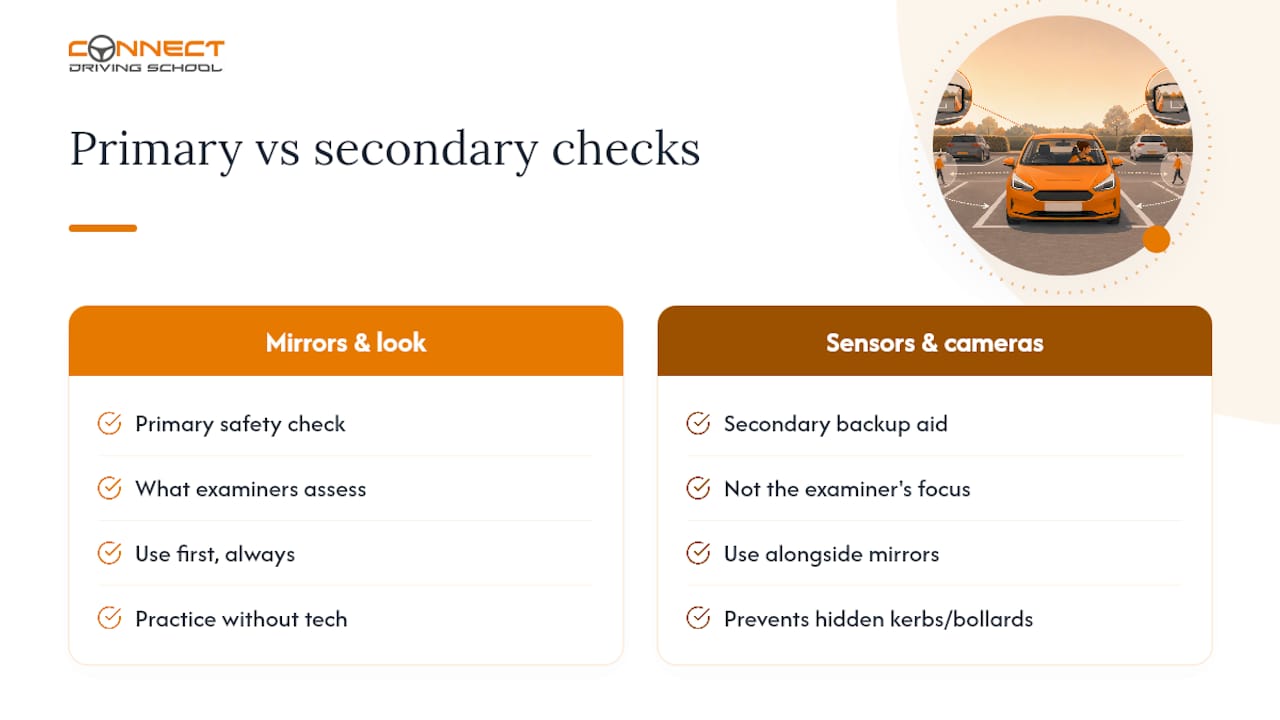
Worth noting for test day: examiners aren’t assessing whether you used your car’s technology well, they’re assessing whether you demonstrated safe observation with your own eyes and mirrors. If you’ve learned to bay park in a car with sensors, it’s worth practising at least a few reps without leaning on them, so you’re not caught out if your test car doesn’t have the same features. Instructors can help you build that habit deliberately during lessons rather than leaving it to chance on the day.
What I’d tell a learner before their bay park attempt
Learners tend to obsess over the steering sequence and underrate observation, when it’s usually the other way round that trips people up on test day. A driver who checks mirrors properly but finishes slightly off‑centre usually passes. A driver with textbook steering who forgets to check a blind spot usually doesn’t.
What improves fastest with focused practice isn’t the manoeuvre itself, it’s the timing of when you look. Ten slow, deliberate reps with an instructor correcting your mirror timing will do more for your confidence than an hour of unsupervised attempts in an empty car park. If you’re based in one of the areas Connectdrivingschool covers across London, that kind of structured, one‑to‑one feedback is exactly what local lessons are built around.
— Mudassar
Book bay parking practice with Connect Driving School
Connectdrivingschool is the practical alternative to working this out alone in a supermarket car park: you get a DVSA‑approved instructor sitting next to you, correcting your mirror timing and steering sequence in real time, rather than guessing whether your last attempt would have passed.
If you’re learning anywhere across Connectdrivingschool’s London service areas, from SW postcodes through to the Kingston and Sutton areas, book a lesson or check current prices and get some proper bay parking reps in before your test date arrives.
Sources
- Gov
- How to bay park for your driving test | RAC Drive
- The Four Driving Test Manoeuvres and What Examiners Mark
FAQ
Is reverse or forward bay parking easier for the test?
Neither is inherently easier; the examiner chooses one on the day, so GOV.UK’s own test structure means you need to practise both rather than picking a favourite.
What happens if my wheel touches the bay line?
For the forward bay park, finishing with a wheel on the line is treated as a driving fault, while ending up partly in the next bay is a serious fault.
How many corrections am I allowed during a bay park?
One or two modest pull‑forwards to reset your angle are generally acceptable; repeated corrections suggest poor control and can tip into a serious fault.
Do I need to use my mirrors constantly during the manoeuvre?
Yes. Examiners mark observation throughout the whole manoeuvre, not just at the start, so mirror and blind‑spot checks should continue right until you’re parked.
Can Connectdrivingschool help me practise bay parking specifically?
Yes.
Related Posts

Comments (0)