
Find the exact roads and hazard hotspots on Uxbridge test routes, plus three instructor‑tested drills and GPX practice sessions to pass with confidence.

Nail the A41 Merge on Hendon Test Routes: 3 Drills, 3 Week Checklist
Exact Hendon test routes change from day to day, and examiners pick whichever suits traffic and conditions on the morning of your test. What stays constant is the pattern: estate roundabouts around Grahame Park Way, a stretch of the A41, narrow residential roads and at least one section of independent driving. Prepare for those four elements specifically, particularly merging onto the A41 and reading multi-lane roundabouts, and you are ready for almost anything the examiner throws at you.
TL;DR:
- Practicing merging onto the A41 and confidently reading multi-lane roundabouts addresses the most common faults seen during Hendon driving tests.
- The typical test route lasts 20 to 35 minutes, covering up to 11 roundabouts and multiple road types, including estate, residential, and dual carriageways.
- Key junctions include Aerodrome Road, Aviation Drive, Grahame Park Way, Colindale Avenue, and West Hendon Broadway, with frequent exposure to high-speed merging and cycling interactions.
- Improvement focuses on consistent observation, decision-making, and lane discipline across unpredictable roads rather than route memorization.
- Specialized drills like A41 lane practice, estate circuit, and corridor runs enhance skills necessary for passing the test in a high-density, varied environment.
Table of Contents
- What Hendon test routes look like: patterns, typical duration and roads used
- Local tricky spots and what examiners are watching at Hendon
- Practice templates: three repeatable route drills for Hendon
- A three-week preparation checklist for Hendon test day
- Tools and low-cost ways to practise Hendon routes
- Author and Connect Driving School proof points
- History and purpose of the Hendon Test Routes
- How Hendon compares with other London test areas
- Handling unexpected changes on test day
- Recommended resources and community forums for Hendon learners
- Why route memorisation misses the point
- How Connect Driving School helps you prepare for Hendon
- Sources
What Hendon test routes look like: patterns, typical duration and roads used
Every route from Hendon runs roughly 20 to 35 minutes, and the route data collected across the test centre’s network shows some circuits packing in as many as 11 roundabouts. That is a dense number for a route of this length, and it tells you where to spend your practice hours.
The road names repeat constantly across mapped routes, which is genuinely useful. Route analyses of Hendon’s test area show Aerodrome Road, Aviation Drive and Grahame Park Way appearing on nearly every published route, alongside regular use of the A41 (Hendon Way) and Colindale Avenue.
Learn these roads properly and you have covered most of what the examiner will actually test:
- Aerodrome Road and Aviation Drive — the roads immediately around the test centre itself, used on almost every route
- Grahame Park Way — a busier link road with multiple junctions and roundabout approaches
- The A41 (Hendon Way) — a dual carriageway stretch requiring confident merging and speed matching
- Colindale Avenue — narrower, bus-heavy, and a common site of cyclist interactions
- West Hendon Broadway — mixed residential and commercial traffic with pedestrian crossings
Expect a blend of estate driving at 20mph, standard 30mph residential roads, and short bursts of 40 or 60mph on the A41 approach. Few test centres in London pack this much variety into such a short loop.
Local tricky spots and what examiners are watching at Hendon
Serious faults at Hendon cluster around a handful of predictable spots, and knowing them in advance changes how you drive past them. Insider analysis of Hendon’s routes identifies hesitation on A41 slip roads as one of the most common causes of test failure in the area.
- Merging onto the A41. The slip roads are short, and traffic moves fast. Hesitating here, or creeping rather than committing to a gap, is the single most cited fault at this test centre.
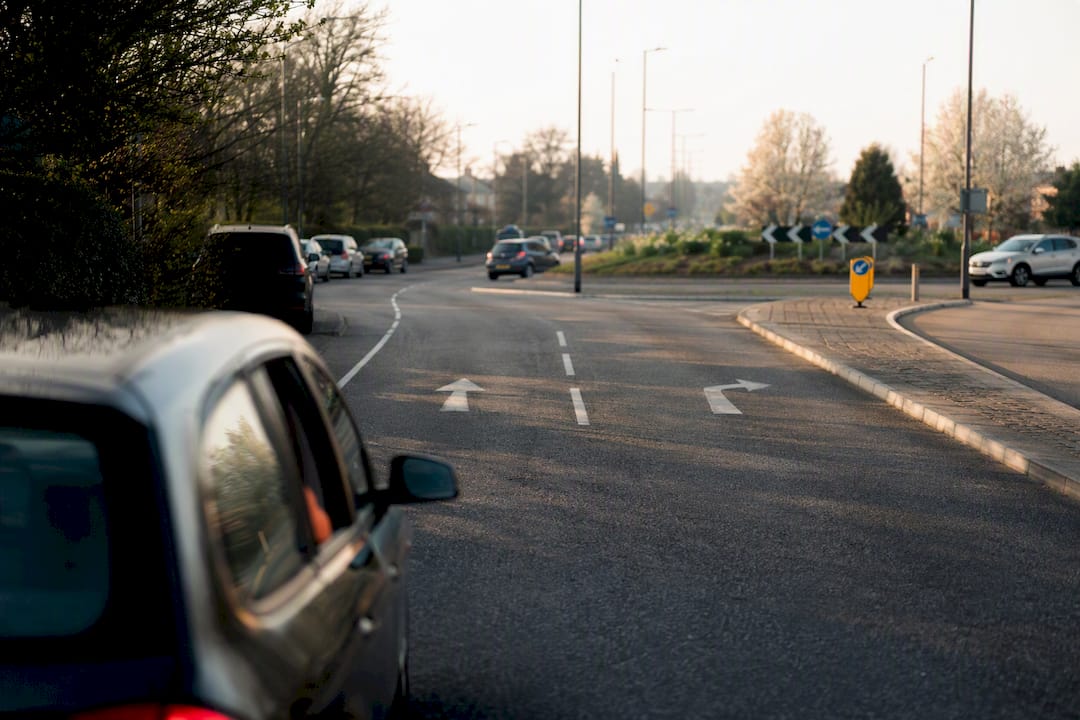
- Multi-lane roundabout lane choice. Several roundabouts around Grahame Park Way have two or three approach lanes with signs that are easy to misread under pressure. Late lane changes or indecisive positioning cost marks fast.
- Estate roundabouts and narrow roads. Around Beaufort Park, tight mini-roundabouts and parked cars demand steady observation and a willingness to make progress without overreacting to every obstruction.
- Bus and cyclist interactions. Colindale Avenue and West Hendon Broadway both carry regular bus traffic and cyclists filtering between lanes, and examiners watch closely for how you manage that space.
- Speed limit transitions. Moving from a 20mph estate zone to a 30mph main road, then onto the A41’s higher limit, catches learners who forget to check the new limit rather than assuming it carries over.
Pro Tip: When practising roundabout approaches, say your lane choice and exit point out loud before you get there. Talking it through forces you to commit early instead of drifting into the wrong lane at the last second.
Examiners are assessing you from the moment you pull away, not just at the “difficult” bits. Smooth observations at every junction, not just the big roundabouts, are what separates a pass from a series of minor faults that add up.
Practice templates: three repeatable route drills for Hendon
Rather than trying to memorise a specific route (which may not even be the one you get), run these three drills repeatedly with an instructor or supervising driver until each element feels automatic.
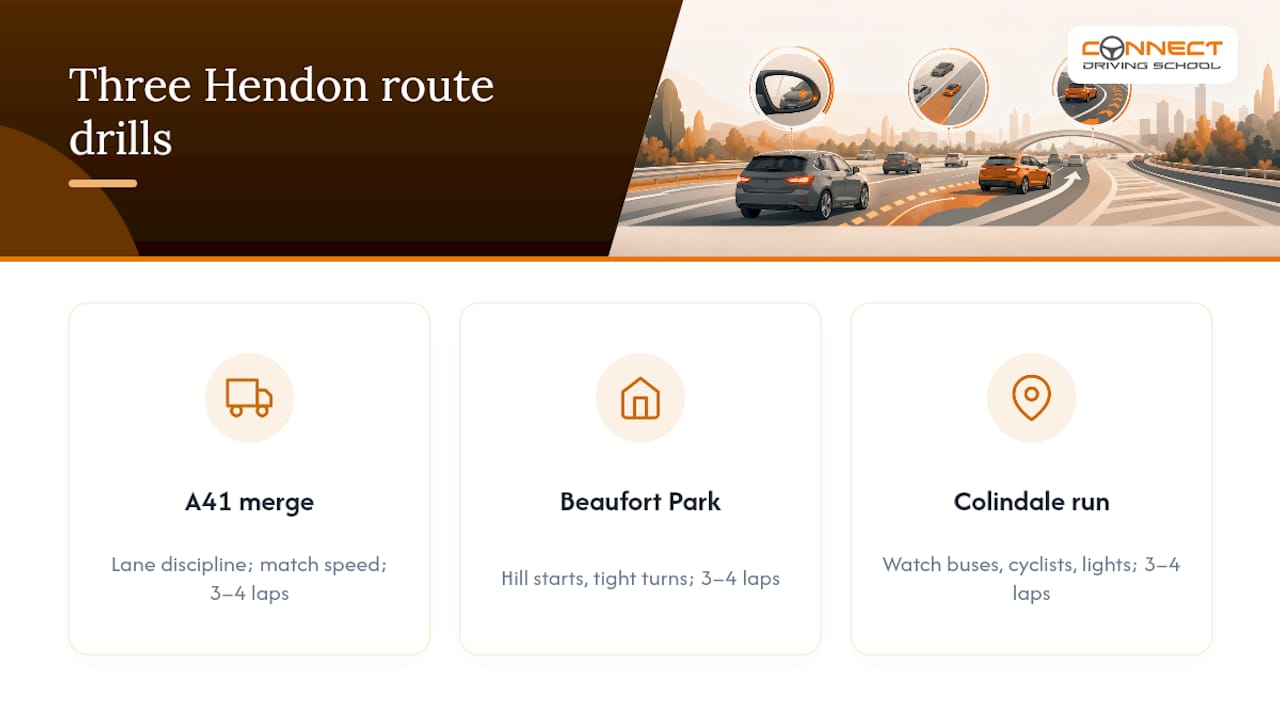
The A41 dual-carriageway loop. Drive out to a slip road onto the A41, merge, hold a steady speed for a few minutes, then exit and repeat from a different junction. The goal is lane discipline and matching your speed to the traffic before you commit to the gap, not just getting onto the road successfully once.
The Beaufort Park estate circuit. Loop through the mini-roundabouts, one-way sections and narrow parked-car streets near the test centre itself. This is where hill starts, tight turns and meeting oncoming traffic around parked vehicles get rehearsed.
The Colindale corridor run. Drive the length of Colindale Avenue and West Hendon Broadway, paying attention to bus stops, cyclists filtering past stationary traffic, and junctions with several sets of lights in quick succession.
Run each drill three to four times over a fortnight, ideally spaced across different times of day, since traffic density on the A41 changes markedly between mid-morning and rush hour. Mapped practice routes for this test centre run 20 to 35 minutes with turn counts and roundabout totals listed for each one, which detailed route breakdowns make useful for planning exactly how long each drill should take.
After every lap, log one thing you got right and one thing you hesitated on. Patterns emerge fast, usually around the same two or three junctions.
A three-week preparation checklist for Hendon test day
Work backwards from test day in three stages, rather than cramming everything into the final week.
- Week one: core control. Focus purely on clutch control, steering precision and mirror checks on quiet roads. No pressure junctions yet, just clean fundamentals.
- Week two: complex junctions. Move onto the A41 merge, the Grahame Park Way roundabouts and the Colindale bus stops. This is where most of your instructor time should go.
- Week three: mock tests and independent driving. Book at least one full mock test that mimics real exam conditions, including a stretch of independent driving following sat-nav or signs without prompting.
If your instructor flags a specific weak point close to the date, a short, focused lesson on that single junction is worth more than a generic final lesson covering everything lightly.
On the morning itself, confirm your provisional licence and theory test pass certificate are both in the car, check mirrors and tyre condition before you leave, and arrive at 3 Aviation Drive with ten minutes to spare rather than rushing in at the last minute.

Tools and low-cost ways to practise Hendon routes
Route-practice apps such as Test Routes offer turn-by-turn navigation for many UK test centres, including Hendon, and can help you rehearse road geometry before a lesson. They add real value for familiarising yourself with junction layouts, but route-app guidance itself is clear that this kind of rehearsal does not replace a live mock test with a qualified instructor watching your observations and decision-making in real time.
- Walk the key junctions on foot first, and photograph lane markings at the trickier roundabouts for quick reference later.
- Use a sat-nav export or app route only as a passenger exercise before driving it, never while you are behind the wheel.
- Book one full ADI-led mock test in the final fortnight to simulate genuine exam pressure rather than a relaxed practice run.
Author and Connect Driving School proof points
This guide is written by Mudassar, drawing on published Hendon route data, examiner-focused insider guidance, and direct familiarity with how DVSA-approved instructors structure test preparation across London.
Connectdrivingschool works with DVSA-approved instructors delivering tailored lessons across London, and reports pass rates of over 92% among its students. That figure reflects a teaching approach built around patient, structured instruction rather than route memorisation, which matters given that Hendon’s own recorded pass rates sit closer to 42.1% to 49.5%. Local ADI experience, applied to the specific junctions covered above, is what turns generic road craft into Hendon-ready driving.
History and purpose of the Hendon Test Routes
Hendon Test Centre sits at 3 Aviation Drive within the Beaufort Park development, an area that grew substantially over the past two decades as former RAF Hendon land was redeveloped into housing, retail and new road infrastructure. The test routes evolved alongside that development, incorporating newer estate roads such as Grahame Park Way and Aerodrome Road as they were built, rather than being fixed from some earlier, simpler layout.
That history explains why Hendon’s routes feel like a patchwork of old and new. Colindale Avenue and West Hendon Broadway carry the older, denser residential character typical of outer London suburbs built decades ago, while the roads immediately around the test centre are comparatively modern, wider and designed with more standardised roundabout geometry.
The purpose behind any DVSA test route, at Hendon or anywhere else, has never changed: examiners need a route that exposes a candidate to a representative mix of road types within a short window. DVSA does not publish live current routes, precisely so learners cannot simply memorise a sequence of turns instead of demonstrating genuine competence. Hendon’s mix of A-road merging, dense roundabouts and mixed-use residential streets happens to deliver that variety in a compact area, which is likely why so many published routes reuse the same core roads even as exact sequences shift.
Understanding that purpose reframes how you should prepare. The goal was never to learn “the route.” It was always to test whether you can handle whatever a road throws at you, and Hendon’s geography just happens to throw a lot at you in a short space.
How Hendon compares with other London test areas
Hendon sits towards the tougher end of London’s test centres, largely because of roundabout density and the A41 merge. Many outer London centres offer longer stretches of straightforward residential driving with only the occasional roundabout. Hendon compresses several complex junctions into a route lasting well under 40 minutes, which leaves less room to recover from an early mistake.
Test centres closer to central London tend to bring different challenges entirely: heavier congestion, more pedestrian crossings, and less opportunity for sustained higher-speed driving. Hendon’s A41 section gives it something those central routes largely lack, a genuine dual-carriageway merge and a sustained period of higher-speed lane discipline, which some learners find harder to prepare for simply because they have less regular access to that kind of road.
Suburban centres further out in Greater London, particularly those without a major A-road nearby, often show higher pass rates partly because the driving itself involves fewer decision points per minute. Hendon’s roundabout count, sometimes reaching double figures on a single route, according to mapped route collections, is unusually high by London standards.
None of this makes Hendon unfair. It simply means the margin for error on lane discipline and roundabout positioning is smaller than at a quieter test centre, so that is exactly where your practice time should be weighted. If you are comparing centres before booking, treat roundabout density and A-road access as the two most useful predictors of how demanding a route will actually feel.
Handling unexpected changes on test day
Routes at Hendon are entirely at the examiner’s discretion, and the specific roads you drive can differ from anything you have rehearsed, even if you have practised every named road in this guide. That is not a loophole in the system. It is the system working as intended, because DVSA deliberately avoids publishing fixed live routes so that candidates cannot pass by memory alone.
The practical response is to stop thinking in terms of “the route” and start thinking in terms of skills that transfer regardless of which roads you get. If you have drilled A41 merging, multi-lane roundabout positioning and estate manoeuvring as described earlier, you can handle a road you have never driven before, because the underlying skill, not the specific junction, is what the examiner is scoring.
If the examiner directs you somewhere unfamiliar mid-test, treat it exactly like independent driving. Follow the instruction calmly, use your mirrors and signals as you normally would, and if you genuinely misunderstand a direction, it is entirely acceptable to ask for clarification. Asking a sensible question costs you nothing. Guessing and getting it wrong can.
Diversions, roadworks and temporary traffic lights also crop up more often around Hendon’s newer estate roads than learners expect, given the ongoing development around Beaufort Park. Build a small buffer into your mental preparation for the possibility that a road you rehearsed might be partially closed or rerouted on the day, and treat any unexpected change as simply another independent driving segment rather than a crisis.
Recommended resources and community forums for Hendon learners
Beyond structured lessons, several free resources help Hendon learners get a feel for the area’s specific challenges before test day. Route-mapping sites that catalogue turn-by-turn breakdowns, roundabout counts and typical durations for this test centre are worth a look during your planning phase, since they give a realistic sense of what a route actually demands rather than a vague impression.
Local driving forums and Facebook groups aimed at London learners often carry recent, first-hand accounts of specific junctions or diversions near Beaufort Park, which can be more current than older published route guides. Treat these as colour and context rather than gospel, since individual experiences vary and DVSA discretion means no single account is a guarantee of what you will get.
Your ADI remains the single most reliable resource, simply because they can adapt instruction to whatever you are struggling with that week rather than offering generic advice. Combining a good instructor with route data and the occasional forum thread, rather than relying on any one source alone, tends to give the most complete picture of what Hendon actually involves.
Why route memorisation misses the point
Most guides to Hendon focus heavily on naming roads, and there is a place for that. But the conventional advice to “learn the route” slightly misses what actually predicts a pass here. Two learners can drive the exact same road and get wildly different outcomes, because the examiner is scoring decision-making, not route recall.
What is genuinely overrated is trying to map every possible route Hendon might use. It is a moving target, and DVSA designed it that way deliberately. What is underrated is drilling the transferable skills, decisive gap selection on the A41, calm lane discipline on roundabouts, steady observation around parked cars, until they hold up regardless of which roads you actually get.
If you take one thing from this guide, prioritise the A41 merge above everything else. It is a short section of most routes, but it produces a disproportionate number of serious faults, and it is also the easiest thing to drill repeatedly in a controlled way before test day. Everything else on this list matters, but that slip road is where confidence either shows or collapses.
— Mudassar
How Connect Driving School helps you prepare for Hendon
Connectdrivingschool is the practical alternative to generic revision apps and route-memorisation guides for learners testing at Hendon. Instead of guessing which roads you might get, you work with a DVSA-approved instructor who already knows the A41 merge, the Grahame Park Way roundabouts and the Colindale bus stops from repeated coaching sessions with previous students.

Lessons can be structured around exactly the weak points this guide covers: a targeted session on slip-road merging, a mock test that mirrors real exam pressure, or a focused run through the Beaufort Park estate circuit if roundabout positioning is your sticking point. A single well-aimed lesson before test day, aligned to the fault you actually make rather than a generic refresher, is usually more effective than repeating the same practice drive on your own. Connectdrivingschool’s instructors report pass rates of over 92% among their students, built on patient, personalised teaching rather than volume tuition.
If you are booking your Hendon test soon, get in touch with Connect Driving School to arrange lessons or a mock test tailored to the routes and junctions this guide has covered.
Sources
Related Posts


Comments (0)