
Compare the best theory test apps for UK learners, see how official DVSA questions and four in one practice fit together, and follow Mudassar’s study plan...
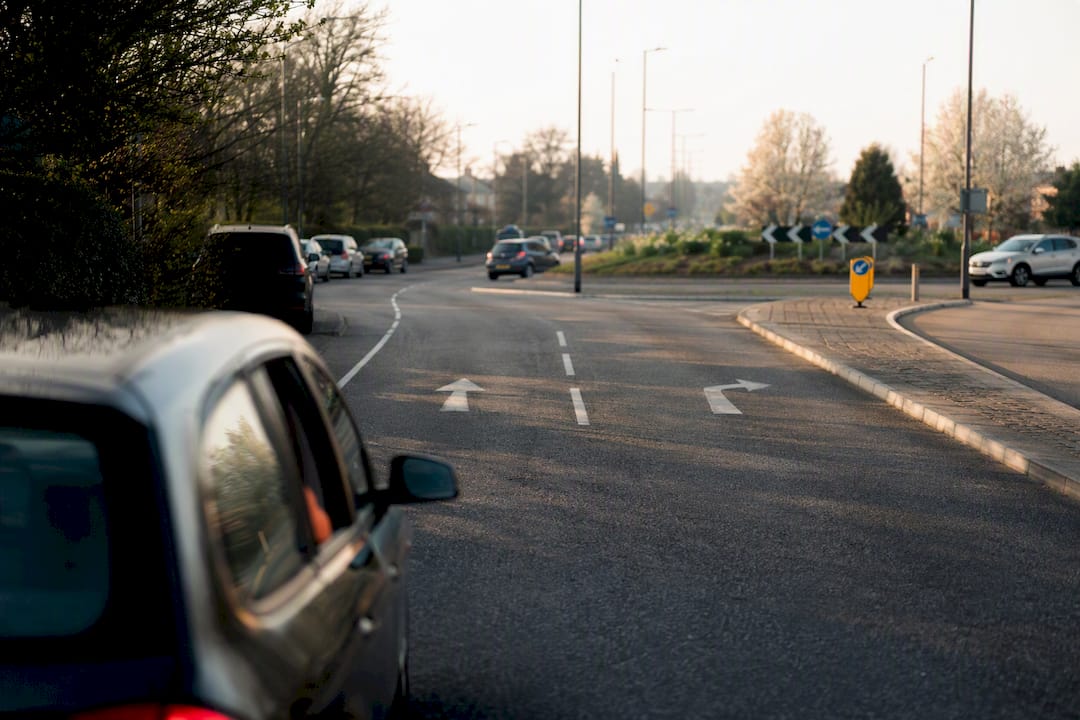
Uxbridge Test Routes: 12–15 km, Lane Hazards and 3 Drills
Uxbridge practical test routes mix fast A-road stretches, the busy A4020, industrial estate junctions and quiet residential pockets, all built around multi-lane roundabouts that trip up unprepared candidates. Tests run for roughly 30 minutes with an independent-driving section making up a big chunk of that. The single most effective thing you can do before your test date is drill the specific road types Uxbridge throws at you, ideally with an ADI or a mapped GPX route, rather than trying to memorise a fixed sequence of turns.
TL;DR:
- Most faults occur at Hillingdon Circus, Denham Roundabout, Cowley Mill Road entrances, and narrow residential streets with parked cars, due to late reactions.
- Practising lane choices early, speed transitions on A-roads, and industrial entrance observations with instructor-led drills significantly reduces failure risk.
- Focused route familiarity, especially through apps or GPS with narration, improves hazard recognition and route adaptation during the test.
- The test covers diverse roads like the A40, A4020, and residential areas, requiring drivers to handle high-speed merges, traffic lights, and tight junctions confidently.
- Conducting mock tests and practising during off-peak times enhances performance by simulating actual test conditions without heavy traffic pressure.
Table of Contents
- What roads make up Uxbridge test routes?
- Where do most Uxbridge test faults happen?
- How should you practise Uxbridge driving test routes?
- What happens on test day at the Uxbridge test centre?
- Instructor advice from Connect Driving School: drills built for Uxbridge
- A driving instructor’s pre-test checklist for Uxbridge
- Book focused Uxbridge test prep with Connect Driving School
- Sources
What roads make up Uxbridge test routes?
Examiners at Uxbridge draw from a set pool of local roads, and knowing them changes how you prepare. You’re not memorising a script. You’re building comfort with specific road behaviours that repeat across nearly every route variation.
Expect to meet:
- A40 Western Avenue – fast-flowing dual carriageway sections that test merging, lane discipline and sustained higher-speed control.
- A4020 Uxbridge Road – heavier traffic, bus lanes, pedestrian crossings and frequent speed changes.
- Cowley Mill Road – home to the test centre itself, with industrial estate entrances and exits demanding sharp observation.
- Oxford Road and Hillingdon Road – residential arteries with parked cars, side-road junctions and cyclists.
- Quieter residential pockets branching off these main roads, used to assess low-speed control, meeting traffic and general awareness.
Route-mapping data puts most Uxbridge routes between roughly 12 and 15 kilometres, taking around 23 to 36 minutes to drive depending on traffic and the specific route chosen that day. Each road type is testing something different: the A40 checks whether you can hold a confident, legal speed in fast traffic; the A4020 checks gap judgement and reaction to sudden stops; Cowley Mill Road checks whether you look for hazards emerging from blind entrances rather than just driving straight ahead.
Where do most Uxbridge test faults happen?
A handful of locations account for a disproportionate number of test faults, and most of them share the same root cause: candidates react late instead of planning early.
- Hillingdon Circus. This multi-lane roundabout catches out learners who pick a lane at the last second. The fix is deciding your lane well before you reach the roundabout, using road markings and signs rather than glancing at other cars for cues.
- Denham Roundabout and the A40 slip roads. Merging here at speed unsettles drivers who haven’t practised matching traffic flow before joining. Check your mirrors early, build speed on the slip road itself, and commit to a gap rather than hesitating and forcing following traffic to brake.
- Cowley Mill Road industrial estate entrances. Vans and lorries pull out with limited warning. Anticipating a vehicle might emerge, even when the road looks clear, is what examiners are watching for.
- Residential streets with parked cars. Misjudging space when passing parked vehicles, or failing to give way when meeting oncoming traffic in a narrow gap, is a common minor-fault magnet that can escalate into a serious one if you cut it too fine.
Examiners mark these moments against observation, positioning and speed control, the three things that show up again and again on driving test feedback sheets. Uxbridge’s own hazard profile, including Hillingdon Circus and the Cowley Mill Road area, is well documented by local instructors precisely because the same errors recur test after test.
Pro Tip: At any roundabout with more than two lanes, say your intended lane out loud as you approach it. Talking through the decision forces you to commit early instead of drifting into the wrong lane under pressure.
How should you practise Uxbridge driving test routes?
Route familiarity only helps if it converts into a transferable skill you can use anywhere, not just on one memorised sequence of turns.
- Use route apps and Google Maps deliberately. Load a mapped route from a GPX-based tool like Test Routes into a sat-nav or your phone, then drive it while narrating your observations rather than just following the arrow.
- Structure instructor-led sessions in three parts. Start with a short warm-up drive to settle nerves, move into focused drills on one hazard (say, Hillingdon Circus lane choice), then finish with a short mock-test segment that includes independent driving.
- Practise mid-morning or early afternoon on weekdays. The A40 and central Uxbridge get congested at commuter peaks, so avoiding rush hour gives you cleaner reps of the actual manoeuvres rather than traffic-jam crawling.
- Review every run against a simple checklist. Mirror, signal, position, speed, look. Whether you’re getting feedback from an instructor or reviewing dashcam footage, the goal is spotting the same mistake before it repeats on test day.
Three to five focused sessions, each hitting a different cluster of hazards, tends to build more genuine competence than one long drive covering everything at once.
What happens on test day at the Uxbridge test centre?
The Uxbridge Practical Driving Test Centre sits at Trade City Business Park, 21 Cowley Mill Road, UB8 2DB, with parking available nearby for candidates arriving by car. Arrive with time to settle rather than rushing in at the last minute; a tense start rarely helps your first few minutes behind the wheel.
The format itself is fairly standard nationally, but Uxbridge’s local mix shapes what you’ll actually face:
- An eyesight check and a couple of vehicle safety questions before you set off.
- Roughly 20 minutes of independent driving, following either sat-nav directions or road signs.
- One or two manoeuvres, commonly including reversing around a corner or a parallel park.
- General driving through the road types covered earlier, including at least one multi-lane roundabout.
Bring your provisional licence and your theory test pass certificate number if you haven’t already linked them digitally. If you miss a sat-nav instruction during independent driving, don’t panic and correct sharply. Examiners expect the odd wrong turn during this section. Simply indicate, find a safe way to get back on route, and carry on. Uxbridge’s pass-rate context alongside national figures shows preparation focused on local hazards, rather than raw driving hours, tends to be what separates a pass from a re-test.
Instructor advice from Connect Driving School: drills built for Uxbridge
Instructors who know the area well tend to run three drills repeatedly with learners heading to Uxbridge. The lane-discipline drill at multi-exit roundabouts like Hillingdon Circus, where you rehearse committing to a lane from 100 metres out rather than at the roundabout mouth. The A-road speed transition drill, practising smooth, early braking for the 30 to 20 mph drops you’ll meet on roads like Cowley Road, instead of the late “creep” that catches out unprepared drivers. And the industrial-entrance observation drill, scanning junction mouths on Cowley Mill Road for vehicles pulling out before they’re fully visible.
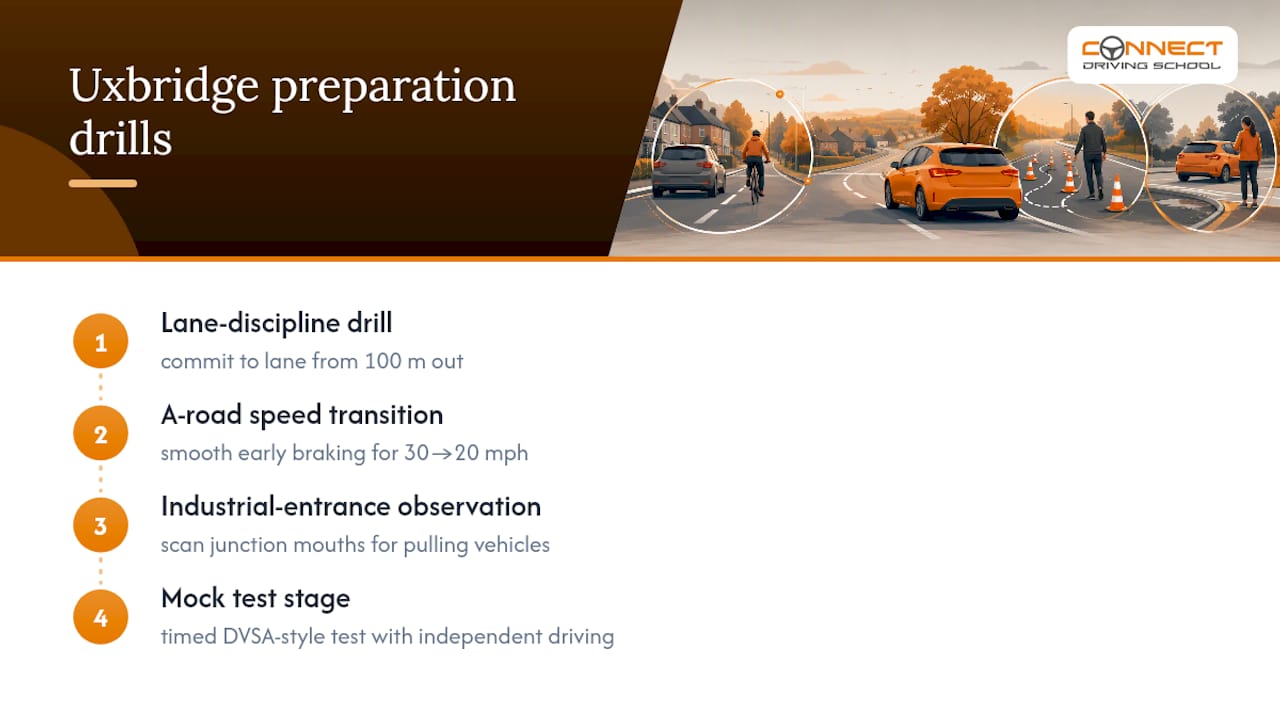
Mock tests run with a DVSA-approved instructor, timed and paced like the real thing including a full independent-driving segment, are what turn these drills into instinct rather than theory.
A driving instructor’s pre-test checklist for Uxbridge
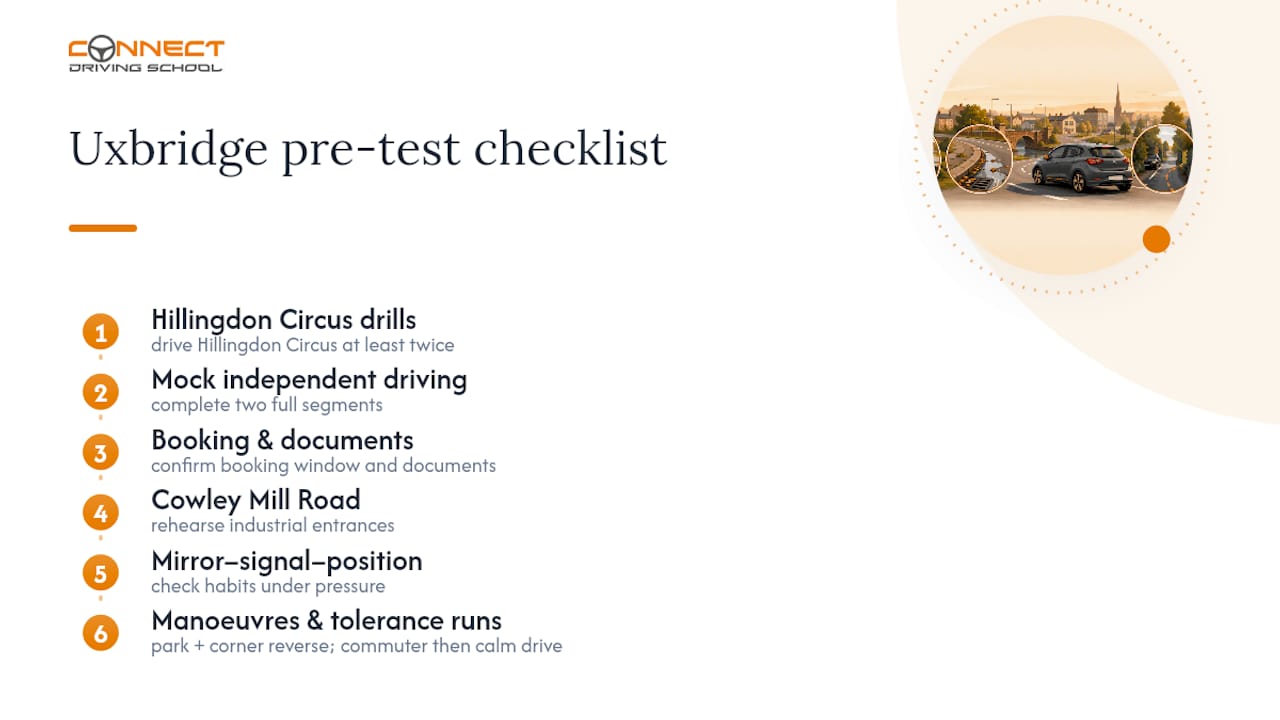
The week before a Uxbridge test, I’d run through eight quick checks: drive Hillingdon Circus at least twice, complete two full mock independent-driving segments, confirm your booking window and documents, rehearse the Cowley Mill Road industrial entrances, check mirror-signal-position habits under pressure, practise one parallel park and one corner reverse, drive during commuter traffic once to build tolerance, then finish with a calm, low-pressure drive the day before.
One learner I’d point to failed twice on late lane changes at roundabouts before a focused week of Hillingdon Circus drills turned that specific weakness around entirely.
— Mudassar
Book focused Uxbridge test prep with Connect Driving School
Driving schools that tailor sessions to specific test routes offer a practical alternative to generic lesson packages for learners facing Uxbridge, focusing on roads and hazards examiners actually use rather than a generic curriculum. This approach can include dedicated test-prep lessons built around common hazard spots, full mock tests with an independent-driving segment timed like the real exam, and flexible scheduling to fit sessions around work, college, or off-peak practice windows.

Lessons from experienced instructors familiar with common learner difficulties on routes like the A4020 and industrial entrances on Cowley Mill Road can help build confidence and skill. If you’re aiming for a test date at Uxbridge, book a lesson or mock test with Connect Driving School and start working through the exact drills covered above with someone who drives these roads regularly.
Sources
Test-centre logistics and address details come from the official GOV.UK test centre directory, always worth checking directly for booking and appointment changes. Route length, timing and pass-rate context are drawn from DrivingTestExpert’s Uxbridge centre page, while local hazard detail comes from GoDriveReady’s Uxbridge route guide. For self-guided practice, GPX-based tools such as Test Routes let you load mapped local routes into a sat-nav or phone.
Related Posts



Comments (0)