
Three repeatable drills, a three week checklist and local tips for Hendon test routes. Practice A41 merging, roundabouts and estate driving with mapped...
12–96m Stopping Distances in the UK: Two Second Rule, Instructor Drills
Stopping distance is thinking distance plus braking distance, and the Highway Code’s Rule 126 sets the benchmark: leave a two-second gap in normal driving, double it in the wet, and multiply it up to tenfold on ice. Memorise the headline figures too: 12 metres at 20 mph, 23 metres at 30 mph, rising to 96 metres at 70 mph. Those numbers are minimums, not targets.
TL;DR:
- Wet and icy conditions can increase braking distances by up to ten times, requiring significantly larger gaps and more cautious driving.
- Real-world reaction times often surpass the Highway Code’s 0.67 seconds, with fatigue and distraction pushing it to around 1.5 seconds, extending thinking distance.
- Doubling your speed from 30 mph to 60 mph more than triples total stopping distance due to the quadratic increase in braking distance.
- The two-second rule for following distance should be doubled in rain and extended further on ice or in low visibility to ensure safety.
- Proper vehicle maintenance, like good tyre tread and correct pressure, alongside early, smooth braking, effectively reduces stopping distances in normal conditions.
Table of Contents
- What are thinking distance and braking distance?
- Official Highway Code stopping distances by speed
- How do you judge a safe following distance on the road?
- What increases your stopping distance beyond the official figures?
- How can you reduce your stopping distance?
- What instructors see learners get wrong on gap judgement
- A quick pre-journey checklist worth building into habit
- Build stopping-distance skills with Connect Driving School
- Sources
- FAQ
What are thinking distance and braking distance?
Thinking distance is how far your car travels between spotting a hazard and your foot touching the brake. The Highway Code assumes a reaction time of around 0.67 seconds, which is closer to a well-rested, alert driver’s best case than an everyday average. Braking distance is what happens after that, and it does not scale in a straight line with speed. Double your speed and braking distance roughly quadruples, because it is tied to speed squared rather than speed itself.
Put numbers on it and the pattern becomes obvious:
- At 30 mph, thinking distance is roughly 9 metres and braking distance around 14 metres, totalling 23 metres.
- At 60 mph, thinking distance roughly doubles to 18 metres, but braking distance balloons to around 55 metres.
- That is why doubling your speed from 30 mph to 60 mph more than triples your total stopping distance, not merely doubles it.
Understanding that split matters because the two distances respond to different things. Thinking distance is about you, your attention, and your reflexes. Braking distance is about the car, the road, and the laws of physics.
Official Highway Code stopping distances by speed
The table below reflects the Highway Code’s typical stopping distances, converted into car lengths using the standard 4-metre reference car used in driver training.
| Speed | Thinking distance | Braking distance | Total stopping distance | Car lengths (approx.) |
|---|---|---|---|---|
| 20 mph | 6 m | 6 m | 12 m | 3 |
| 30 mph | 9 m | 14 m | 23 m | 6 |
| 40 mph | 12 m | 24 m | 36 m | 9 |
| 50 mph | 15 m | 38 m | 53 m | 13 |
| 60 mph | 18 m | 55 m | 73 m | 18 |
| 70 mph | 21 m | 75 m | 96 m | 24 |
These figures assume a dry road, good tyres, working brakes, and an alert driver, as The AA points out. They are the floor, not the ceiling. A heavier vehicle, a car towing a trailer, or a driver who has just glanced at a phone will all need considerably more room than the table suggests.
How do you judge a safe following distance on the road?
The two-second rule turns an abstract distance into something you can actually check while driving. It works the same way regardless of speed, which is what makes it more practical than trying to estimate metres.
- Pick a fixed point ahead, such as a road sign, bridge, or lamppost.
- Start counting “one thousand and one, one thousand and two” as soon as the vehicle in front passes it.
- If you reach that same point before finishing the count, you are following too closely.
- Ease back and repeat the check until the two-second gap holds steady.
Double that gap to four seconds in the rain, and stretch it much further, up to ten times the dry figure on icy or snow-covered roads, following Rule 126. In tunnels, behind large vehicles, or in low visibility, err on the side of more space rather than less.
Pro Tip: Practise the count out loud during ordinary drives, not just in a hazard. It trains your eye to judge gaps automatically, so the skill is already there when you actually need it.
What increases your stopping distance beyond the official figures?
The Highway Code table describes a best-case scenario. Real driving conditions push the numbers up, sometimes dramatically.
Weather and road surface do the heaviest lifting. A wet road roughly doubles braking distance compared with dry tarmac, and ice can increase it by up to ten times, according to Brake’s analysis of stopping distances. Standing water, leaf litter, and loose gravel all reduce grip in ways the official table simply does not account for.
Vehicle condition matters just as much:
- Tyre tread below the legal minimum of 1.6 mm sharply reduces grip, particularly in wet weather.
- Under-inflated tyres and worn brake pads both extend braking distance noticeably.
- Extra weight from passengers, luggage, or towing increases the force needed to stop the vehicle.
- ABS prevents wheel lock-up but does not shorten stopping distance on its own.
Driver state is the wildcard most people underestimate. The Highway Code’s 0.67-second reaction time is closer to a best-case figure than a realistic average — TRL research reviewed by Brake suggests real-world reaction times can run to around 1.5 seconds, adding several extra metres of thinking distance at motorway speeds. Tiredness, alcohol, drugs, and distraction from a phone all push reaction time higher still.
How can you reduce your stopping distance?
Most of the gap between the official table and real-world risk comes down to maintenance and habit, both of which are within your control.
Before any journey, run a quick check:
- Tyres: tread depth above 1.6 mm across the central three-quarters of the tyre, and correct pressure for the load you’re carrying.
- Brakes: no grinding, pulling to one side, or a spongy pedal feel.
- Lights and wipers: full visibility for you and to other drivers, especially as autumn and winter close in.
On the move, technique closes the rest of the gap. Scan well ahead so you brake early and progressively rather than snatching at the pedal, keep your following distance rather than tailgating, and avoid abrupt lane changes that leave you needing an emergency stop you didn’t plan for.
Pro Tip: Book a session with a DVSA-approved instructor to practise a controlled emergency stop. Doing it once in a supervised setting builds muscle memory that pays off if you ever need it for real.
What instructors see learners get wrong on gap judgement
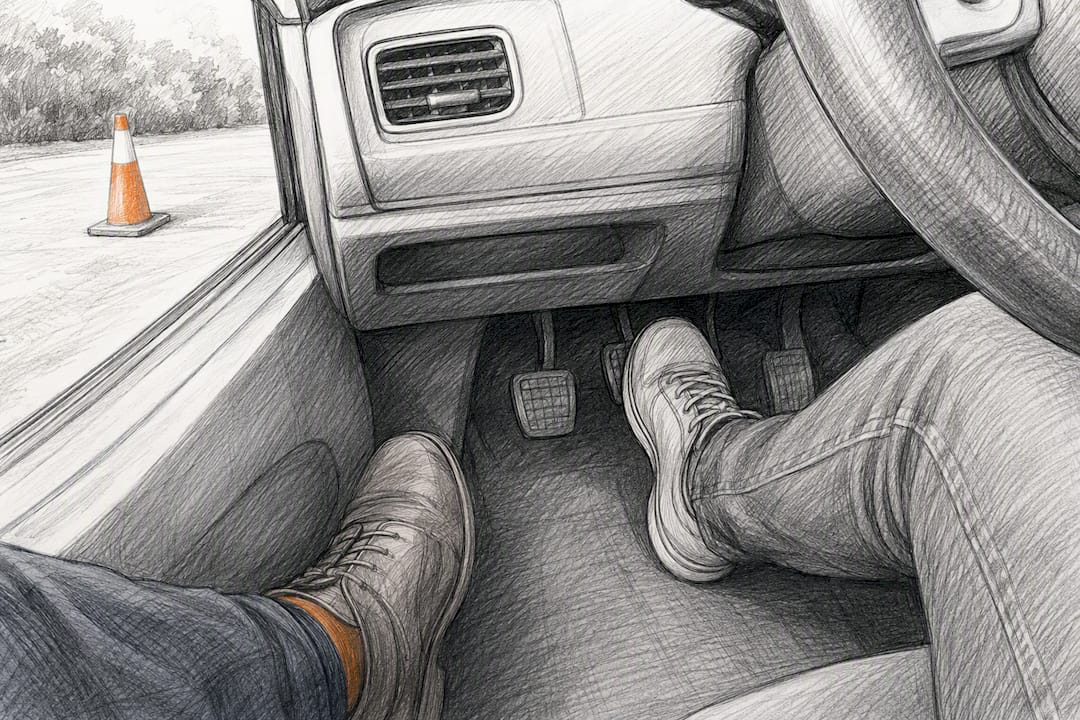
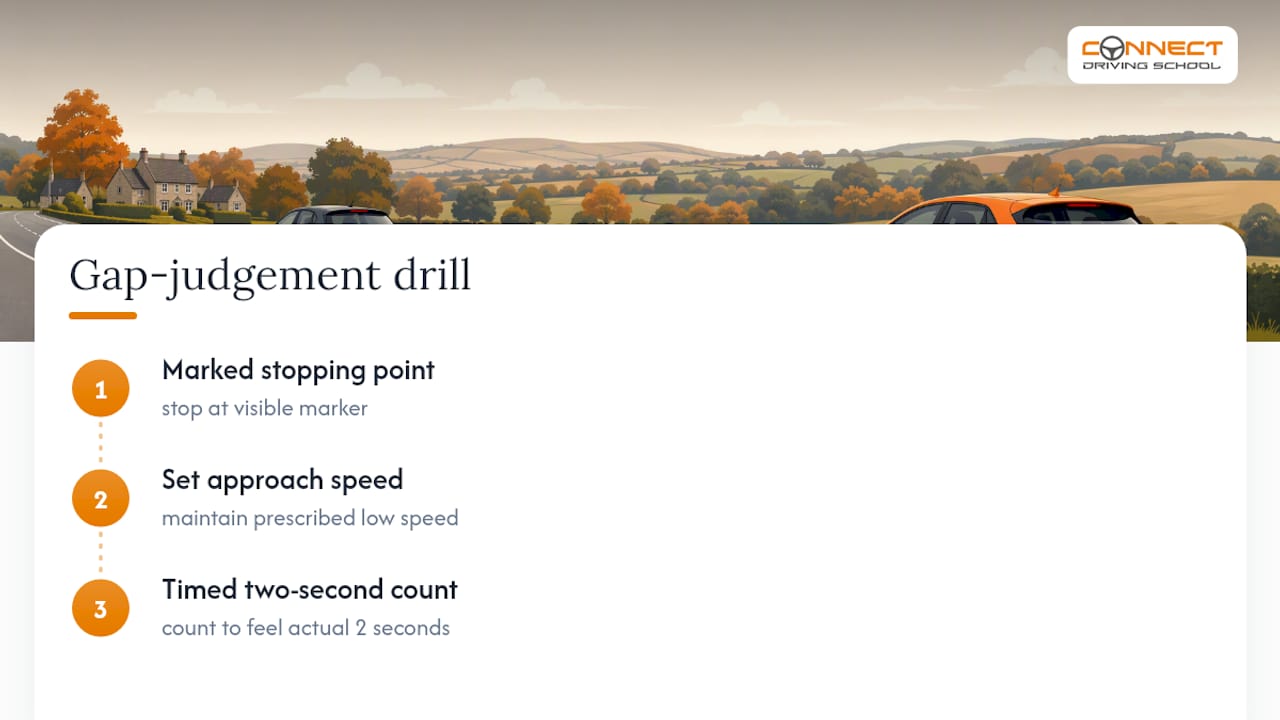
Driving instructors run gap-judgement drills at low speed before pupils ever face real traffic: a marked stopping point, a set approach speed, and a timed count so the learner feels the difference between what they think two seconds looks like and what it actually is. It is a small drill, but it closes the gap between theory and instinct fast.
The most common mistake is creeping close behind the car ahead, especially in slow traffic, because the risk feels lower at low speed. It isn’t; reaction time doesn’t shrink just because the speedometer reads less. The second is late observation, meaning brakes get applied only once a hazard is obvious rather than the moment it becomes possible. Learners who practise scanning further ahead consistently brake earlier and more smoothly, which is exactly what examiners look for on test day.
A quick pre-journey checklist worth building into habit
Before pulling away, glance at tyres, mirrors, and lights. It takes thirty seconds and catches most of the problems that turn a routine stop into a near miss.
Set your intention for the drive: two seconds as the baseline gap, doubled the moment rain starts. Adjust again for fog, ice, or a large vehicle ahead blocking your view. If you’re still learning, ask your instructor for dedicated time on emergency braking and motorway-speed following distances rather than picking it up incidentally between other lessons. Judging a gap correctly is a skill built through repetition, not a fact memorised once and forgotten.
— Mudassar
Build stopping-distance skills with Connect Driving School
Connect Driving School is the practical alternative to learning stopping distances from a book alone. A Highway Code table tells you the theory; a DVSA-approved instructor sitting beside you during a controlled emergency stop is what actually makes the two-second rule instinctive.

Pass Plus builds confidence in higher-risk conditions, motorway lessons give you controlled practice at 70 mph following distances, and mock tests let you rehearse gap judgement under exam pressure before the real thing. If you’re in SW4, SW11, SW12, SW15 to SW20, KT1 to KT6, SM1 to SM5, CR4, or one of the school’s other London service areas, book a lesson with Connect Driving School and get a session on the calendar built around exactly this: judging gaps correctly and stopping in time, every time.
Sources
- The Highway Code — General rules, techniques and advice for all drivers and riders (103 to 158)
- Typical stopping distances — The Highway Code (PDF)
- Stopping distances — Brake
- Know your stopping distances — The AA
FAQ
Are stopping distances part of the 2026 theory test?
Yes. The theory test regularly includes questions on the Highway Code’s typical stopping distances, so learners are expected to know the six figures from 20 to 70 mph.
How far can a car stop from 25 mph?
The Highway Code doesn’t list 25 mph directly, so stopping distance from 25 mph varies depending on conditions and driver alertness.
How far is two seconds at 70 mph?
At 70 mph, a two-second gap translates to a certain distance based on speed, and the Highway Code specifies a total stopping distance of 96 metres.
Can I overtake a vehicle that is hogging the middle lane?
Undertaking (passing on the inside) a middle-lane hogger is legal on a motorway when traffic conditions justify it, but it should be done with extra caution and a wider safety margin, since the vehicle ahead may move back into the correct lane without warning.
Does wet weather really double stopping distance?
Yes. Wet roads roughly double braking distance compared with dry conditions, according to Brake’s research, which is why Rule 126 recommends doubling your following gap in the rain.
Related Posts
Comments (0)